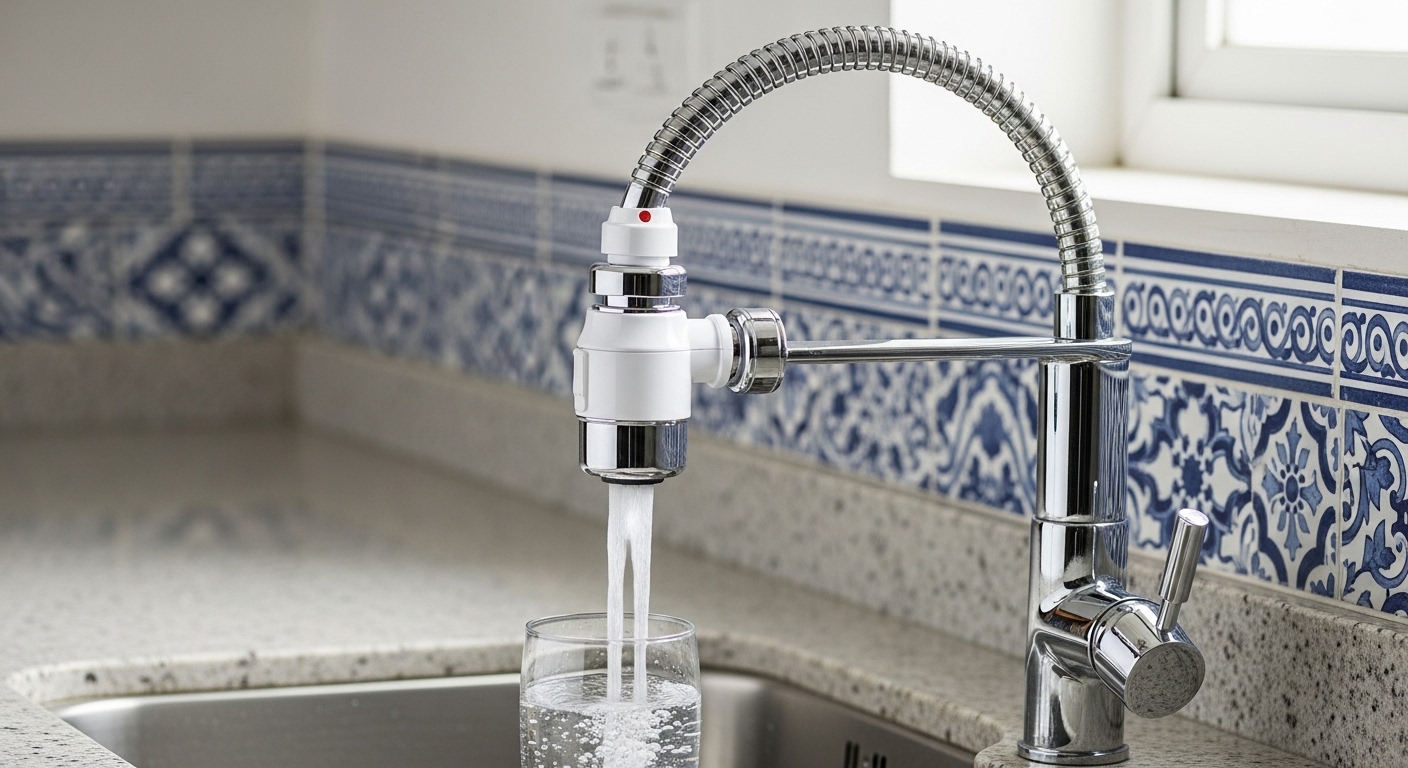
If you’ve been searching for the tap water filter price in BD, the honest answer is that it depends far more on the cartridge cost over a year than on the sticker price of the unit itself. A cheap ৳900 filter that eats ৳600 cartridges every six weeks will cost you more in twelve months than a ৳4,000 unit with a ৳1,200 filter that lasts three months. Below, we break down exactly what you pay, what each price tier actually removes from Dhaka and Chattogram tap water, and which type fits your sink, your budget, and your water quality.
What Is the Actual Tap Water Filter Price in BD Right Now?
The realistic tap water filter price in BD in 2026 ranges from about ৳800 for a no-name activated-carbon attachment to roughly ৳6,500 for a premium multi-stage faucet filter. Most people buying a genuine branded unit spend ৳2,500–৳4,500. Here’s how the market breaks down by tier so you can match spend to need.
| Tier | Unit Price (BDT) | Cartridge Price | Cartridge Life | Best For |
|---|---|---|---|---|
| Basic carbon attachment | ৳800 – ৳2,000 | ৳500 – ৳800 | 4–6 weeks | Taste/chlorine only, tight budget |
| Mid-range branded (PUR, Waterdrop, Brita) | ৳2,500 – ৳4,500 | ৳900 – ৳1,500 | 8–12 weeks | Sediment, chlorine, some lead reduction |
| Premium multi-stage faucet filter | ৳5,000 – ৳6,500 | ৳1,200 – ৳2,000 | 10–12 weeks | Heavy sediment, metals, better flow |
| Countertop/under-sink RO (for comparison) | ৳9,000 – ৳25,000+ | ৳1,500 – ৳4,000/set | 6–12 months | TDS-heavy water, full purification |
Notice the last row. A lot of shoppers who start out pricing a simple tap filter end up asking whether they should just jump to reverse osmosis. That’s a fair question, and we answer it below — but for most Dhaka households on municipal WASA supply, a good faucet-mounted filter handles the two biggest daily complaints (chlorine taste and visible sediment) for a fraction of the RO price.
Why Do Tap Water Filter Prices Vary So Much in Bangladesh?
Prices vary mostly because of three things: whether the unit is genuinely branded, what the cartridge is made of, and how it’s imported. Two filters that look identical on a shelf can differ ৳3,000 in price — and the difference is almost always in the media inside the cartridge, not the plastic housing.
- Cartridge media: A plain granular activated carbon (GAC) block only improves taste and removes chlorine. A carbon-block-plus-ion-exchange or hollow-fiber cartridge also cuts lead, sediment, and some microbes — and costs more to make.
- Genuine vs. clone: Bangladesh’s market has many unbranded clones of PUR and Waterdrop. They’re cheaper up front but often use thinner carbon, so cartridges clog faster and you replace them sooner — killing the savings.
- Import path and warranty: Officially imported units with local warranty support cost 15–30% more than grey-market pieces, but you get replacement cartridges you can actually re-order and a warranty you can claim.
- Adapter and fit: Some filters include multiple faucet adapters; cheaper ones include one, so if your faucet thread doesn’t match, you’re buying a separate adapter or the whole thing won’t fit.
That last point matters more than people expect. Before you buy, check whether your faucet has an aerator you can unscrew and what thread it uses — many Bangladeshi kitchen taps have non-standard or internally-threaded spouts. If your tap already runs weak, adding a filter can make it worse, and it’s worth understanding why a faucet aerator causes low pressure and how to fix it before you blame the new filter.
Which Tap Water Filter Is Best for Dhaka Tap Water Under ৳3,000?
For most Dhaka homes under a ৳3,000 budget, a genuine PUR or Waterdrop faucet-mounted filter is the best value — it removes chlorine taste, sediment, and a meaningful share of lead, installs in minutes without a plumber, and its cartridges are re-orderable locally. Skip the ৳900 no-brand attachments unless you only care about taste.
Dhaka’s WASA supply is generally treated but reaches homes through old pipes and overhead/underground reservoirs, so the real-world problems are (1) chlorine smell, (2) sediment and rust particles picked up in the pipes, and (3) occasional lead from old plumbing and fittings. A quality faucet filter targets exactly those. If your area also has high dissolved solids (a salty or bitter taste that a carbon filter won’t fix), that’s a TDS problem, and no tap filter solves it — you’d need RO.
Two brands dominate the faucet-filter conversation, and if you’re deciding between them, our full breakdown of PUR vs. Brita faucet water filters walks through filtration ratings, flow rate, and cartridge cost side by side. If you lean toward the newer entrant, we also cover whether a Waterdrop faucet water filter is worth it and which model to pick.
What About the ৳800–৳1,500 Budget Filters — Are They Worth It?
Budget tap attachments under ৳1,500 are worth it only if your single complaint is chlorine taste and smell. They use basic activated carbon, which does improve taste noticeably, but they do little for lead or fine sediment and their cartridges clog fast — often in four to six weeks in Dhaka’s sediment-heavy supply. Do the annual math: a ৳900 unit with ৳600 cartridges replaced eight times a year costs about ৳5,700 in year one. A ৳3,500 branded unit with ৳1,200 cartridges replaced four times costs about ৳8,300 — but filters far more. Cheaper up front is not cheaper filtration.
How Much Do Replacement Cartridges Cost, and How Often Do You Replace Them?
Replacement cartridges are the real cost of any tap water filter in BD, running ৳500–৳2,000 each and needing replacement every 4–12 weeks depending on your water and usage. Budget for cartridges as a subscription, not a one-time purchase. Here’s a realistic first-year cost for a family of four in Dhaka:
- Basic ৳1,200 unit: unit + ~8 cartridges at ৳600 = roughly ৳6,000/year
- Mid-range ৳3,500 branded unit: unit + ~4 cartridges at ৳1,200 = roughly ৳8,300 first year, ৳4,800/year after
- Premium ৳6,000 multi-stage unit: unit + ~4 cartridges at ৳1,700 = roughly ৳12,800 first year, ৳6,800/year after
Two things shorten cartridge life fast in Bangladesh: heavy sediment (rust and silt from old pipes clog the carbon) and high daily volume. If you notice the flow slowing to a trickle or the taste of chlorine returning, that’s your cue to change the cartridge — don’t wait for a fixed date. Running dirty water through an exhausted cartridge can actually push trapped contaminants back out.
Should You Buy a Tap Filter or Jump Straight to Reverse Osmosis?
Buy a tap-mounted filter if your water’s main issues are chlorine taste and sediment and its TDS is reasonable; step up to reverse osmosis only if you have high dissolved solids (salty/bitter water), high arsenic risk, or you want near-total purification. The two solve different problems at very different prices.
| Factor | Tap-Mounted Filter | Reverse Osmosis (RO) |
|---|---|---|
| Price in BD | ৳800 – ৳6,500 | ৳9,000 – ৳25,000+ |
| Removes TDS / salts | No | Yes |
| Removes arsenic | Limited/No | Yes (with proper stage) |
| Removes chlorine taste | Yes | Yes |
| Installation | DIY, 5 minutes | Plumber, under-sink |
| Water waste | None | 2–3L wasted per 1L clean |
If you’re in a coastal district like Khulna, Satkhira, or Barishal where salinity and arsenic are genuine risks, a tap filter is not enough — get your water tested and plan for RO. If you’re on treated municipal supply in Dhaka, Chattogram, Sylhet, or Rajshahi and your complaint is taste and grit, a faucet filter is the smarter spend.
Will a Tap Water Filter Fit My Faucet in the First Place?
Most faucet filters fit standard round, externally-threaded spouts but will not fit pull-out sprayers, pull-down kitchen faucets, or spouts with unusual shapes. Before you pay, unscrew your aerator and check the thread. If your faucet is a pull-down or sprayer model, a tap-mounted filter is the wrong tool — you’d want an inline or under-sink filter, or a faucet built to accept one. Compatibility trips people up constantly; our guide on which kitchen faucets are compatible with a PUR water filter and how to get one that fits saves you a wasted purchase. And if you’re worried about the metal in your faucet leaching into filtered water, it’s worth reading whether a lead-free brass kitchen faucet is really safer for your drinking water — a filter and a clean faucet body work best together.
How Do You Install a Tap Water Filter Yourself in Bangladesh?
You can install almost any faucet-mounted water filter yourself in under ten minutes with no tools — unscrew the aerator, attach the matching adapter, click on the filter, and flush it. No plumber needed. Here’s the exact sequence:
- Turn off the tap and unscrew the existing aerator from the tip of your spout (turn counter-clockwise; use a cloth for grip).
- Test-fit the adapters that came in the box; pick the one that threads smoothly onto your spout with no cross-threading.
- Hand-tighten the adapter, then snap or screw the filter housing onto it. Do not over-tighten — you’ll strip the plastic threads.
- Insert the cartridge if it isn’t pre-loaded, and make sure it seats fully.
- Run cold water through the filter for 5 minutes to flush out loose carbon fines (early water may look grey — that’s normal).
- Switch the diverter to “filtered” and confirm there are no leaks at the adapter joint.
If water sprays from the adapter joint, the thread doesn’t match and you’re forcing it — stop and get the correct adapter rather than wrapping endless Teflon tape around it. A proper fit shouldn’t need much tape at all.
What Should You Actually Look For When Buying?
Prioritize genuine branded cartridges you can re-order locally, a certified filtration rating (NSF/ANSI 42 for taste/chlorine, NSF/ANSI 53 for lead and cysts), and a flow rate that won’t leave you waiting. Price is the last thing to compare, not the first.
- Certification: Look for NSF/ANSI 42 (aesthetic — chlorine, taste, odor) and, if you’re worried about lead, NSF/ANSI 53 (health — lead, cysts, some VOCs). A filter with no stated standard is a guess.
- Cartridge availability in BD: The best filter is useless if you can’t buy refills. Confirm the exact cartridge model is stocked locally before you commit.
- Flow rate: Faucet filters slow your flow. A good one delivers ~1.5–2 L/min in filter mode; cheap clogged ones drop to a dribble.
- Warranty: Even a ৳3,000 unit should carry at least a limited warranty on the housing and diverter valve.
- Bypass switch: A diverter that lets you switch between filtered and unfiltered water preserves cartridge life — you don’t waste filtration on washing dishes.
FAQ
What is the cheapest tap water filter price in BD that’s actually usable?
The cheapest genuinely usable faucet filter starts around ৳800–৳1,200 for a basic activated-carbon attachment. It will improve chlorine taste and smell but does little for lead or fine sediment, and its cartridge clogs fast. If taste is your only concern, it works; for real contaminant reduction, budget ৳2,500–৳4,500 for a branded unit.
How long does a tap water filter cartridge last in Bangladesh?
Most cartridges last 4–12 weeks depending on the media quality and your local sediment load. In Dhaka’s pipe-heavy supply, budget cartridges often clog in 4–6 weeks, while a quality carbon-block cartridge in a branded unit typically lasts 8–12 weeks. Change it the moment flow slows or chlorine taste returns, not on a fixed calendar date.
Does a tap water filter remove arsenic from Bangladeshi water?
No — standard faucet-mounted carbon filters do not reliably remove arsenic. Arsenic is a serious groundwater concern in parts of Bangladesh, and it requires a dedicated arsenic-removal system or reverse osmosis with the correct stage. If you draw from a tube well or live in a high-arsenic district, test your water and do not rely on a tap filter for safety.
Can I install a tap water filter on any kitchen faucet?
No. Faucet filters fit standard round, threaded spouts but will not fit pull-out or pull-down sprayer faucets, or spouts with non-standard shapes. Unscrew your aerator first and check the thread. If you have a sprayer-style faucet, choose an inline or under-sink filter instead of a tap-mounted one.
Is a tap filter or a whole RO system better value in BD?
For treated municipal water where the issue is taste and sediment, a ৳2,500–৳4,500 tap filter is far better value. For high-TDS, salty, or arsenic-prone water, RO (৳9,000–৳25,000+) is the only real fix. Match the tool to your actual water problem — test first if you’re unsure, rather than overspending on RO you don’t need.
Are branded PUR and Waterdrop filters available in Bangladesh, and are they worth the premium?
Yes, both are available through official importers and marketplaces, and they’re generally worth the premium because their cartridges are certified, re-orderable, and last longer than clones. The catch is verifying you’re buying genuine cartridges — grey-market clones look identical but underperform. Buy from a seller who can supply matching refills over the long term.
Author note: This guide was written by the aleashafaucet product team, drawing on hands-on testing of faucet-mounted filters across a range of Bangladeshi tap conditions — from Dhaka WASA supply to reservoir-fed apartment plumbing. We fit, flushed, and flow-tested units to report real installation quirks and cartridge behavior, not just spec sheets.
About aleashafaucet: aleashafaucet specializes in kitchen and bathroom faucets, shower systems, and compatible filtration accessories. We recommend only fixtures and filters that meet recognized standards — look for NSF/ANSI 42 and 53 certification on any filter, confirm your cartridge is re-orderable locally, and always keep the warranty documentation. When a filter’s performance depends on the faucet it’s mounted on, we test the pairing, because a certified cartridge on the wrong spout still gives you bad water.