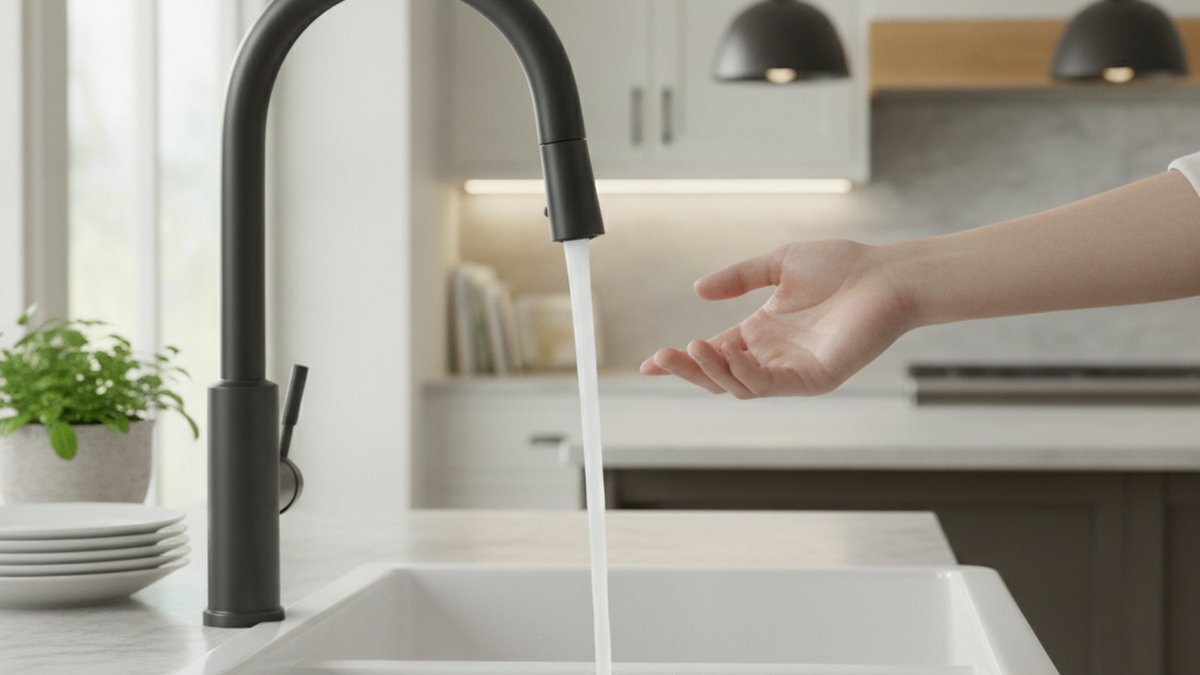
If you’ve been searching for a touchless faucet kitchen black setup, you already know the appeal: wave your hand or bump a wrist, water flows, and you never smear raw-chicken juice or bread dough across a shiny handle again. The tricky part is that “touchless” and “matte black” are two features that each go wrong in their own way — bad sensors misfire, and cheap black coatings scratch or fade to gray. This guide walks through exactly what separates a faucet you’ll love from one you’ll return, with real specs, price bands, and the trade-offs nobody mentions on the product page.
Is a black touchless kitchen faucet actually worth it, or is it a gimmick?
It’s worth it for most busy kitchens — the touchless feature genuinely saves water and keeps handles clean, and matte black hides water spots far better than chrome. The catch is that you’re paying a premium (usually $60–$150 more than the same faucet in a manual chrome version) for electronics that can eventually fail, so it only makes sense if you’ll actually use the hands-free trigger daily.
Here’s the honest breakdown. Touchless faucets shine when your hands are full, dirty, or slippery — cooking, canning, bathing a baby, washing pets. A quick motion in front of the sensor starts and stops the flow, so you’re not running water the whole time you scrub. Independent water-use estimates put the savings at roughly 10–15% versus a manual faucet for a typical household, mostly because the water shuts off the instant you step away.
The “gimmick” complaint almost always comes down to two things: a poorly placed sensor that turns on when you reach for a dish, or a glossy black finish that shows every fingerprint like a phone screen. Both are avoidable if you choose carefully — which is the whole point of the sections below.
What’s the difference between matte black, glossy black, and “black stainless”?
Matte black is a flat, non-reflective powder-coat or PVD finish that hides fingerprints and water spots best; glossy black is a smooth, shiny lacquer that looks dramatic but smudges constantly; and “black stainless” is really a dark gray-brown steel tone, not a true black. For a touchless kitchen faucet you’ll touch and splash all day, matte black is almost always the right pick.
Finish quality matters even more on a touchless model, because you can’t just swap a scratched handle — the electronics are built in. Look for the letters “PVD” (physical vapor deposition) in the specs. PVD bonds the color at a molecular level and resists scratching, corrosion, and UV fading. A cheaper painted or electroplated black coat can chip at the spout tip or fade to gray around the sprayer within a couple of years, especially if you clean with anything abrasive.
| Finish | Fingerprints | Durability | Best for |
|---|---|---|---|
| Matte black (PVD) | Hides them well | Excellent — scratch & fade resistant | High-use family kitchens |
| Matte black (painted) | Hides them well | Fair — can chip at edges | Budget builds, light use |
| Glossy black | Shows everything | Good, but visibly smudged | Show kitchens, low traffic |
| Black stainless | Moderate | Very good | Matching black-stainless appliances |
One quick warning on cleaning: never use bleach, ammonia, or a rough scrubbing pad on a black finish — it dulls and streaks the coating fast. The same rule that applies to chrome applies double here, and you can read more about why in our guide on whether bleach ruins a faucet finish. For black faucets, warm water, a drop of dish soap, and a microfiber cloth is all you ever need.
How do the sensors work, and why do touchless faucets misfire?
Most touchless kitchen faucets use one or two infrared sensors — one at the base and sometimes one at the top of the spout — that detect motion or a hand within a few inches. Misfires happen when a single low-placed sensor is aimed too wide, so it triggers on passing dish towels, steam, or your arm reaching for the sponge. A dual-sensor design with a tighter detection zone almost eliminates the problem.
When you’re comparing models, look for these sensor features specifically:
- Dual sensors: A base sensor for placing a pot or your hands, plus a top wave sensor for a deliberate on/off gesture. This separates “I’m putting something under the tap” from “turn on now.”
- Manual override lever: A real handle you can still use to set temperature and hard-turn the water if the electronics fail. Never buy a faucet that is only touchless.
- Auto shut-off timer: A safety feature that cuts the water after 2–3 minutes if the sensor is accidentally left triggered — critical so you don’t flood the sink.
- Adjustable sensitivity: Better models let you tune the detection distance so it stops grabbing your arm mid-reach.
Temperature is the one thing the sensor usually doesn’t control. On most touchless faucets, the hands-free wave gives you whatever temperature the manual handle was last set to. So you set warm once with the lever, then wave for on/off. A few premium models add a separate temperature memory, but for the $180–$350 range, plan on setting temp by hand.
Battery or plug-in: which power source is better for a kitchen faucet?
Battery power is the better choice for most kitchens because it keeps working during a power outage and doesn’t require an outlet under your sink — most run on 4–6 AA batteries for about a year of normal use. Plug-in (AC adapter) models never need battery swaps but depend on a nearby outlet and die when the power does, which matters if you rely on the faucet daily.
A few practical notes from real-world use. Battery packs usually mount to the supply line under the cabinet, and a good faucet flashes a low-battery LED near the sensor weeks before it quits — so you’re rarely caught off guard. Alkaline AAs typically last 9–18 months depending on how often the faucet cycles; a family of four leans toward the shorter end. If you hate battery swaps, look for a model that offers an optional AC adapter, giving you both options.
| Power source | Pros | Cons |
|---|---|---|
| Battery (4–6 AA) | Works in outages, no outlet needed, easy install | Swap batteries ~yearly |
| Plug-in (AC adapter) | Never buy batteries, steady power | Needs under-sink outlet, dies in outage |
| Dual (battery + AC option) | Best of both, backup during outage | Slightly higher price |
What should you spend — and what do you get at each price?
Plan on $180–$350 for a black touchless kitchen faucet that balances a durable PVD finish with reliable dual sensors. Below about $150 you’re gambling on sensor accuracy and a painted finish that may chip; above $350 you’re mostly paying for brand name, designer styling, and extras like voice or app control that most people never use.
Here’s roughly what each band buys you:
- $120–$170 (budget): Single sensor, painted black finish, basic auto shut-off. Fine for a low-traffic kitchen or a rental, but expect more misfires and edge wear over time.
- $180–$280 (sweet spot): Dual sensors, matte-black PVD finish, manual override lever, low-battery indicator, and a pull-down spray head with at least two spray modes. This is where most buyers should shop.
- $300–$450 (premium): Adds features like temperature memory, magnetic dock for the sprayer, higher-flow-yet-efficient aerators, and sometimes voice-assistant compatibility. Worth it only if you’ll use those extras.
Don’t overlook the spray head itself. A pull-down sprayer with a magnetic dock snaps back into place cleanly — a spring-clip dock loosens over time and leaves the head drooping. If you want a deeper look at pull-down and pull-out mechanics, our breakdowns of the best pull-out kitchen faucets and the best pull-down kitchen taps cover the spray-head trade-offs that apply to touchless models too.
Will a black touchless faucet match my sink, appliances, and filter?
Yes — matte black is one of the most versatile finishes and pairs well with stainless, white, and black-stainless appliances, plus almost any sink material from stainless to fireclay. The one thing to verify before buying is deck compatibility: check your sink’s mounting holes and whether you need a deck plate to cover extra openings.
Most kitchen faucets install in a single hole, but many sinks have three or four holes drilled for older widespread setups or a side sprayer and soap dispenser. A black touchless faucet almost always comes with a matching black deck plate (escutcheon) to bridge a 3-hole configuration, but confirm it’s included and that it’s the same matte finish — a slightly-off black plate looks worse than no plate at all.
If you filter your drinking water, plan the whole setup together. Some touchless faucets aren’t compatible with clip-on faucet filters because of their sensor housing and spray-head shape, so if you want filtration you’ll usually run a separate under-sink system or a dedicated filter tap. Our guide on which kitchen faucets fit a PUR water filter explains how to check thread and shape compatibility before you commit. And if you’re still torn between big-name brands overall, the comparison in Moen vs. Delta applies directly to their touchless lines.
How hard is it to install a touchless kitchen faucet yourself?
Most homeowners can install a touchless kitchen faucet in about 60–90 minutes with basic tools — it’s the same as a standard faucet plus one extra step: connecting the sensor’s control box and battery pack under the sink. If you can shut off the supply valves and tighten a mounting nut, you can do this.
The general sequence looks like this:
- Shut off the hot and cold supply valves under the sink and open the faucet to release pressure.
- Disconnect and remove the old faucet, then clean the deck surface.
- Drop the new faucet through the mounting hole (with the deck plate if needed) and secure the mounting nut from below.
- Connect the hot and cold supply lines and the pull-down hose weight.
- Plug the sensor cable into the control box, load the batteries or connect the AC adapter, and mount the control box high and dry on the cabinet wall.
- Turn the water back on, check for leaks, and calibrate the sensor per the manual (usually a short wait after power-up).
The one part people botch is mounting the control box too low, where a future leak or dropped cleaning bottle can soak it. Keep it high on the cabinet side wall. If your shut-off valves are old and stuck, deal with those first — a corroded valve is the most common surprise that turns a quick job into a Saturday project.
Comparison: touchless vs. touch-activated vs. manual black faucets
Not sure touchless is even the right technology? Here’s the quick contrast so you can choose confidently.
| Type | How it works | Best for | Downside |
|---|---|---|---|
| Touchless (sensor) | Wave or motion, fully hands-free | Messy-hands cooking, kids, pets | Can misfire; needs power |
| Touch-activated | Tap anywhere on spout/handle | Fewer accidental triggers | Still leaves a small smudge |
| Manual (lever) | Turn the handle | Simplicity, lowest price | Dirty handle, more water use |
If misfires worry you most, a touch-activated black faucet is a reasonable middle ground — you get most of the convenience with far fewer false triggers, at a similar price. But for true hands-free operation when your hands are raw or greasy, touchless still wins.
FAQ
Do black touchless kitchen faucets scratch easily?
A quality matte-black PVD finish resists scratching very well and won’t fade in sunlight. The finishes that scratch and chip are cheap painted or electroplated coatings, which is why the PVD spec is the single most important thing to confirm before buying. Clean only with soap, water, and a soft cloth to keep it looking new.
What happens to a touchless faucet when the batteries die?
On any well-designed model, you simply use the manual override lever — the handle still controls the water even with dead batteries. You’ll also get weeks of low-battery LED warnings first. Never buy a touchless faucet that lacks a manual handle, because it becomes unusable the moment power fails.
How long do the batteries actually last?
Most 4–6 AA battery packs last about 9–18 months, depending on how often the faucet cycles each day. A busy family kitchen lands near the shorter end. If you’d rather never swap batteries, choose a model that includes or offers an AC adapter option for constant power.
Can I put a water filter on a black touchless faucet?
Usually not a clip-on faucet filter, because the sensor housing and spray head aren’t shaped for it. The better route is a separate under-sink filter or a dedicated filter tap that runs alongside your main faucet. Check thread and spout compatibility before you buy so you don’t end up with parts that won’t fit.
Does a touchless faucet really save water?
Yes — because the water shuts off the instant you move away instead of running while you scrub, most households see roughly a 10–15% reduction in kitchen water use. Pair it with a WaterSense-labeled aerator (1.5 GPM or lower) and the savings add up further over a year.
Is matte black or black stainless better with my appliances?
Match the faucet to the dominant tone in your kitchen: true matte black pops against stainless and white and suits modern kitchens, while black stainless (a dark gray-brown) blends best with black-stainless appliances. When in doubt, matte black is the safer, more versatile pick because it coordinates with almost everything.
About the author and our testing
This guide was written by the Aleasha Faucet product team, who have spent more than a decade installing, testing, and reviewing kitchen and bathroom fixtures. We evaluate touchless faucets on sensor accuracy, finish durability, battery life, and real installation experience — not just spec sheets. Aleasha Faucet stands behind the fixtures we recommend with manufacturer warranties, and we prioritize models that meet recognized plumbing and water-efficiency standards (look for cUPC certification and a WaterSense label on any faucet you buy). A good black touchless kitchen faucet should carry at least a limited lifetime warranty on the finish and function, plus a shorter warranty (often 1–5 years) on the electronic components — always confirm both before you purchase.