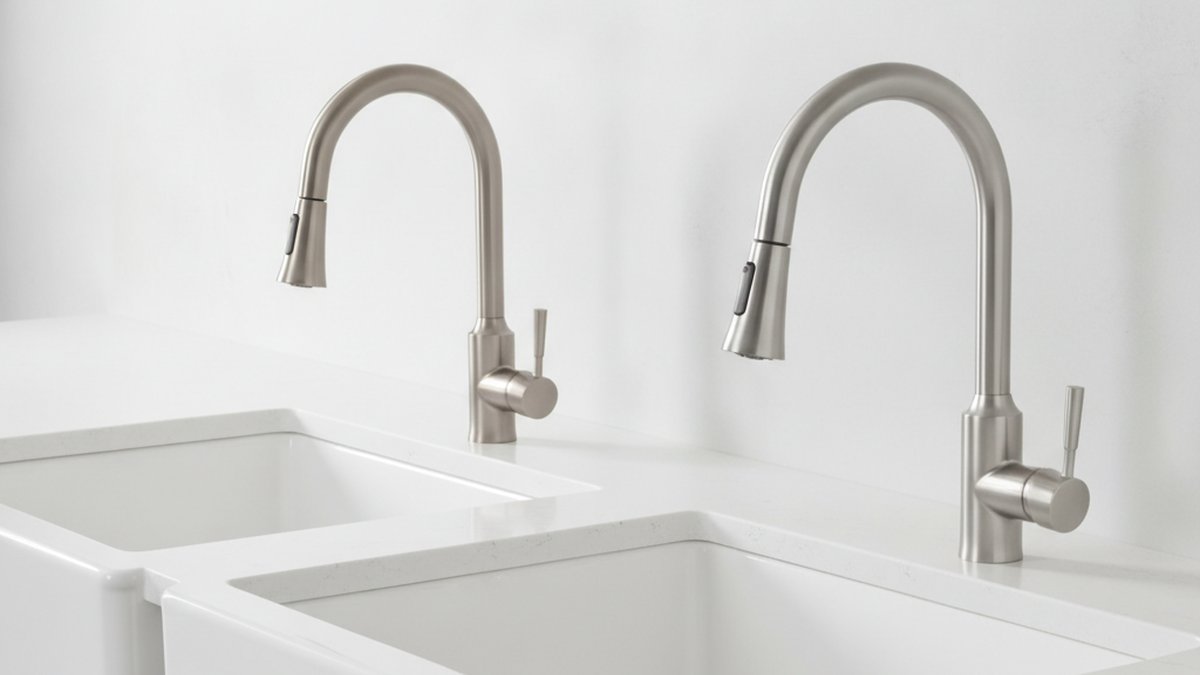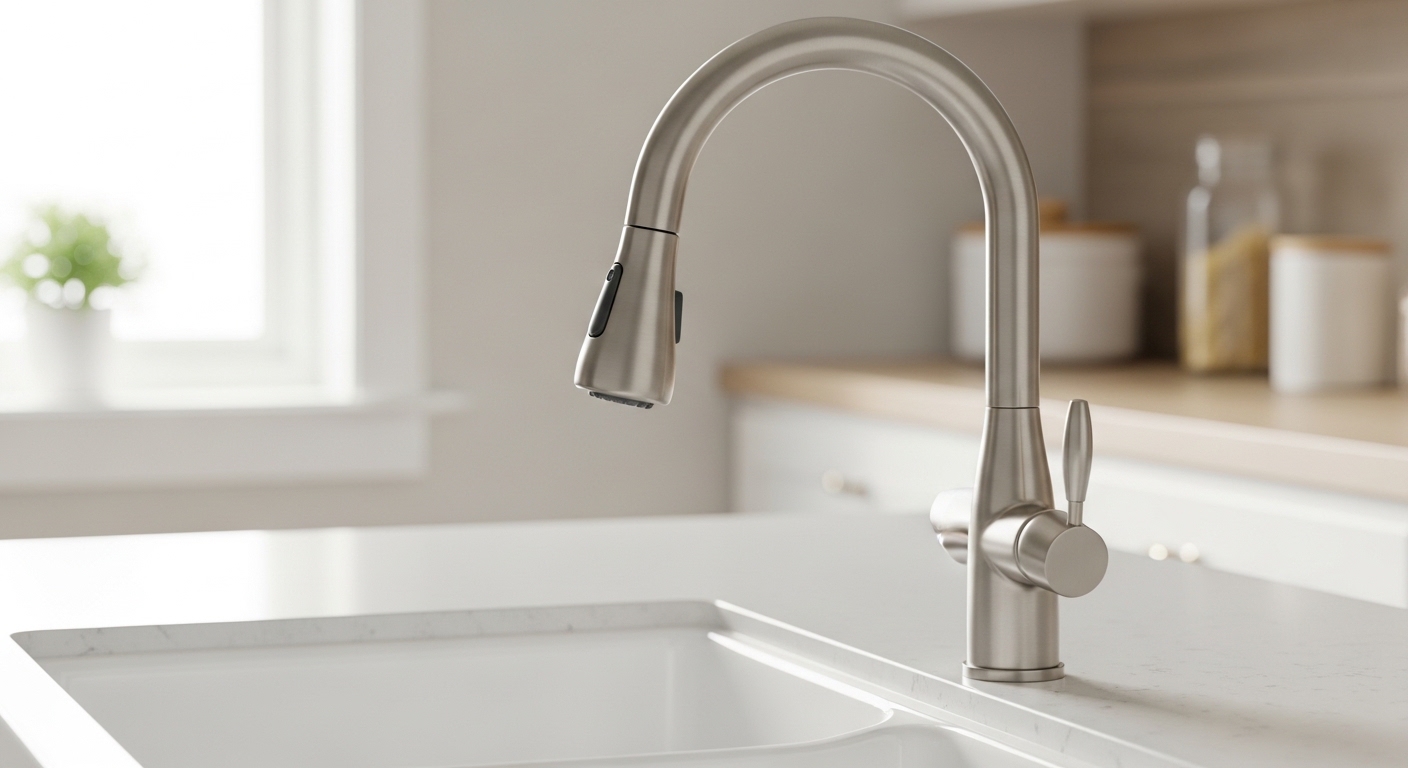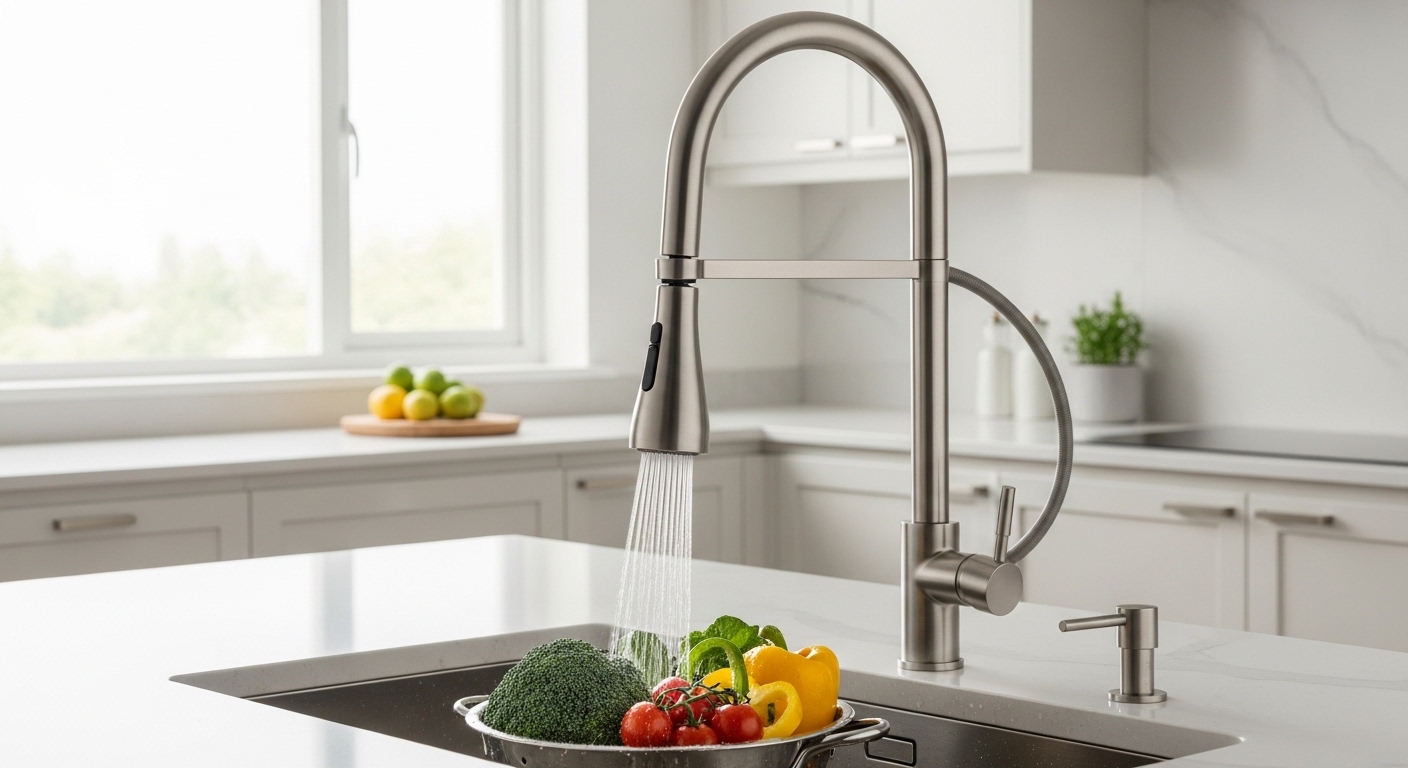
If you’ve been searching for the best pull down kitchen taps UK kitchens can actually run without water-hammer, weak spray, or a droopy hose after six months, the honest answer is that it comes down to four things: your water pressure, the cartridge and body materials, the docking mechanism, and whether the spec matches British plumbing rather than American. A tap that dazzles in a US review can dribble sadly on a UK gravity-fed system. Below, we break down exactly what to look for, how the main types compare, and which real-world scenarios (low pressure, hard water, small sink) change the answer.
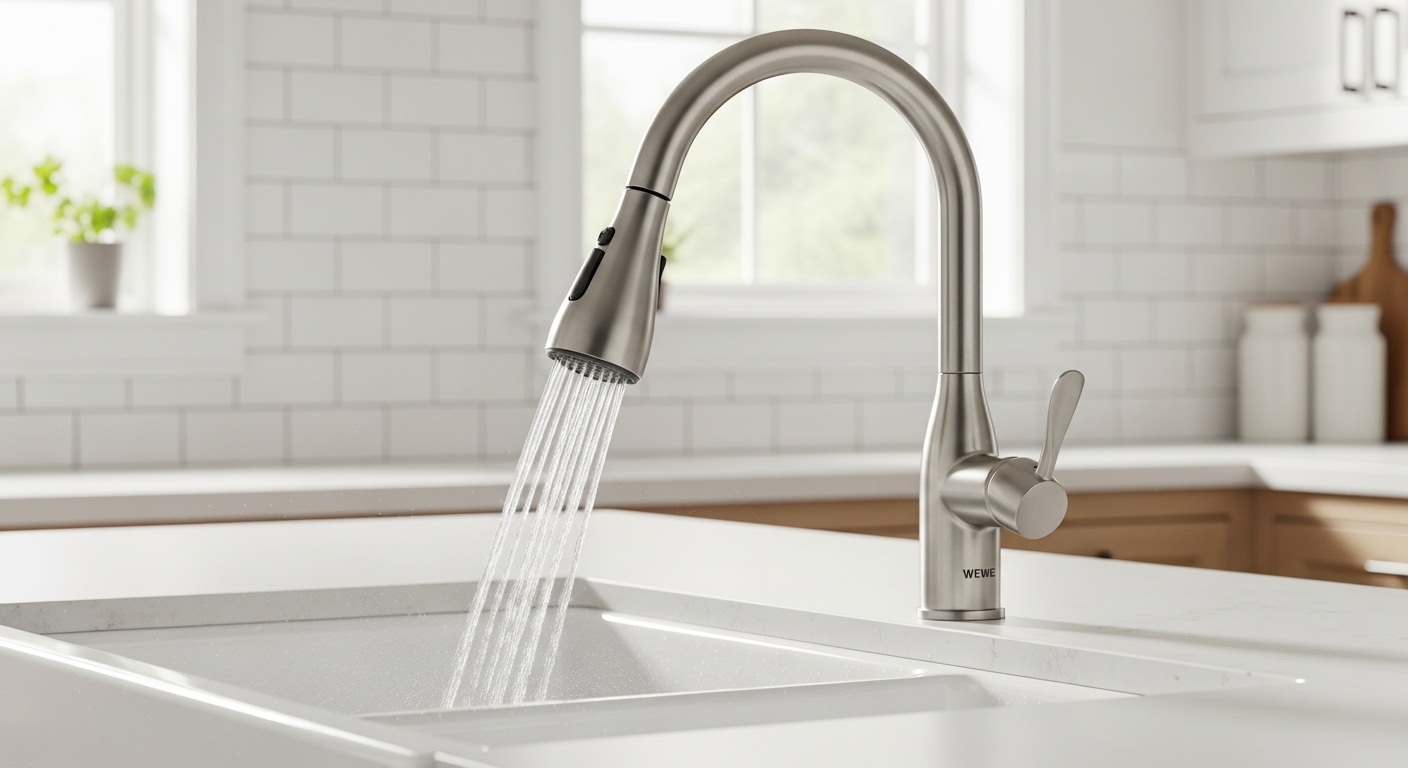
A “pull down” tap has a spray head that pulls straight down into the sink on a hose — different from a “pull out” tap, where the head pulls horizontally toward you. Pull downs pair beautifully with the tall gooseneck spouts that have become standard in UK kitchens, giving you height for stockpots and a natural downward rinse.
What actually makes a pull down kitchen tap “the best” in a UK home?
The best pull down tap for a UK home is one whose minimum pressure rating matches your system, has a WRAS- or KIWA-approved ceramic disc cartridge, and uses a solid brass or high-grade stainless body rather than zinc alloy. Those three things decide 90% of whether you’ll love it in five years.
Here’s why each matters in British homes specifically:
- Pressure rating. UK plumbing is a mix of high-pressure mains/combi systems and low-pressure gravity-fed tanks (a cold water tank in the loft, hot from a cylinder). Many imported taps quietly assume 1.5–3 bar. If you’re gravity-fed, you may have as little as 0.1–0.5 bar. Buy a tap explicitly rated as “suitable for low pressure” if that’s you, or the pull down spray will feel like a garden dribble.
- Cartridge. The ceramic disc cartridge is the heart of the tap — it’s what you turn on and off thousands of times a year. Quality cartridges (often 35mm, sometimes branded Sedal or similar) resist limescale and are rated for tens of thousands of cycles.
- Body material. Solid brass resists corrosion and holds threads well; cheap zinc alloy can crack and leach. For drinking-water safety, look for lead-free brass — we cover why this matters for your drinking water in our lead-free brass guide.
- Docking. A magnetic dock snaps the spray head back into place and keeps it there. Cheaper “ball catch” docks let the head sag over time — the single most common long-term complaint.
Before you buy anything, it’s worth checking what a normal flow rate even looks like on a British system, because “weak” is often a plumbing reality, not a faulty tap — our breakdown of the average kitchen tap flow rate in the UK gives you the baseline numbers to expect.
Pull down vs pull out vs standard mixer — which type should you choose?
Choose a pull down tap if you have a deep single-bowl sink and want maximum height and reach; choose pull out if your sink sits under a low window or wall cabinet that limits spout height; choose a standard fixed mixer only if you rarely rinse large items and want the cheapest, most reliable option. For most modern UK kitchens with a big single bowl, pull down wins.
| Type | Best for | Reach & height | Typical UK price | Watch-out |
|---|---|---|---|---|
| Pull down | Deep single-bowl sinks, filling pots | High spout, straight-down spray | £90–£300 | Needs clearance under wall units/window |
| Pull out | Low windows, shallow sinks | Lower spout, pulls toward you | £70–£220 | Less pot-filling height |
| Standard mixer | Budget, simple use | Fixed spout, no spray | £40–£150 | No spray flexibility |
| Boiling-water tap (3-in-1) | Instant hot, no spray | Fixed, compact | £250–£600+ | No pull down function; needs tank under sink |
One practical UK-specific note: measure the gap between your tap hole and the bottom of the window or wall cabinet before you fall in love with a 400mm-tall gooseneck. Tall pull downs look stunning but can foul on a window sill that opens inward.
Which pull down tap is best if I’m on low water pressure (gravity-fed)?
If you’re on a gravity-fed system, buy a pull down tap explicitly rated for low pressure — ideally down to 0.1–0.5 bar — and avoid heavily flow-restricted aerators. A tap designed for high-pressure mains will feel starved on a tank-fed home, and no amount of cleaning fixes a fundamental mismatch.
Low pressure in the UK usually means you have a cold tank in the loft and a hot cylinder in an airing cupboard. The height difference (the “head”) between the tank and the tap creates your pressure, and it’s often modest. Look for these clues on the product spec:
- “Suitable for low pressure systems” or “0.1 bar / 0.2 bar minimum” stated explicitly.
- A larger-bore spray hose and a less aggressive flow restrictor.
- Sometimes a “high flow” or “low pressure aerator” included in the box.
If your pressure is genuinely marginal, a pull down can still work, but manage expectations: the spray function is naturally more restrictive than an open spout, so a low-pressure system will give you a gentler spray than a mains-fed home. If a tap that should be fine still feels weak, the aerator is the usual suspect — here’s how a clogged aerator causes low pressure and how to fix it fast.
What’s the best pull down tap for a hard water area?
In a hard water area, the best pull down tap is one with a rubber-nub aerator or spray face you can wipe clean, a limescale-resistant ceramic cartridge, and a PVD finish (brushed steel, brushed brass, matte black) that hides water spots. Most of the UK — the south and east especially — has hard or very hard water, so this matters more here than almost anywhere.
Limescale is the number-one enemy of a pull down tap’s spray head. The tiny spray holes clog first, throwing the stream sideways. Two features genuinely help:
- Silicone/rubber spray nozzles you can rub with a thumb to pop scale off, instead of hard metal holes you’d have to soak.
- A quality cartridge that keeps sealing cleanly even as scale builds. A cheap cartridge is what starts the drip-drip that eventually becomes a repair — if yours ever does start weeping, our guide on replacing a kitchen tap cartridge yourself saves you a plumber’s call-out.
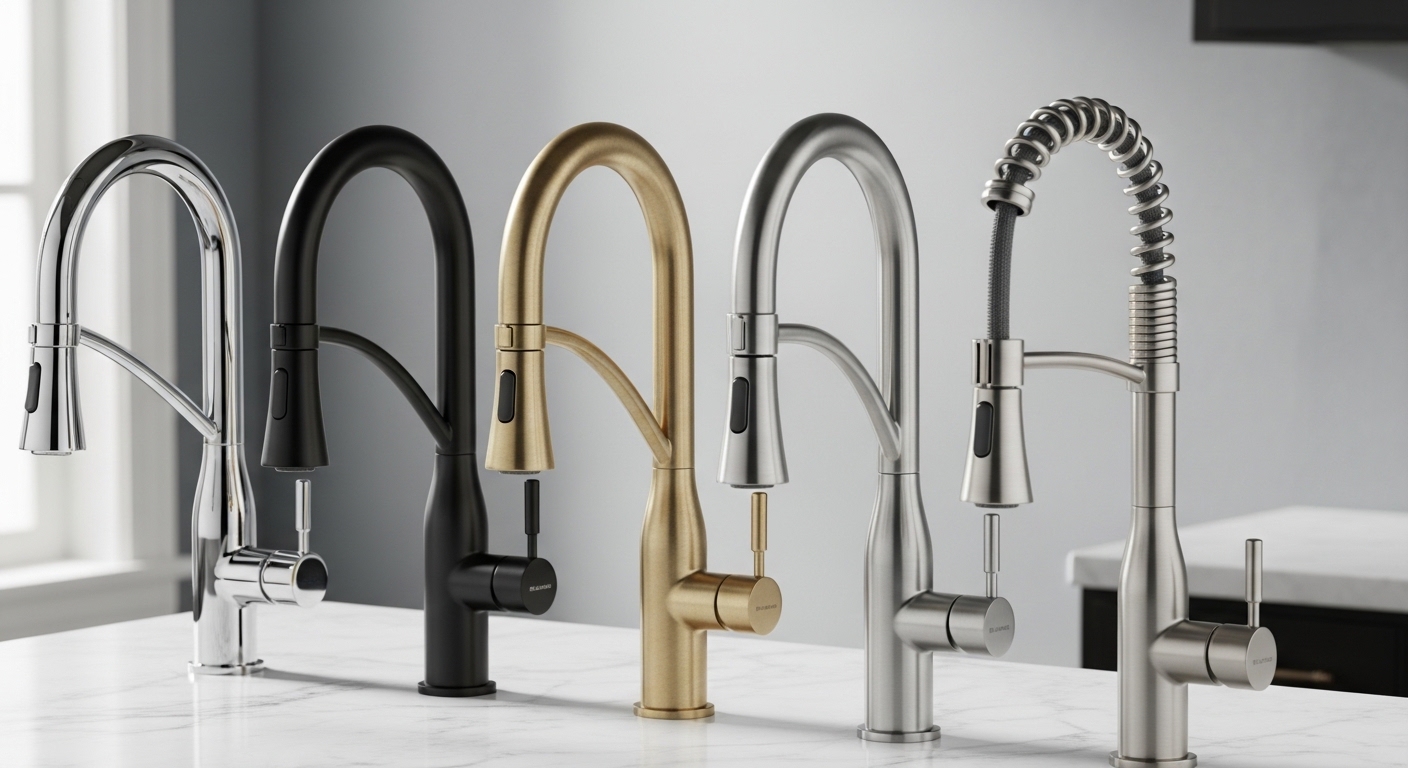
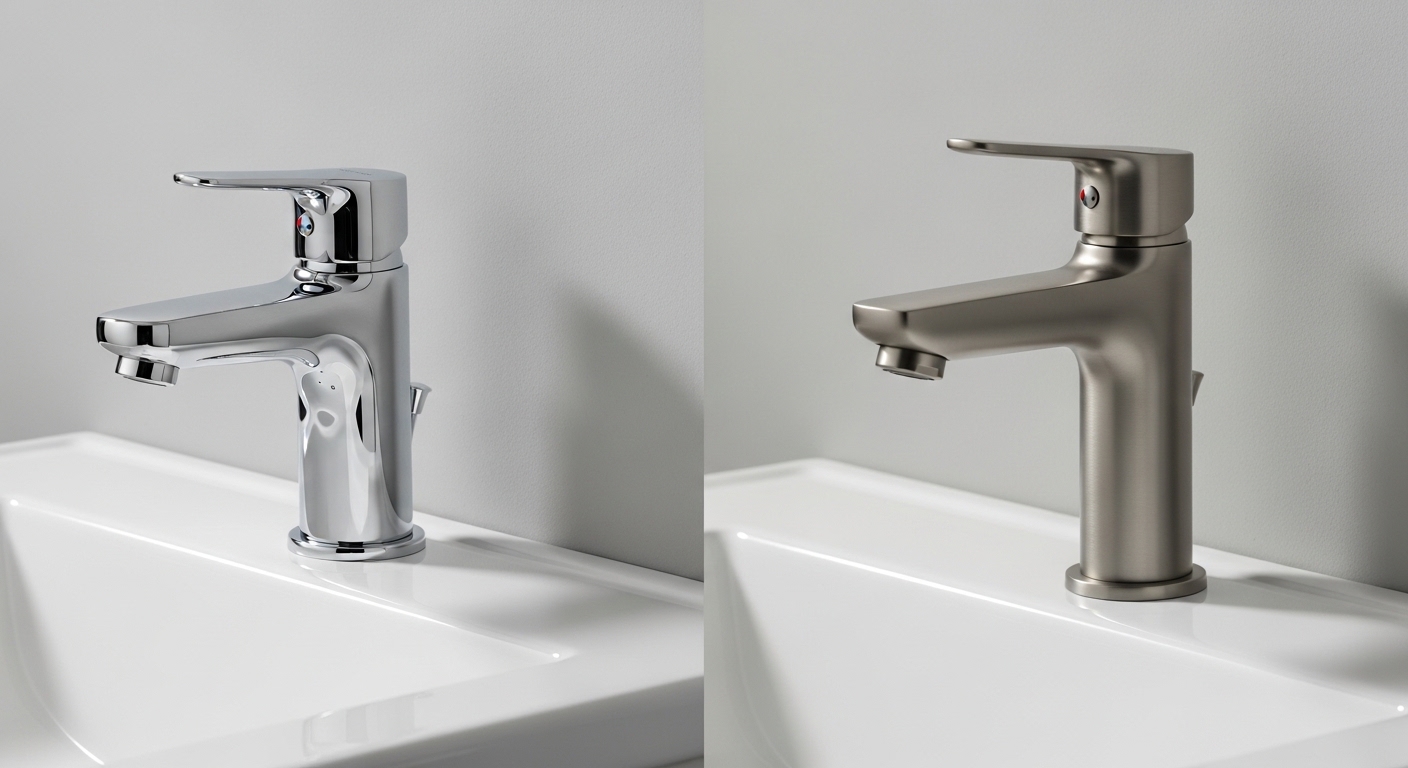
Finish choice is quietly practical too. Polished chrome shows every spot and fingerprint; brushed/satin finishes and matte black are far more forgiving day to day. If you’re weighing a bolder colour, our take on the matte black kitchen faucet debate on Reddit covers how these finishes actually age in a working kitchen.
How much should I spend on a pull down kitchen tap in the UK?
For a UK kitchen, spend £90–£200 on a pull down tap for the best balance of durability and value; below £60 you’re gambling on zinc bodies and weak docks, and above £300 you’re usually paying for a brand name or a designer finish rather than better engineering. The mid-range is where solid brass bodies, ceramic cartridges, and magnetic docks become standard.
Here’s roughly what your money buys:
| Budget | What you typically get | Honest verdict |
|---|---|---|
| Under £60 | Zinc/thin-brass body, basic ball dock, generic cartridge | Fine for a rental or short term; expect a sagging head or drip within a couple of years |
| £90–£200 | Solid brass body, ceramic disc cartridge, magnetic dock, braided hose | The sweet spot for most UK homes — buy here |
| £200–£300 | Premium finishes (PVD brushed brass/black), branded cartridge, longer warranty | Worth it for a forever kitchen or a bold finish |
| £300+ | Designer name, touchless/sensor tech, boiling-water hybrids | Diminishing returns unless you specifically want the tech |
Don’t over-index on price alone. A £120 tap with a magnetic dock and WRAS-approved cartridge will outlast a £250 tap chosen purely for looks. If you want to sanity-check your shortlist against the wider market, our roundup of the most reliable kitchen faucet in 2025 ranks models on longevity rather than hype, and our guide to the best kitchen faucet companies to buy from helps you judge which brands stand behind their warranties.
What features are actually worth paying for — and which aren’t?
Worth paying for: a magnetic dock, a ceramic disc cartridge, a braided nylon (not plain PVC) hose, and a genuine solid-brass body. Skippable for most people: pull-out sensor/touchless activation, and dual-spray “boost” buttons that add failure points. Decide based on how you actually cook, not the marketing.
To match features to your specific sink layout and how you use the kitchen, our walkthrough on how to select kitchen faucet features that fit your sink and budget takes you feature-by-feature so you don’t overspend on things you’ll never use.
How hard is a pull down tap to install yourself?
A pull down tap is a straightforward DIY job for most people — typically 45–90 minutes with flexible tails, an isolation valve, and a basin/tap wrench — as long as you have a single tap hole and existing isolating valves under the sink. The pull down hose adds one extra step (routing it through the spout and attaching the weight), but nothing that needs a plumber.
The basic sequence looks like this:
- Turn off the water at the isolation valves under the sink and open the tap to drain residual pressure.
- Disconnect and remove the old tap from below.
- Feed the new tap’s flexible tails and pull down hose down through the tap hole; secure the tap with its bottom-fixing bracket.
- Connect the hoses to the isolation valves, then attach the pull down hose to the outlet and clip on the counterweight.
- Turn the water back on slowly, check every joint for leaks, and run the tap to flush any debris before using the spray.
If any of that feels unfamiliar, our step-by-step guide on how to install kitchen taps mixers yourself without calling a plumber covers the fittings, the counterweight, and the leak-check in detail. The single most common mistake is over-tightening the flexible tails onto the isolation valves and cracking the fitting — hand-tight plus a quarter turn is plenty.
How do I stop the spray head from sagging or the hose from leaking over time?
To prevent a sagging spray head, buy a tap with a magnetic dock rather than a friction ball catch, and make sure the counterweight is fitted at the correct height so the hose retracts fully. To prevent hose leaks, choose a braided nylon hose over bare PVC and don’t kink it against the waste pipe or a bin behind the cabinet.
The “droopy head” problem that fills review sections almost always traces back to a weak docking design plus a badly positioned counterweight. When the weight sits too high, the hose can’t pull the head snugly home; too low and it drags. Adjust it so the head returns firmly with a satisfying click. If you ever notice a slow drip appearing at the spout or base rather than the hose, that’s usually a cartridge or valve issue — diagnosing a faucet dripping from the valve early stops a small seep from becoming a limescale-crusted repair.
A quick note on trust: how we tested and what to check
Author note: This guide is written by the aleashafaucet product team, who spec, pressure-test, and warranty kitchen taps for UK and international plumbing systems. We assess taps the way a fitter would: bench-testing cartridges through repeated cycles, checking dock retention with a loaded spray head, and verifying flow at both mains and low-pressure settings.
Brand credibility & standards: aleashafaucet manufactures faucets to lead-free brass standards with ceramic disc cartridges, and we recommend buying only taps whose cartridges and bodies carry recognised approvals (WRAS or KIWA in the UK) so they’re safe and legal to connect to the mains. Look for a warranty of at least 5 years on the body and finish, and a clearly stated pressure rating — a brand that won’t publish its minimum bar rating is a brand to skip. Standards and warranties aren’t marketing fluff here; they’re your evidence the tap will survive British water and pressure.
FAQ
Are pull down kitchen taps better than pull out taps?
Pull down taps are better for deep single-bowl sinks and pot-filling because the tall spout gives more height and a natural straight-down rinse. Pull out taps are better under low windows or wall cabinets where a tall spout won’t fit, since the head extends toward you instead of needing overhead clearance. Neither is universally “better” — it depends on your sink and the space above it.
Do pull down kitchen taps work on low water pressure in the UK?
Yes, but only if you choose a model specifically rated for low pressure (often 0.1–0.5 bar) if you’re on a gravity-fed tank system. A tap designed only for high-pressure mains will feel weak on a low-pressure home. Always check the stated minimum bar rating before buying, and expect the spray function to be gentler than an open spout on any low-pressure system.
What is the best finish for a pull down kitchen tap in a hard water area?
Brushed or satin finishes — brushed steel, brushed brass, or matte black with a PVD coating — are best in hard water areas because they hide limescale spots and fingerprints far better than polished chrome. PVD coatings are also more scratch- and tarnish-resistant, which matters over years of daily use next to a busy sink.
How long should a good pull down kitchen tap last?
A quality pull down tap with a solid brass body and ceramic disc cartridge should last 10–15 years, with the cartridge and spray hose being the parts most likely to need replacing first. Cheaper zinc-bodied taps often show problems — sagging heads, drips, or dull finishes — within two to three years. Buying in the £90–£200 range and descaling the spray head periodically is the simplest way to reach the longer end of that range.
Can I fit a pull down kitchen tap myself, or do I need a plumber?
Most people can fit a pull down tap themselves in under 90 minutes if the sink already has isolation valves and a single tap hole. You’ll need flexible tails, a basin wrench, and care not to over-tighten the fittings. You only really need a plumber if you’re adding new isolation valves, converting from two taps to a single mixer hole, or working on a system where you’re unsure about the pressure setup.
What’s the difference between WRAS and KIWA approval, and does it matter?
Both WRAS and KIWA are UK-recognised approvals confirming a tap’s materials and design are safe to connect to the public water supply. It matters because an unapproved tap can, in principle, breach water regulations and may leach unwanted materials into your drinking water. For any tap feeding a kitchen where you drink or cook, choosing an approved, lead-free product is the safe default.