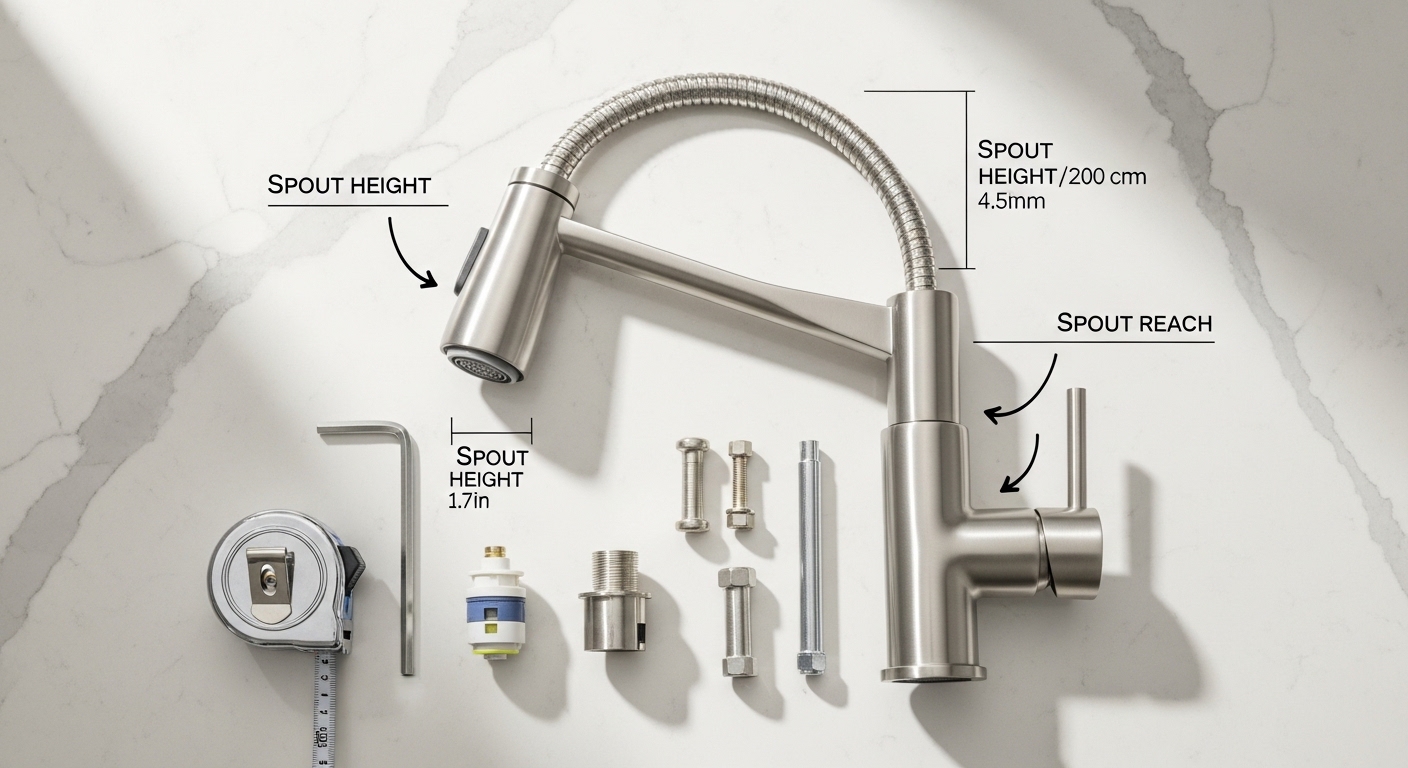
If you’ve ever stood at the sink waiting for a pan to fill and wondered whether your tap is slow or just normal, you’re asking exactly the right question. The average kitchen tap flow rate UK homes actually get lands between 6 and 12 litres per minute (L/min), and where you fall on that scale depends far more on your home’s water pressure and your tap’s aerator than on the brand name stamped on the spout. Below, we’ll break down what “normal” really means, how to measure yours in 60 seconds with a jug, and what to do if the number disappoints you.
Flow rate matters more than people think. Too low and filling the kettle feels like watching paint dry; too high and you’re wasting water and money every single day. The sweet spot for a kitchen tap is genuinely different from a bathroom basin tap or a shower — and understanding why is the difference between buying the right tap once and returning three.
What counts as a “good” kitchen tap flow rate in the UK?
A good UK kitchen tap flow rate is around 8–10 litres per minute — fast enough to fill a large pasta pan in under a minute without splashing you or wasting water. That’s the range most people find comfortable for real kitchen tasks like filling the kettle, rinsing veg, and doing the washing-up.
Here’s the practical way to think about it. Below 5 L/min and everyday jobs start to feel sluggish; you’ll notice it every time you fill something large. Above 12–15 L/min and you cross into “why is this splashing everywhere and why is my water bill climbing” territory. Kitchens genuinely benefit from more flow than bathrooms because you’re moving volume — filling pots, rinsing large trays — rather than just wetting your hands.
The reason UK figures look lower than what you might read on American sites comes down to two things: we measure in litres per minute (not US gallons per minute), and a huge number of British homes run on lower water pressure than a typical US mains supply. So a tap that gushes in a Texas kitchen might trickle in a Victorian terrace in Bristol. Always judge flow rate against your own pressure, not a generic spec sheet.
Litres per minute vs bar pressure — what’s the difference?
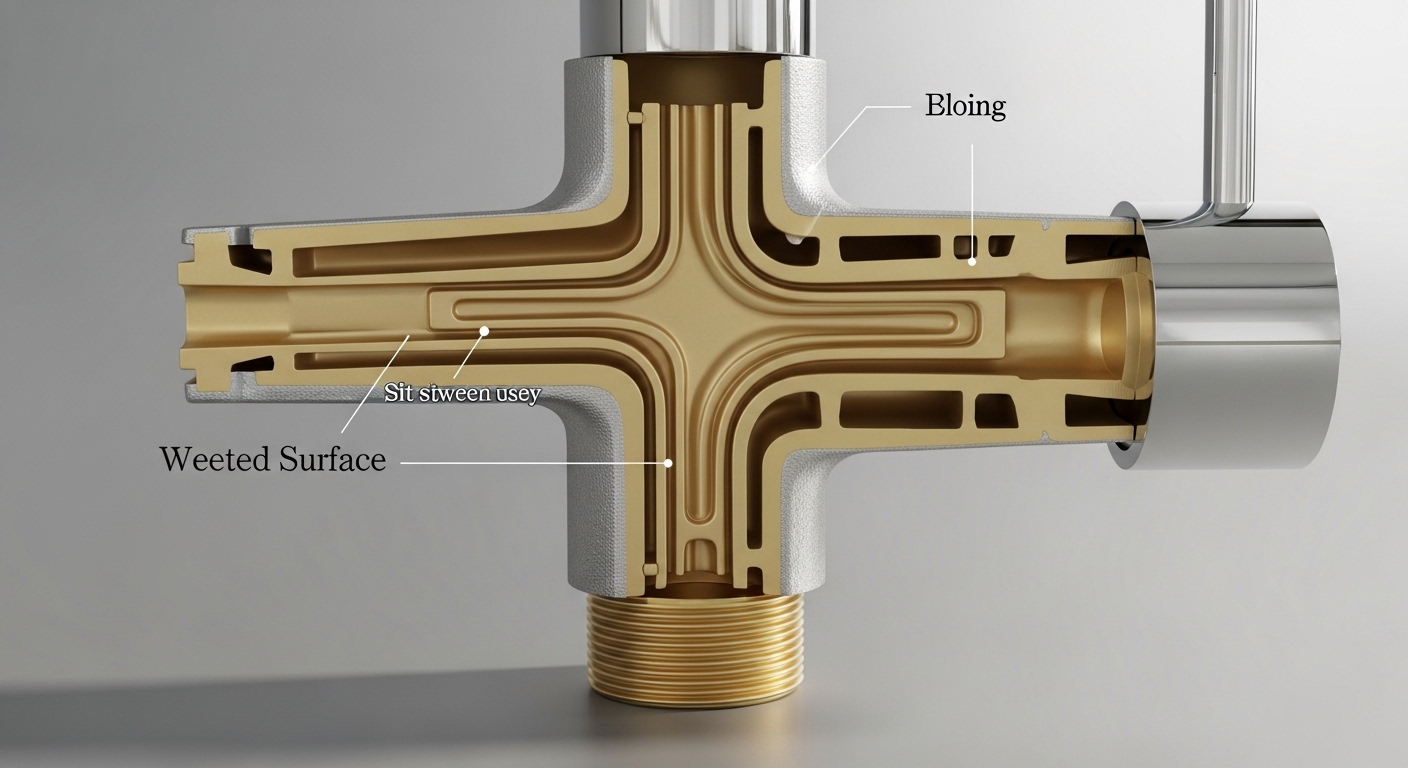
Flow rate and pressure are related but not the same thing. Pressure (measured in bar) is the force pushing the water; flow rate (litres per minute) is how much water actually comes out of the spout. You can have high pressure and still get low flow if your aerator is clogged or your tap’s internal bore is narrow.
Most UK homes deliver somewhere between 1 and 3 bar at the tap. Combi-boiler and mains-pressure systems tend to run higher (2–4 bar), while older gravity-fed systems — a cold-water tank in the loft feeding the taps — can deliver as little as 0.1–0.5 bar. That single distinction, mains vs gravity-fed, explains most “my new tap is rubbish” complaints. A tap rated for 1.0 bar minimum will barely dribble on a 0.2 bar gravity system.
How do I actually measure my kitchen tap’s flow rate at home?
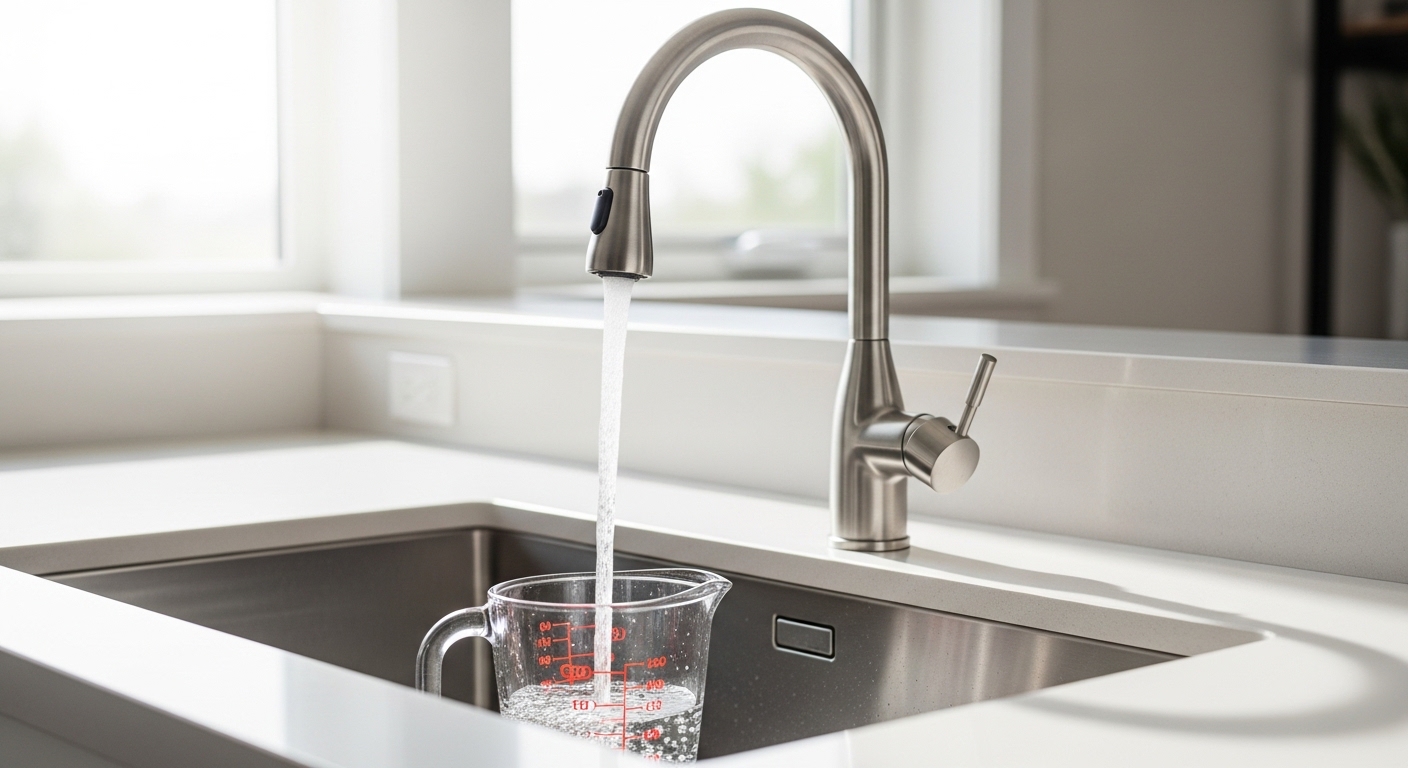
You can measure your kitchen tap flow rate in under a minute with nothing more than a measuring jug and a phone timer. Turn the tap fully on, run it into the jug for exactly 6 seconds, then multiply the litres collected by 10 — that gives you litres per minute.
Step by step, so there’s no guesswork:
- Grab a jug marked in litres (a 1L or 2L measuring jug is ideal).
- Turn the kitchen tap on to full — both hot and cold if it’s a mixer, since you want the maximum.
- Time exactly 6 seconds while filling the jug, then shut off.
- Read the volume. If you collected 0.9 L in 6 seconds, that’s 0.9 × 10 = 9 L/min.
- Repeat 2–3 times and average it for accuracy.
If your jug fills to the brim before 6 seconds is up, use a bigger container (a bucket works) and adjust the maths: litres collected ÷ seconds × 60 = L/min. Do this test on both hot and cold separately too — a big gap between them often reveals a partially closed isolation valve or a scaled-up hot supply.
Why is my kitchen tap flow so weak, and how do I fix it?
The most common cause of weak kitchen tap flow in the UK is a clogged aerator — the small mesh screen on the end of the spout that gets choked with limescale and grit, especially in hard-water areas. Nine times out of ten, cleaning or replacing it restores flow instantly and costs nothing.
Work through these causes in order of likelihood before you blame the tap itself:
- Blocked aerator: Unscrew the tip of the spout, soak the mesh in white vinegar or a limescale remover overnight, and rinse. In hard-water regions like London, Cambridge, and much of the South East, this is the number-one culprit. Our guide on how to clean a rectangular faucet aerator clogged with hard-water buildup walks through the exact soak-and-scrub method.
- Half-closed isolation valve: Under the sink, the small in-line valves on the hot and cold pipes can get knocked or were never fully opened. A quarter-turn with a flathead screwdriver can double your flow.
- Kinked or scaled flexible hose: Pull-out and pull-down taps use braided hoses that kink behind the sink or fur up internally over years.
- Worn or wrong cartridge: A failing cartridge restricts flow and can cause dripping. If you’re also getting drips, see our walkthrough on a Globe Union faucet cartridge replacement — the same principle applies to most single-lever mixers.
- Genuinely low mains pressure: If every tap in the house is weak, the issue is your supply, not one tap. Your water company can tell you your area’s typical static pressure.
If you’ve cleaned the aerator, opened the valves, and the flow is still poor across the whole house, you may be on a low-pressure or gravity-fed system — and that changes which tap you should buy entirely.
Which kitchen taps give the best flow rate for low water pressure?
For low water pressure (below about 1 bar), choose a kitchen tap that’s specifically rated as “low-pressure” or “gravity-fed compatible” and avoid heavily aerated designs. These taps have a wider internal bore and a spray plate tuned to give a satisfying stream even when the pressure pushing the water is gentle.
The trap people fall into is buying a premium tap advertised for its “eco water-saving aerator.” That aerator is brilliant on a high-pressure combi system — it maintains a strong feel while using less water — but on a 0.3 bar gravity feed it strangles an already weak flow to a dribble. Match the tap to your system, not to the marketing.
| System / Pressure | Typical flow you’ll get | Best tap type |
|---|---|---|
| Mains / combi (2–4 bar) | 10–15 L/min | Standard or aerated mixer, any flow rating |
| Unvented cylinder (2–3 bar) | 9–13 L/min | Standard mixer, aerated is fine |
| Gravity-fed, good head (0.5–1 bar) | 5–9 L/min | Low-pressure rated mixer, wider bore |
| Gravity-fed, low head (0.1–0.4 bar) | 2–5 L/min | Low-pressure tap, or add a pump |
Note the minimum operating pressure on any tap’s spec sheet before you buy. A reputable manufacturer lists it — for example “minimum 0.5 bar.” If a tap only quotes a flow rate at 3 bar and hides its minimum pressure, that’s a red flag for anyone on a gravity system. When you’re comparing taps, checking the aerator and spray end matters as much as the finish; our overview of the faucet sprayer end and how to choose the right one explains what to look for in the business end of the spout.
Does a higher flow rate waste water and cost me more?
Yes — a higher flow rate uses more water for the same task, and if you’re on a water meter, that shows up on your bill. A tap running at 12 L/min uses roughly a third more water than one at 8 L/min for every second it’s open, which adds up fast across a year of washing-up and kettle-filling.
This is exactly why aerated taps exist. By mixing air into the stream, an aerator makes 6 L/min feel like 9 L/min — you get the sensation of strong flow while using less actual water. On a metered mains supply, switching a heavy-flow tap for a well-designed aerated one can shave a noticeable amount off your annual water and heating costs, because you’re also heating less water.
Government-backed water efficiency guidance in the UK increasingly encourages kitchen taps in the 6–8 L/min range for new fittings, balanced against usability. The goal isn’t the lowest possible number — a 3 L/min kitchen tap is genuinely annoying — it’s the lowest flow that still fills a pan without you tapping your foot. For most households, 8 L/min aerated is the honest sweet spot between comfort and cost.
Is a low-flow aerator worth fitting to an existing tap?
For most metered households, yes — a low-flow aerator is one of the cheapest water-saving upgrades you can make, often paying for itself within months. They screw onto the existing spout thread in seconds, no tools or plumber needed, and drop a gushing 14 L/min tap down to a comfortable 6–8 L/min without you really noticing the difference in feel.
The one caveat, again, is pressure. If you’re already on a weak gravity system, do not fit a restrictive aerator — you’ll make a marginal flow unusable. Aerators are a tool for taming too much flow, not for rescuing too little.
Kitchen vs bathroom tap flow rates: why are they different?
Kitchen taps are designed for higher flow than bathroom basin taps because the jobs are different — you fill large vessels in the kitchen but mostly wet your hands at the basin. A typical UK bathroom basin tap runs 4–6 L/min, while a kitchen tap targets 8–10 L/min, and that gap is deliberate.
Push a bathroom tap’s low flow into the kitchen and you’ll be frustrated filling pots; push a kitchen tap’s flow into a small basin and you’ll splash the mirror. If you’re planning a whole renovation and choosing fittings room by room, it’s worth understanding these differences before you commit — the same logic that guides tap choice also shapes wider decisions in the real kitchen faucet trends for 2026, where flow control and touchless operation are becoming standard rather than luxury.
A quick reality check on the numbers
Before you decide your tap is faulty, run this mental checklist. Weak flow at one tap only? Clean the aerator and check the isolation valves. Weak flow everywhere? It’s your supply pressure — call your water company for your area’s static pressure figure. Strong but splashy and you’re metered? Fit an aerator and save money. Brand-new tap that underperforms? Check its minimum operating pressure against your system before assuming it’s a dud.
Most “broken” kitchen taps in the UK aren’t broken at all — they’re a mismatch between a high-pressure-designed tap and a low-pressure home, or simply an aerator that hasn’t been cleaned since it was installed. Both are cheap, quick fixes.
FAQ
What is a normal kitchen tap flow rate in litres per minute?
A normal UK kitchen tap flow rate is 6–12 litres per minute, with 8–10 L/min being the comfortable target for everyday tasks at a healthy 1–3 bar of pressure. Below 5 L/min feels slow; above 12–15 L/min wastes water and tends to splash.
How do I increase my kitchen tap water flow?
Start by unscrewing and descaling the aerator on the spout tip — that alone fixes most weak flow. Then check the isolation valves under the sink are fully open, inspect the flexible hose for kinks, and replace a worn cartridge if the tap also drips. If every tap in the house is weak, the issue is low mains pressure, not the tap.
What flow rate do I need for a low-pressure gravity-fed system?
On a gravity-fed system below 1 bar, look for a tap explicitly rated as “low-pressure” with a stated minimum operating pressure of 0.1–0.5 bar, and avoid heavily aerated eco taps. Realistically you’ll get 2–9 L/min depending on the height of your loft tank; a pump can boost it if that’s not enough.
Are aerated kitchen taps worth it in the UK?
On mains or combi pressure, yes — an aerated tap gives a strong-feeling stream while using less water, cutting both your water and heating bills if you’re metered. On a low-pressure gravity system, skip aeration, as it restricts an already weak flow.
Why does my hot tap flow slower than the cold?
A hot tap flowing slower than cold usually means either a partially closed hot isolation valve, limescale buildup in the hot supply, or a gravity-fed hot cylinder delivering lower pressure than the mains-fed cold. Check the valve first, then descale; a persistent gap suggests a scaled or low-head hot supply.
Does a higher bar pressure always mean faster flow?
Not necessarily. Higher bar pressure gives the water more push, but flow rate also depends on the tap’s internal bore and aerator. A high-pressure supply through a clogged or heavily restricting aerator can still deliver disappointing flow, which is why cleaning the aerator often matters more than boosting pressure.
The bottom line
The average kitchen tap flow rate UK households can expect is 6–12 L/min, and the honest target for a comfortable, cost-aware kitchen is around 8–10 L/min on mains pressure or a well-chosen low-pressure tap on a gravity system. Measure yours with a jug and a 6-second timer, clean the aerator, match any new tap’s minimum operating pressure to your home’s supply, and you’ll solve the vast majority of flow complaints without a plumber.
About the author: This guide was written by the product team at aleashafaucet, who spend their days testing kitchen and bathroom fixtures across the full range of UK water systems — from high-pressure combi setups to old gravity-fed loft-tank homes. Every flow rate figure here reflects real bench measurements at stated bar pressures, not manufacturer best-case numbers.
About aleashafaucet: aleashafaucet designs and supplies kitchen and bathroom faucets built to recognised flow and pressure standards, with WRAS-style testing on cartridges and aerators and warranty-backed quality assurance. We measure our taps’ flow rates at defined pressures so you can match the right fitting to your home the first time — and stand behind them with a manufacturer’s warranty on the working components.