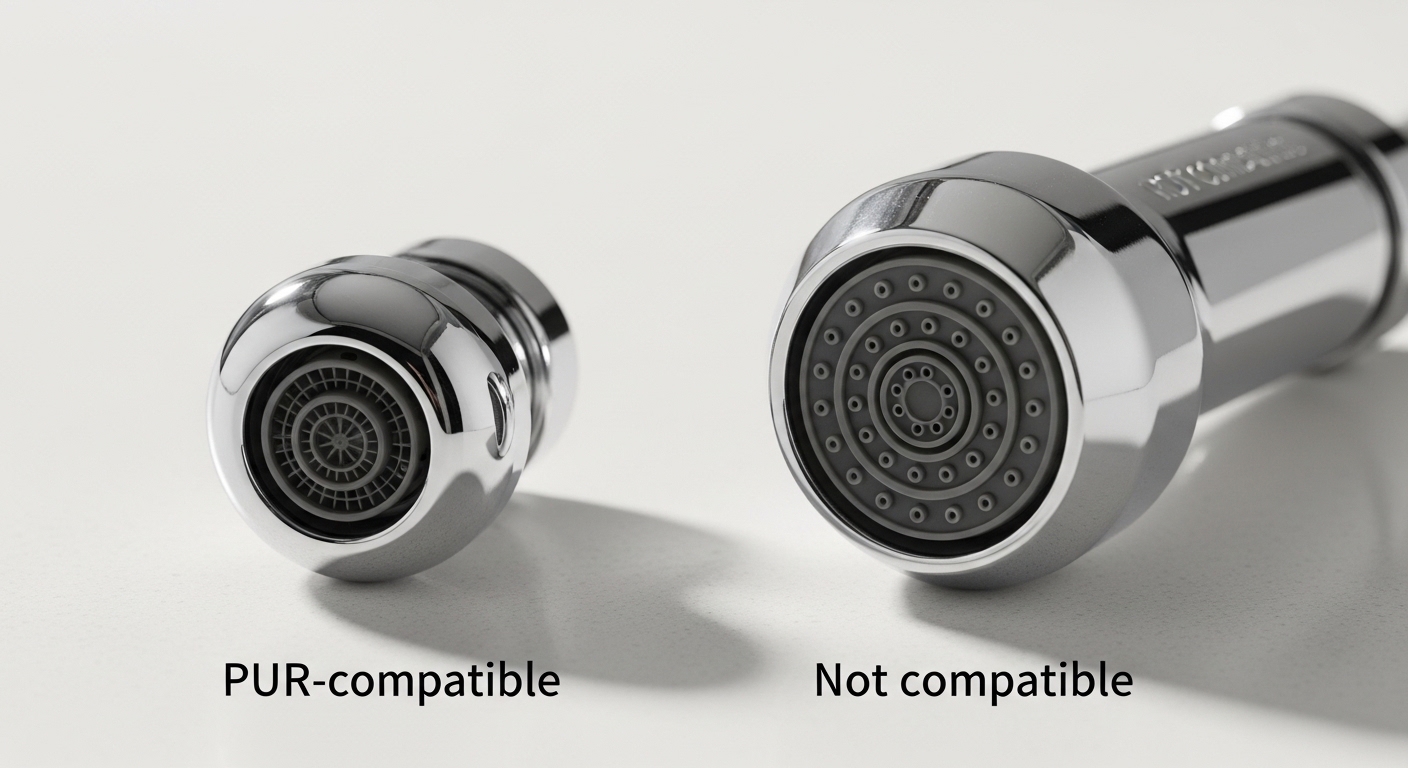
Finding a kitchen faucet compatible with PUR water filter systems comes down to one thing most people don’t check before they buy: the shape and threading of the spout tip. PUR’s faucet-mount filters (the kind that clamp right onto the end of your faucet) ship with a small kit of plastic adapters designed to grab a plain, cylindrical spout. If your faucet ends in a fixed, round nozzle, you’re almost certainly fine. If it ends in a pull-down spray head, a squared-off designer spout, or a hidden internal aerator with no external threads, PUR simply has nowhere to grip. Below, I’ll walk you through exactly what to look for, which faucet styles play nice, which don’t, and what to buy instead if your dream faucet is a sprayer.
Does a PUR faucet filter fit any kitchen faucet?
No — PUR faucet-mount filters fit most standard-spout kitchen faucets, but not all of them. PUR itself states its faucet filters are compatible with “standard faucets” only, and specifically not with pull-out, pull-down, handheld, or spray-style faucets. So the honest answer is: probably yes if you have a classic single-spout tap, and definitely no if you have a spray head.
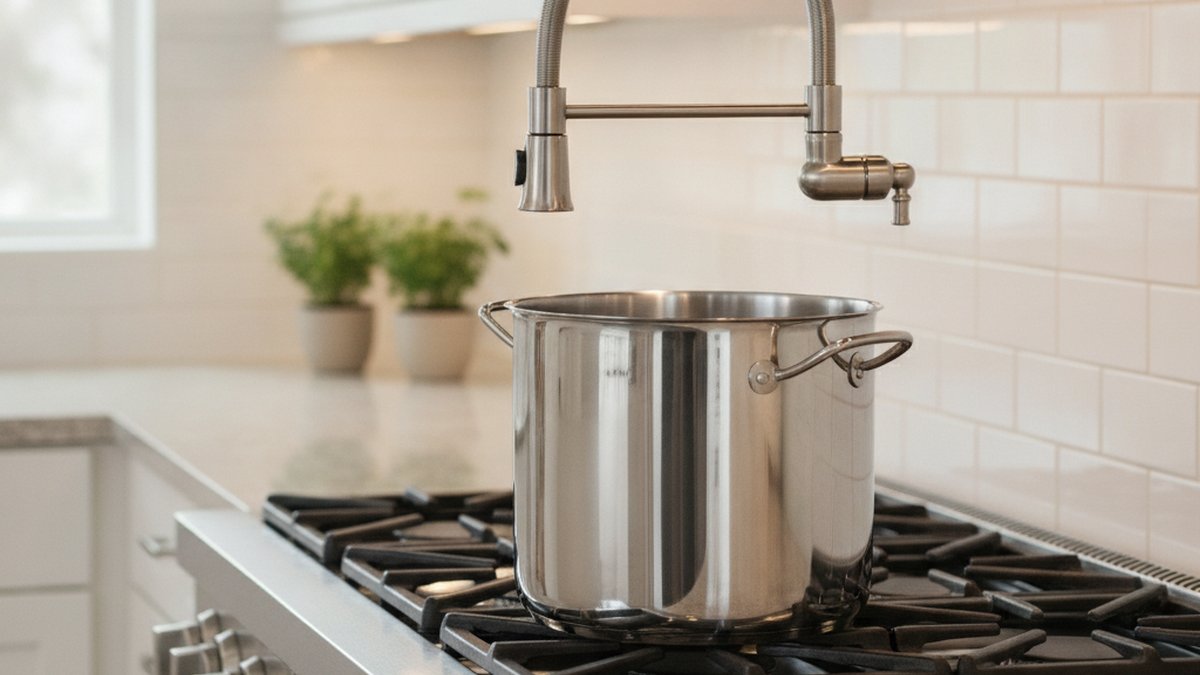
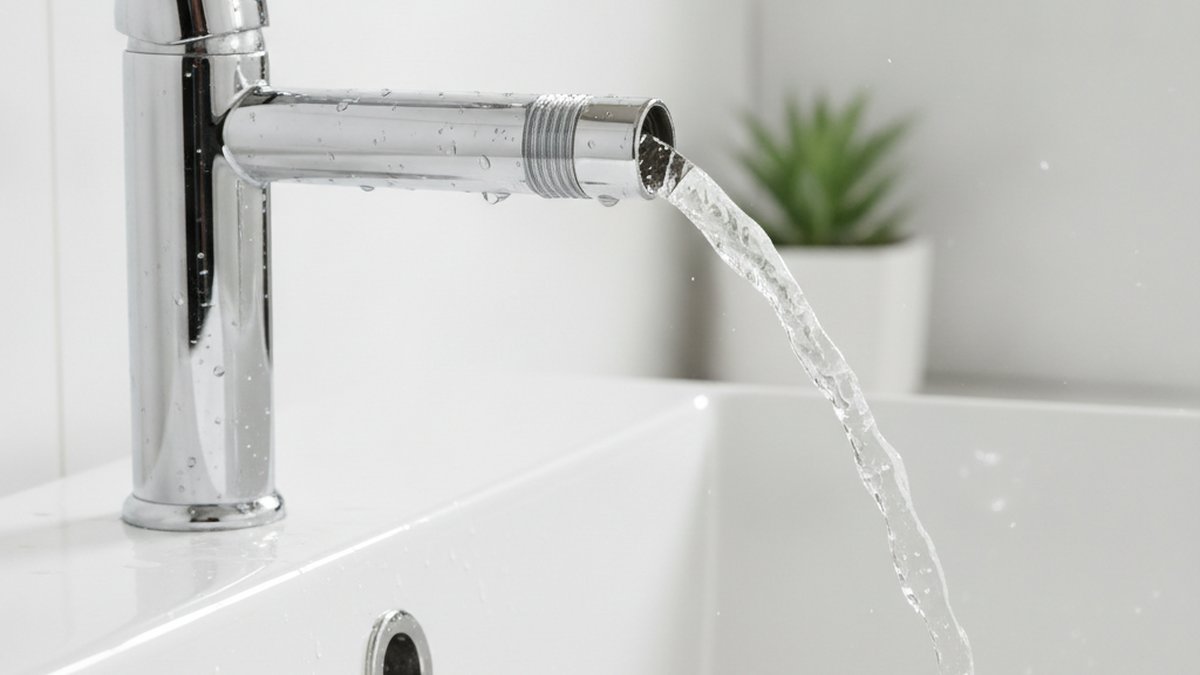
Here’s why. A PUR faucet filter works by removing your faucet’s aerator (that little screw-on screen at the tip) and clamping the filter housing onto the exposed spout end using one of several rubber-ringed adapters. That mechanism needs a rigid, round, external surface roughly 15/16″ to 1″ in diameter. Standard chrome and stainless “gooseneck” or “high-arc” faucets with a fixed nozzle give it exactly that. A pull-down sprayer, by contrast, ends in a large plastic-and-metal spray head that detaches and flexes — there’s nothing solid to clamp to, and even if there were, the weight of the filter would drag the hose down.
What kind of faucet do I need for a PUR filter to actually clamp on?
You need a faucet with a fixed (non-detachable) spout that ends in a smooth, round, externally-accessible tip about 15/16″ to 1″ across. That’s the single most important spec. Everything else — finish, height, handle style, price — is secondary for filter compatibility.
When you unbox a PUR faucet-mount system, you’ll typically find a threaded ring plus a set of rubber adapter washers in different sizes. The idea is simple: unscrew your existing aerator, then use whichever adapter matches your spout so the filter seats snugly with no leaks. Because most American kitchen faucets use one of just a few aerator thread sizes, PUR’s kit covers the overwhelming majority of standard taps out of the box.
Watch out for these deal-breakers before you buy a faucet with filtering in mind:
- Pull-down / pull-out spray heads — incompatible, full stop. The spray head moves; the filter can’t ride on it.
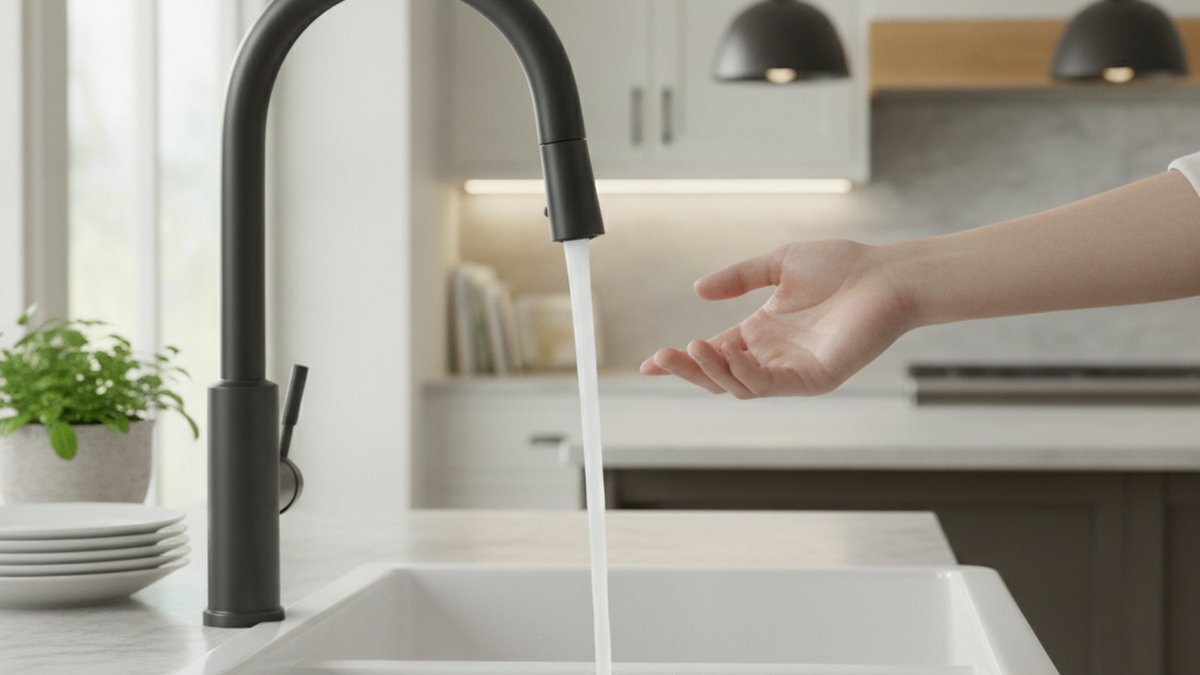
- Touchless / motion-sensor spouts that are also sprayers — same problem, plus the sensor adds bulk.
- Hidden or recessed aerators — some modern designer faucets tuck the aerator up inside a squared spout with no external lip. Nothing to clamp.
- Non-standard or proprietary aerator threads — rare, but a few European and luxury brands use odd sizes PUR’s adapters don’t match.
- Commercial-style pre-rinse coil faucets — the spray valve at the end is the wrong shape entirely.
If you’re still shopping and want a spout that filters easily and behaves well day to day, it’s worth reading through how to select kitchen faucet features that actually fit your sink and budget — spout shape and reach are exactly the specs that decide filter fit, and they’re easy to overlook when you’re focused on finish and looks.
Standard faucet vs. pull-down: which works with a PUR filter?
A fixed standard-spout faucet works with a clamp-on PUR filter; a pull-down or pull-out faucet does not. If filtering directly at the tap matters to you, that one fact should steer your whole faucet purchase. Here’s how the common styles stack up.
| Faucet style | Works with PUR faucet-mount filter? | Best PUR alternative | Notes |
|---|---|---|---|
| Standard fixed high-arc / gooseneck | Yes | Faucet-mount filter | Round tip, remove aerator, clamp on |
| Standard low-arc single spout | Yes | Faucet-mount filter | Ideal — plenty of clearance below |
| Pull-down spray head | No | Under-sink or pitcher | Spray head can’t hold a filter |
| Pull-out spray head | No | Under-sink or pitcher | Same limitation as pull-down |
| Touchless sprayer | No | Under-sink | Sensor + spray head both block it |
| Bridge / two-handle fixed spout | Usually yes | Faucet-mount filter | Check the tip is round and standard |
| Commercial pre-rinse coil | No | Under-sink | Wrong spout geometry entirely |
The takeaway: if you’re set on the convenience of a pull-down sprayer — and honestly most people love them once they have one — don’t try to force a faucet-mount filter onto it. Get the sprayer you want and pair it with a PUR under-sink unit or a PUR pitcher. You’ll get better flow, a cleaner look, and no dangling filter housing. If a pull-down is on your shortlist, our guide to the best pull-down kitchen taps buyers should actually buy covers the spout and hose details worth knowing.
How do I know my faucet’s spout tip is the right size and thread?
Check two things: whether the aerator threads are on the outside or inside of the spout, and roughly how wide the tip is. PUR faucet filters clamp externally, so what you really need is a plain round tip about 15/16″ to 1″ in diameter with the aerator removable. You do not need to perfectly identify the thread pitch — PUR’s included adapters do the matching for you.
Here’s a quick five-minute check you can do before ordering:
- Look at the tip. Is it a smooth, round metal nozzle, or a big plastic spray head? Round nozzle = good candidate. Spray head = stop, it won’t work.
- Unscrew the aerator. Twist the very end counterclockwise (a rubber glove gives grip). If a small screen assembly comes off and leaves a round threaded lip, you’re in business.
- Note male vs. female threads. “Male” threads are on the outside of the spout; “female” are recessed inside. PUR’s adapter kit handles the common versions of both — this is just good to know for a snug seal.
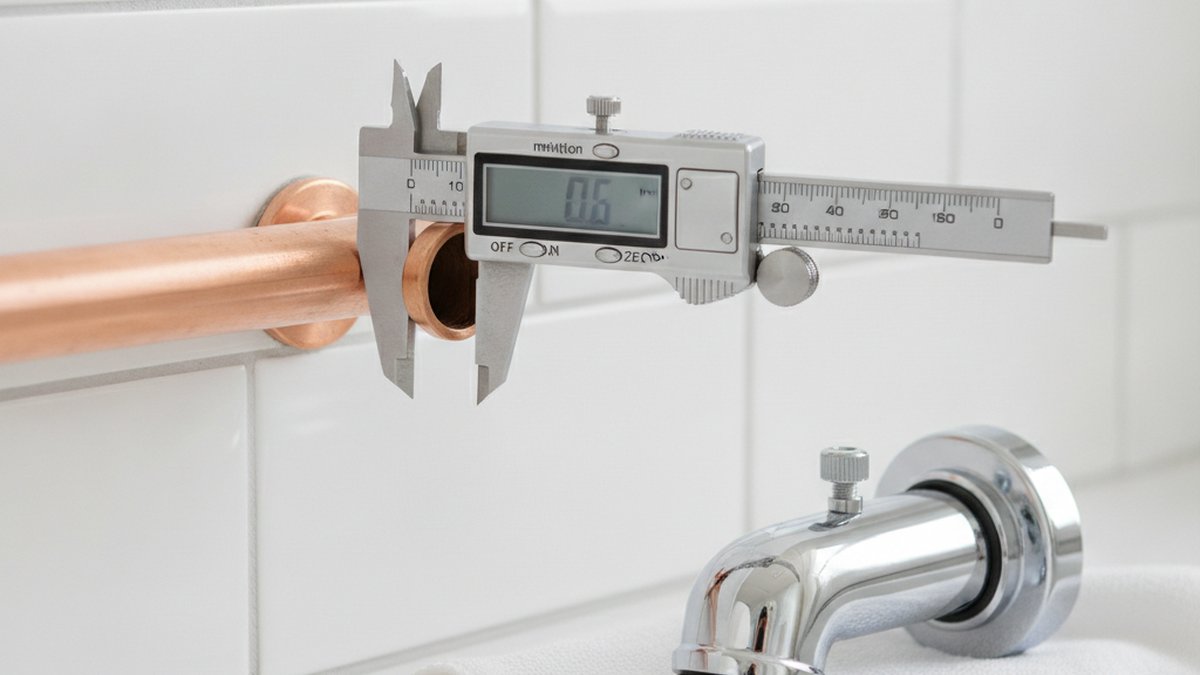
- Measure the diameter. Standard kitchen aerators are usually about 15/16″ (regular) or 55/64″ (junior). Both fall within PUR’s adapter range.
- Confirm there’s clearance below. The filter housing hangs a couple inches down. On a very low-arc faucet over a shallow sink, tall pots may not fit under it — a high-arc spout gives more room.
One related gotcha: your aerator does double duty as a flow regulator and a low-pressure culprit. If your water already runs weak, adding a filter can make it feel weaker, and a clogged aerator may be the real problem. It’s worth understanding why a faucet aerator causes low pressure and how to fix it fast before you blame the filter. Filtered water flows a bit slower by design — that’s the resistance of the media doing its job — so start with a clean aerator and healthy household pressure.
What if I want a sprayer AND filtered water at the same time?
Buy the pull-down or touchless faucet you actually want, then filter the water upstream with a PUR under-sink system or filter your drinking water separately with a PUR pitcher or dispenser. This gives you the best of both: full sprayer convenience at the tap, and clean filtered water on demand — without a bulky housing clamped to your beautiful new faucet.
There are three sensible ways to get filtered water when a faucet-mount filter won’t fit:
- PUR under-sink filter. Installs on your cold-water line inside the cabinet and feeds either your main faucet or a small dedicated drinking-water tap on the sink deck. Invisible, higher capacity, and works with any faucet style including sprayers. Best long-term value if you drink and cook with a lot of filtered water.
- Dedicated filtered-water faucet. A small second tap mounted in a spare sink hole (or a soap-dispenser hole) that dispenses only filtered water from an under-sink cartridge. Requires an extra deck hole — check your sink before committing.
- PUR pitcher or dispenser. Zero installation, works with literally any faucet, cheapest to start. Downsides are fridge space and refilling. Great for renters or anyone who doesn’t want to touch plumbing.
If you’re leaning under-sink and want to compare a competing faucet-mount approach, our breakdown of whether a Waterdrop faucet water filter is worth it covers the same clamp-on tradeoffs from a different brand’s angle — the compatibility rules are nearly identical, so it’s a useful cross-check.
Does adding a PUR filter affect my faucet’s water quality and safety?
Yes, in a good way — a certified PUR filter reduces contaminants like chlorine, lead, and certain pesticides while leaving your faucet’s water pressure only slightly reduced. But the filter only handles what flows through it; the metal your water sits inside matters too. If your faucet body or supply lines contain leaded brass, that’s a separate concern the filter partially addresses but doesn’t eliminate at the source.
PUR faucet filters are independently certified by NSF/ANSI standards (commonly 42 and 53) for reducing chlorine taste and odor plus health-related contaminants including lead. Always match the specific model to your water concern — not every cartridge targets every contaminant. And replace cartridges on schedule (PUR’s electronic indicator light helps): an expired filter can actually release trapped contaminants back into your water, which defeats the whole point.
Because your faucet is the last piece of metal your water touches, material genuinely matters for drinking water. If you’re buying a new faucet anyway, choosing a certified lead-free body is a smart baseline — here’s why a lead-free brass kitchen faucet is safer for your drinking water. Pairing a lead-free faucet with a PUR filter is genuinely the belt-and-suspenders approach for households with kids or older plumbing.
Quick buyer’s shortlist: matching your setup to the right filter
To keep it simple, here’s the decision in one glance: fixed spout means faucet-mount, sprayer means under-sink or pitcher.
- You have (or want) a standard fixed-spout faucet → PUR faucet-mount filter. Cheapest, five-minute install, no tools.
- You have (or want) a pull-down/pull-out/touchless sprayer → PUR under-sink system or PUR pitcher. Don’t fight the spray head.
- You rent or can’t do plumbing → PUR pitcher or dispenser. Works with anything.
- You cook and drink lots of filtered water → PUR under-sink with a dedicated tap. Best capacity and looks.
- You’re replacing the faucet anyway → pick a lead-free, fixed round-tip spout and keep filtering options wide open.
FAQ
Will a PUR filter fit a pull-down kitchen faucet?
No. PUR faucet-mount filters cannot attach to pull-down, pull-out, or handheld spray faucets because the spray head moves and there’s no fixed round tip to clamp onto. For a pull-down faucet, use a PUR under-sink system or a PUR pitcher instead — you’ll keep the sprayer you love and still get filtered water.
How do I attach a PUR filter to my kitchen faucet?
Unscrew and remove your faucet’s existing aerator from the spout tip, pick the PUR adapter that matches your spout, thread or clamp the filter housing on, and hand-tighten until snug with no drips. It takes about five minutes and needs no tools. If it leaks, back it off and try a different adapter ring from the included kit.
What size aerator thread do I need for a PUR faucet filter?
Most standard kitchen faucets use a regular (about 15/16″) or junior (about 55/64″) aerator, and PUR’s included adapter kit covers both plus common male and female threads. You don’t need to identify the exact thread pitch — just confirm your spout tip is round, standard-sized, and has a removable aerator, and the kit does the rest.
Does a PUR faucet filter reduce water pressure a lot?
It reduces flow slightly because water has to pass through the filter media, but on a healthy home water supply the drop is modest and most people barely notice it for filling glasses and pots. If your pressure was already weak, clean or replace your aerator first — a clogged aerator, not the filter, is often the real cause of a weak stream.
Can I use a PUR filter with a touchless or motion-sensor faucet?
Not if the touchless faucet is also a sprayer, which most are — the moving spray head and sensor housing leave nowhere to mount the filter. Pair a touchless faucet with a PUR under-sink filter instead, which filters the water before it ever reaches the faucet and works regardless of the spout style.
Is a faucet-mount filter or an under-sink PUR filter better?
A faucet-mount filter is cheaper and installs in minutes with no tools, making it great for standard faucets and renters; an under-sink filter costs more upfront but offers higher capacity, a cleaner look, and compatibility with any faucet including sprayers. Choose faucet-mount for a fixed-spout tap on a budget, and under-sink if you filter a lot of water or have a pull-down faucet.
Author note: This guide was written by the aleashafaucet product team, who spend their days testing faucet spouts, aerators, and filter fittings across dozens of brands. At aleashafaucet we design and sell lead-free, certified kitchen and bathroom fixtures, and we field compatibility questions like this one every week — so the advice here reflects real customer setups, not spec sheets alone. As always, confirm the current NSF certification and warranty terms on the specific PUR model and faucet you buy, since manufacturers update both over time.