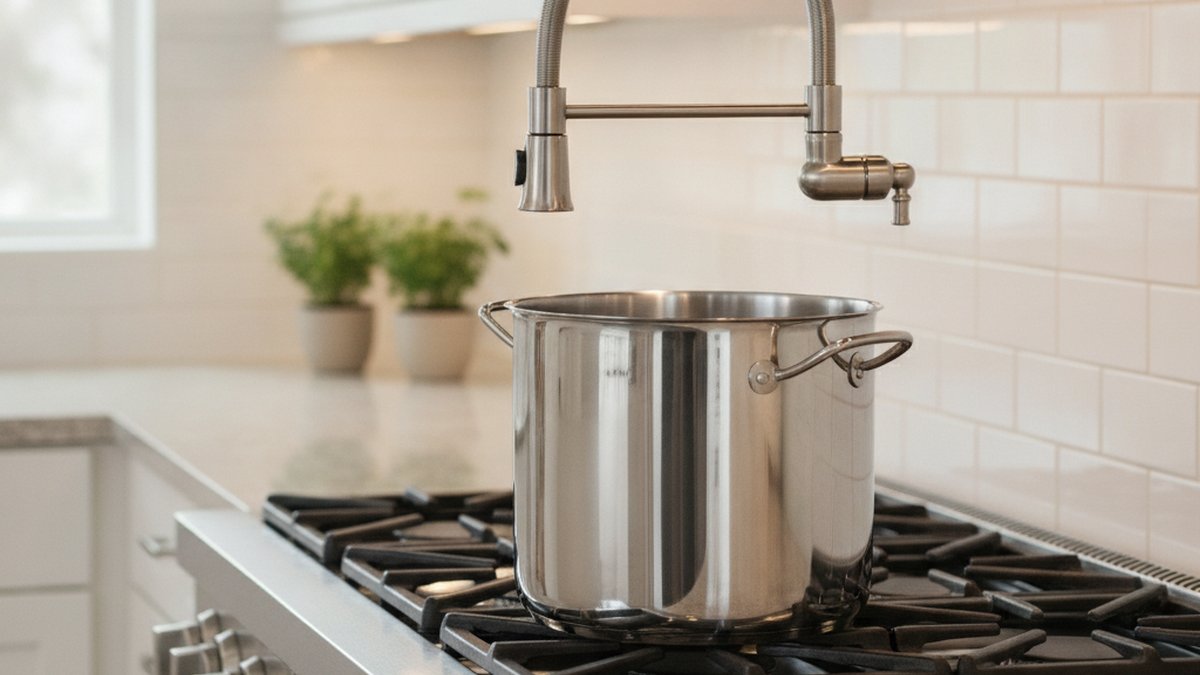
A pull out kitchen faucet Delta builds is a single- or dual-handle faucet whose spray head pulls straight out toward you on a hose — instead of arcing down like a pull-down — so you can drag the water right to a pot on the counter, rinse a cutting board in the sink, or fill a bucket on the floor. Delta is one of the two or three names people trust most for these, mainly because of three things that are genuinely theirs: MagnaTite docking (a magnet that yanks the wand back into the spout so it never sags), Touch2O touch-to-activate tech, and a lifetime limited warranty on the finish and function. This guide walks through which Delta pull out faucet is right for your sink, your water, and your budget — in plain terms, with real numbers.
What exactly is a “pull out” faucet, and how is it different from a pull-down?
A pull out faucet has a spray wand that slides horizontally out of the end of a lower, more compact spout; a pull-down has a tall gooseneck spout and the wand drops vertically down into the sink. That’s the whole difference, and it matters more than people expect. Pull outs sit lower, so they fit under low cabinets and over windowsills, and the horizontal pull makes it easier to reach a pot sitting on the countertop next to the sink. Pull-downs give you more clearance to wash tall stockpots directly in the basin and tend to look more dramatic.
If you cook a lot and fill big pots, or you have a shallow single-bowl sink, a pull out’s straight-out reach is a real daily convenience. If you have a deep double bowl and want a statement gooseneck, a pull-down usually wins. Delta makes excellent versions of both, and if you’re torn on spout style specifically, it’s worth reading our breakdown of the best pull down kitchen taps buyers should actually consider before you commit.
Quick comparison: pull out vs pull-down at a glance
| Factor | Pull Out Faucet | Pull-Down Faucet |
|---|---|---|
| Spout height | Lower (fits under cabinets/windows) | Tall gooseneck |
| Wand motion | Pulls straight out toward you | Drops down into the sink |
| Best for | Reaching counters, low clearance, small sinks | Deep basins, filling tall pots in-sink |
| Reach beyond sink | Excellent | Good |
| Typical Delta price | $150–$300 | $180–$400 |
| Common Delta models | Essa, Trask, Faryn | Leland, Cassidy, Trinsic |
Which Delta pull out kitchen faucet is best for most kitchens?
For most kitchens, the Delta Essa (touch or non-touch) and the Delta Trask are the two smartest picks. The Essa is the value workhorse: clean modern lines, MagnaTite docking, and a Touch2O option, usually $170–$280. The Trask is the transitional-style upgrade with a slightly nicer handle and finish selection, often $200–$330. Both use the same core Delta cartridge and hose hardware, so reliability is essentially identical — you’re mostly paying for looks.
Here’s the honest logic. Delta’s real advantage isn’t any single showpiece feature — it’s that the boring internals are excellent and the parts are everywhere. The DIAMOND Seal ceramic cartridge is rated for hundreds of thousands of on-off cycles, the InnoFlex supply lines are one continuous piece so there are fewer connections to leak, and if anything ever fails, Delta ships replacement parts free under the lifetime limited warranty. That’s why Delta lands on nearly every shortlist when we look at the most reliable kitchen faucet options and the best kitchen faucet companies to buy from.
Delta pull out faucet lineup compared
| Model | Style | Touch2O? | Spray Modes | Typical Price | Best For |
|---|---|---|---|---|---|
| Delta Essa | Modern | Optional | Stream / spray | $170–$280 | Best all-around value |
| Delta Trask | Transitional | Optional | Stream / spray / pause | $200–$330 | Nicer look, same guts |
| Delta Faryn | Transitional | No | Stream / spray | $150–$230 | Budget-friendly Costco/warehouse pick |
| Delta Leland (pull-down) | Traditional | Optional | Stream / spray / pause | $220–$360 | Classic gooseneck look |
Is Delta’s Touch2O worth the extra money, or is it a gimmick?
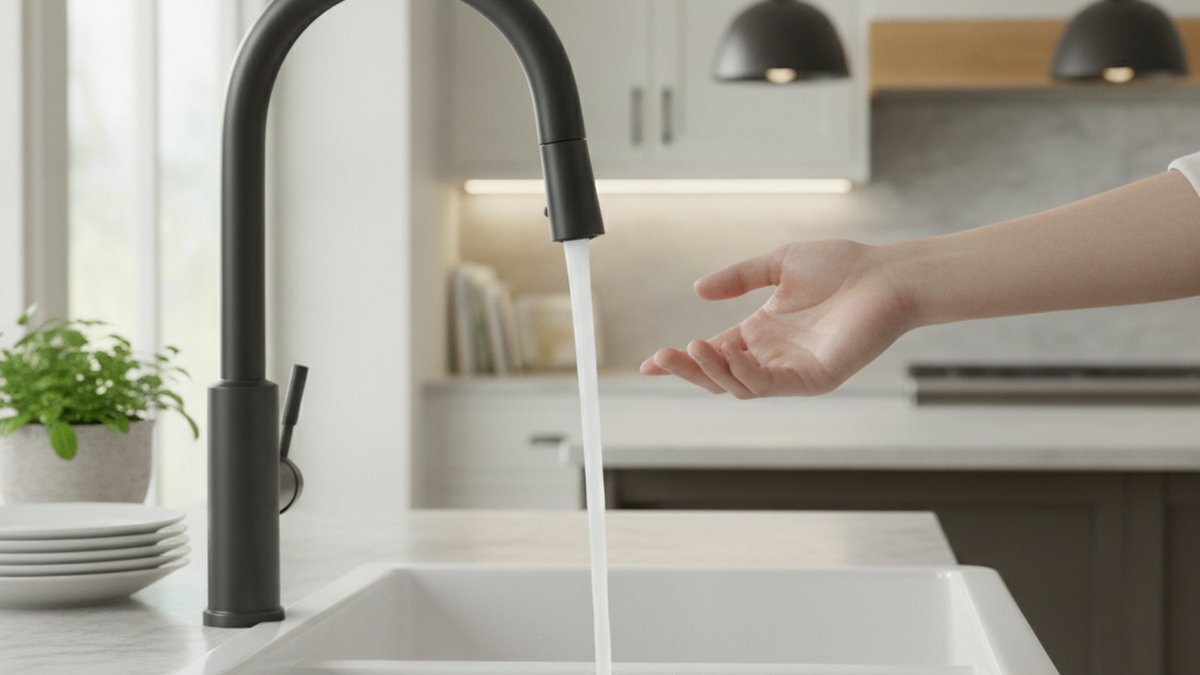
Touch2O is worth it if you cook with raw meat, have kids, or hate cleaning grimy handles — otherwise it’s a nice-to-have, not a must. The feature lets you tap anywhere on the spout or handle with a wrist or forearm to start and stop the water, so you never smear a filthy hand on the faucet. In practice, the people who love it are cooks and parents; the people who find it fussy are those who accidentally trigger it or dislike swapping the AA batteries (or wiring the optional AC adapter) every so often.
- Get Touch2O if: you handle raw chicken often, you have sticky-handed kids, or you have arthritis and appreciate hands-free on/off.
- Skip it if: you want the simplest possible faucet, you’re on a tight budget, or you don’t want to deal with batteries.
- Good to know: Touch2O has a manual handle too, so even if the electronics ever die, the faucet still works like a normal one. Battery life is typically 1–2 years on 6 AA cells.
One more real-world note: hard water is the silent killer of any kitchen faucet, touch or not. Mineral scale clogs the aerator and spray face and makes the wand spit. If your water is hard, plan to unscrew and soak the spray head in vinegar every few months regardless of which Delta you buy.
What size and how many holes do I need for a Delta pull out faucet?
Most Delta pull out faucets install in a single hole and fit a standard 1-3/8 inch (about 35 mm) sink opening, and they include an optional escutcheon (base plate) to cover a 3-hole configuration if that’s what your sink or countertop has. So the short answer: measure your existing holes, and a single Delta pull out will almost always adapt to either a 1-hole or 3-hole setup.
Before you buy, check three measurements so you don’t get surprised at install time:
- Number of holes in your sink/countertop (1, 2, 3, or 4). Delta includes a base plate to hide extra holes.
- Deck thickness — most Delta mounting hardware handles up to about 2-1/2 inches of counter + sink deck.
- Under-sink clearance and shutoff valves — you’ll connect to standard 3/8 inch supply lines. If your valves are old, replace them while you’re under there.
Installation is genuinely DIY-friendly on modern Delta faucets thanks to the pre-attached InnoFlex lines and a tool-free-ish mounting nut, but you’ll still want a basin wrench. If you’ve never done it, our step-by-step on how to install kitchen taps and mixers yourself covers the whole process, and how to select kitchen faucet features that fit your sink and budget helps you match spout reach to your basin before you order.
How much should I spend on a Delta pull out faucet in 2026?
Plan on $150–$250 for a solid non-touch Delta pull out and $220–$350 if you add Touch2O or a premium finish like Champagne Bronze or Matte Black. Spending more than about $350 on a pull out usually just buys you a designer finish or a fancier handle, not better internals — the cartridge and hose are shared across the range.
Where the money actually matters:
- Finish: SpotShield Stainless and Arctic Stainless hide water spots and fingerprints; Matte Black and Champagne Bronze cost a bit more and show scale in hard-water areas faster.
- Touch tech: Touch2O adds roughly $40–$70 over the same model without it.
- Spray head quality: higher models get a metal spray face and smoother mode toggle; budget models use more plastic but still function fine.
Don’t overpay for “commercial-style” springs on a pull out — that coil-spring look is a pull-down thing. On a pull out, your money is best spent on getting the Touch2O feature (if you want it) and a spot-resistant finish.
Does Delta make a matching bar faucet or other fixtures?
Yes — Delta designs full suites so your prep sink, bar sink, and main faucet match. If you’re doing an island prep station or a wet bar, Delta offers a scaled-down bar/prep faucet in the same design families (Trinsic, Leland, Essa styling), so the finishes line up perfectly. We cover this in detail in our guide to the best bar faucet Delta makes, which is worth a look if you’re outfitting more than one sink.
Matching matters more than people think. Mixing a warm Champagne Bronze main faucet with a cooler brushed-nickel bar faucet reads as a mistake even to guests who can’t name why. Buy your main and secondary faucets in the same finish family from the same brand and the kitchen looks intentional.
How do I keep a Delta pull out faucet working like new?
The two maintenance jobs that matter most are cleaning the aerator/spray face and, eventually, swapping the ceramic cartridge — both are 15-minute jobs with basic tools. A Delta cartridge can last a decade or more, but hard water and grit will eventually cause drips or stiff handles, and that’s a replacement, not a whole new faucet.
- Monthly-ish: unscrew the spray head aerator and rinse out grit; soak in white vinegar if flow is weak or uneven.
- If the wand won’t dock: check the MagnaTite magnet and the little weight on the hose under the sink — it can slip out of position.
- If it drips: that’s almost always the cartridge or an O-ring, not the faucet body. Our walkthrough on how to replace a kitchen tap cartridge yourself applies directly to Delta and saves a plumber’s visit.
- Finish care: wipe with a soft damp cloth only — no abrasive pads or acidic cleaners, which void the finish warranty.
Because Delta’s warranty is a lifetime limited warranty covering both function and finish for the original homeowner, replacement cartridges, O-rings, and even spray heads are typically free — you just contact Delta with your model number. Keep the little spec card that comes in the box; it has the exact part numbers.
Delta pull out vs other brands — how does it really stack up?
Against Moen and Kohler, Delta’s edge is MagnaTite docking (the strongest magnetic dock in the category) and free lifetime parts; Moen counters with the excellent Reflex system and Kohler with premium finishes. For a pull out specifically, Delta and Moen are the two I’d shortlist first, with Delta usually a little cheaper for the same feature set.
| Brand | Signature Tech | Docking | Warranty | Price Feel |
|---|---|---|---|---|
| Delta | Touch2O + DIAMOND Seal | MagnaTite (magnetic) | Lifetime limited, free parts | Great value |
| Moen | MotionSense + Power Clean | Reflex (magnetic) | Lifetime limited | Comparable |
| Kohler | Response touchless | Docking collar | Lifetime limited | Pricier finishes |
If drinking-water safety is on your mind, note that Delta’s kitchen faucets are certified to NSF/ANSI 61 and 372 for lead-free waterways — the same lead-free standard we explain in our piece on the lead free brass kitchen faucet question. It’s a real safety spec, not marketing, and every reputable Delta pull out kitchen faucet meets it.
FAQ
Are Delta pull out kitchen faucets easy to install yourself?
Yes. Modern Delta pull out faucets come with pre-attached InnoFlex supply lines and a simple mounting nut, so most people finish in 30–60 minutes with a basin wrench and an adjustable wrench. The trickiest part is working in the tight space under the sink, not the faucet itself. Turn off the shutoff valves first, and replace old valves while you’re down there.
How long do Delta pull out faucets last?
With basic care, a Delta pull out faucet commonly lasts 10–20 years. The DIAMOND Seal ceramic cartridge is the wear part and is rated for hundreds of thousands of cycles; when it eventually drips or stiffens, you replace just the cartridge — a cheap, quick fix that Delta usually covers free under warranty rather than needing a whole new faucet.
What’s the difference between Delta Essa and Delta Trask?
They share the same internal cartridge, hose, MagnaTite dock, and optional Touch2O — so reliability is identical. The difference is styling: the Essa is sleek and modern and cheaper, while the Trask has a transitional look with a slightly more refined handle and a broader finish selection. Pick by looks and budget, not by function.
Do Delta pull out faucets work with a water filter?
Delta pull out faucets themselves don’t have a built-in filter, but you can add an under-sink filter that feeds the faucet, or use a separate filtered-water tap. Screw-on faucet-mount filters generally don’t fit spray wands, so under-sink or dedicated-tap filtration is the right route for a pull out. Confirm your setup has room under the cabinet before buying a filter system.
Why won’t my Delta spray wand stay docked?
Nine times out of ten it’s the hose weight or the MagnaTite magnet. Check that the small counterweight clamped to the hose under the sink hasn’t slipped — it should sit a few inches below the faucet body so the wand retracts fully. Also make sure no debris is stuck to the magnetic dock inside the spout. Both are quick, tool-free fixes.
Is Touch2O safe and reliable, or will it break?
Touch2O is reliable and safe — it runs on low-voltage battery power (or an optional AC adapter), so there’s no shock risk, and it has a manual handle backup if the electronics ever fail. Batteries typically last 1–2 years. The most common complaint isn’t breakage but accidental activation, which the sensitivity is designed to minimize by ignoring a resting hand.
The bottom line
Buy the Delta Essa if you want the best value, the Trask if you want a more upscale look, and add Touch2O if you cook with raw meat or have kids. Match the finish across any secondary faucets, measure your holes and clearance before ordering, and keep the spec card for warranty parts. Do that, and a Delta pull out kitchen faucet will quietly do its job for 15 years without drama.
Author note: This guide was written by the aleashafaucet product team, who spec, install, and pressure-test kitchen and bath fixtures year-round. At aleashafaucet we’ve fitted hundreds of pull out and pull-down faucets across real kitchens, and our recommendations are based on hands-on install experience, cartridge cycle-life data, and NSF/ANSI 61/372 lead-free certification standards — not just spec sheets. Faucets carrying a lifetime limited warranty, like Delta’s, are the ones we stand behind for everyday use.