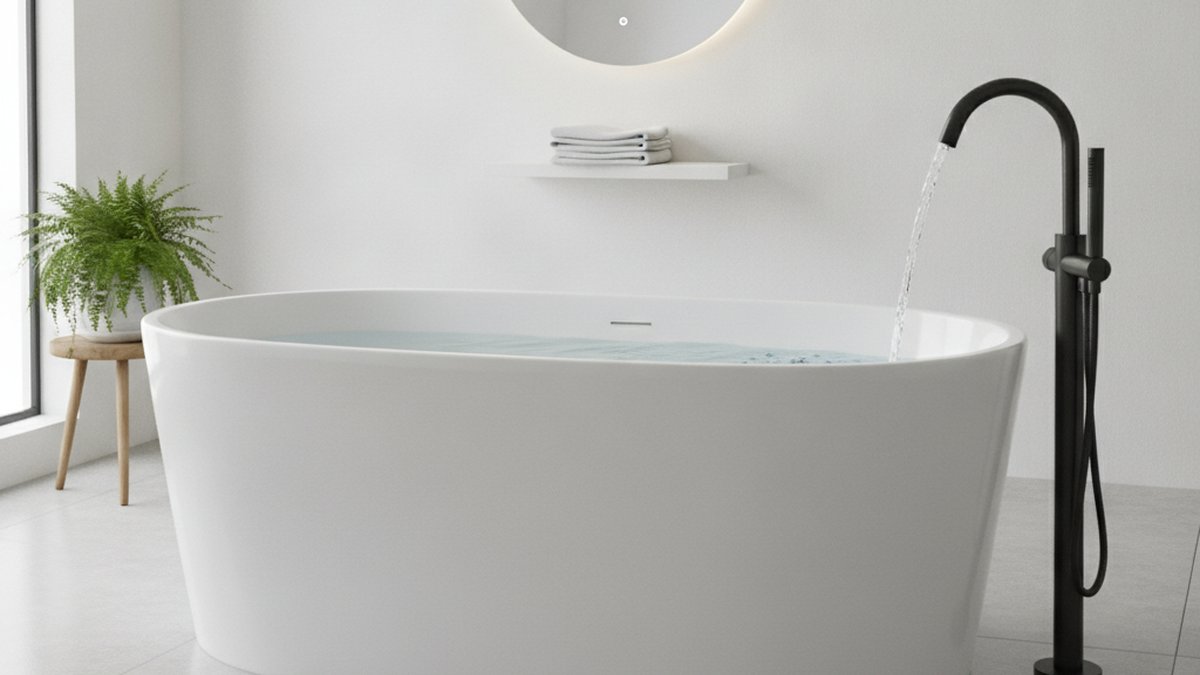
If you’re staring at a whirlpool tub and wondering whether a matte black jacuzzi tub faucet is the smart pick — or just a trendy one you’ll regret — the short answer is that it’s an excellent choice, as long as you match the faucet to how a jacuzzi-style tub actually works. A deep soaking or whirlpool tub holds 60 to 90+ gallons, so it needs a high-flow filler, not a standard bathroom faucet. And matte black, when it’s done right (PVD or baked powder coat over brass), is one of the most durable and forgiving finishes you can put in a wet, hard-water bathroom. Below, I’ll walk you through the flow-rate math, the mounting types, the finish quality that actually lasts, and how to pick the right one without overpaying.
What exactly is a “jacuzzi tub faucet,” and how is it different from a normal tub faucet?
A jacuzzi tub faucet is simply a filler designed for a large-volume whirlpool, air, or deep soaking tub — the key difference is flow rate and reach, not the jets. “Jacuzzi” is a brand name that became shorthand for any jetted or oversized tub, so when people search for a jacuzzi tub faucet, they almost always mean a high-flow tub filler that can move a lot of water fast, plus a handheld sprayer for rinsing and cleaning.
A standard bathroom sink faucet in the U.S. is capped at 1.2–1.5 GPM (gallons per minute) by federal water-efficiency rules. Tub fillers are exempt from that cap because a tub is meant to be filled, not run continuously — so a good jacuzzi filler moves 5 to 8+ GPM. Do the math: an 80-gallon whirlpool tub filled at 1.5 GPM takes over 50 minutes; at 6 GPM it fills in about 13. That single spec is the difference between a tub you enjoy and a tub you avoid.
If you’re still nailing down the exact name of the fixture you’re replacing — freestanding filler vs. deck-mount vs. wall-mount — our guide to the right bathtub faucet name for the fixture you’re trying to buy is the fastest way to make sure you order the correct type the first time.
Why do people choose matte black for a jacuzzi tub filler?
People choose matte black because it hides water spots and fingerprints better than any other finish, pairs with almost any tile or vanity color, and — when it’s a real PVD or powder-coat finish — resists corrosion in a steamy, wet environment. Matte black is the single most forgiving finish for a high-use fixture that gets splashed constantly.
Here’s the practical reality that photos don’t show you: chrome and polished nickel show every dried water droplet and every smudge, which means you’re wiping a jacuzzi filler daily to keep it looking clean. Matte black’s low-sheen surface visually absorbs those spots. In a hard-water home, that’s a genuine quality-of-life upgrade. Matte black also reads as intentional and high-end next to white acrylic tubs, black-framed shower glass, and both warm-wood and cool-gray bathrooms — it’s close to a universal match.
The catch is finish quality. “Matte black” covers everything from a $600 solid-brass floor filler with a bonded PVD coating to a $70 sprayed-zinc filler that will chip at the spout tip within a season. The color looks identical online; the durability is night and day. I’ll show you how to tell them apart in the buying section.
What flow rate and specs should a matte black jacuzzi tub faucet actually have?
Aim for at least 5–7 GPM of flow, a solid-brass waterway, a ceramic-disc valve or pressure-balanced cartridge, and a deck-to-spout reach that clears your tub rim by a comfortable margin. Those four specs separate a filler that performs from one that just looks good in the box.
- Flow rate: 5–8 GPM for a whirlpool or deep soaker. Below 4 GPM, a big tub fills too slowly and the water cools before it’s full.
- Body material: solid brass. It resists corrosion, holds a finish better, and won’t crack under thermal cycling the way zinc alloy can.
- Valve/cartridge: ceramic-disc cartridges are the standard for drip-free, long-life performance. This is also the part you’ll replace someday, so buy a brand with available parts.
- Reach & height: a floor-mount filler should stand tall enough (typically 40–46″) to arc water into the tub center; a deck-mount needs enough spout reach to clear the rolled rim.
- Handheld sprayer: almost essential for a jacuzzi tub — you’ll use it to rinse hair, clean the jets, and fill without splashing.
Deck-mount, floor-mount, or wall-mount — which matte black jacuzzi filler fits my tub?
Match the mount to your tub: use a deck-mount filler if your whirlpool tub has a wide flat rim with pre-drilled holes, a floor-mount (freestanding) filler if the tub sits away from the wall with no deck, and a wall-mount filler if your plumbing already comes out of the wall behind the tub. Getting this wrong is the #1 return reason for tub fillers.
| Mount type | Best for | Rough price (matte black, brass) | Install difficulty |
|---|---|---|---|
| Deck-mount (roman) | Drop-in / whirlpool tubs with a wide rim and pre-drilled holes | $150–$400 | Moderate — access panel needed |
| Floor-mount (freestanding) | Freestanding soaking/whirlpool tubs with floor plumbing | $300–$700 | Hard — rough-in must be set precisely |
| Wall-mount | Alcove or built-in tubs with existing wall supply | $120–$350 | Moderate — behind-wall access helps |
Before you buy, count and measure your existing holes. Whirlpool tubs are usually pre-drilled for a specific configuration — a spout, two handles, and a hand sprayer (a 4-hole roman set) or a single-handle deck set. If you’re swapping out an old filler and the valve behind it is leaking, our walkthrough on how to replace a bathtub faucet valve yourself covers the behind-the-scenes part most product pages skip.
How much should I spend on a matte black jacuzzi tub faucet?
Budget $150–$400 for a quality deck-mount matte black filler and $300–$700 for a freestanding floor-mount one — that range gets you solid brass, a real PVD/powder finish, and replaceable ceramic cartridges. Spending under about $120 on a jacuzzi filler usually means zinc internals and a sprayed finish that won’t survive daily use.
Where the money actually goes: the body material (brass costs more than zinc), the finish process (bonded PVD lasts far longer than spray paint or basic electroplate), and the cartridge quality (a good ceramic disc valve stays drip-free for years). You don’t need to buy the most expensive option — a mid-range solid-brass filler with a PVD matte black finish outperforms a “designer” model that’s really just marketing markup. What you want to avoid is the bargain tier, because a jacuzzi filler moves a lot of water under pressure, and cheap valves fail early.
One more cost note: matte black shows chips more visibly than it shows water spots. If the finish is genuinely bonded to brass, chipping is rare; if it’s sprayed onto zinc, an impact at the spout tip exposes bright metal underneath. That’s the whole argument for spending in the mid-range instead of the bottom.
How do I clean and maintain matte black so it doesn’t fade or streak?
Clean matte black with a soft damp cloth and mild dish soap, dry it, and skip anything abrasive or acidic — no bleach, no vinegar-soaking, no scouring pads. Matte black’s durability comes from an intact finish layer, so gentle cleaning is the entire maintenance strategy.
The most common way people ruin a black finish is reaching for harsh chemicals, assuming “black hides everything.” It hides water spots, yes — but bleach and strong acids can dull or discolor the coating over time, especially on lower-quality finishes. The same caution applies across finishes: our piece on whether it’s safe to use bleach on a faucet finish explains why harsh cleaners and fixture coatings don’t mix. For hard-water buildup around the spout, a cloth dampened with a 50/50 water-and-white-vinegar mix used briefly and then rinsed and dried is usually safe, but never let acidic cleaners sit on the finish.
- Wipe daily or after use with a damp microfiber cloth.
- For soap scum, use mild dish soap, then rinse and dry.
- Never use abrasive powders, steel wool, or magic-eraser pads — they micro-scratch the matte surface and create shiny spots.
- Address hard-water spots quickly so minerals don’t etch in.
Does matte black go out of style, or is it a safe long-term choice?
Matte black has moved from “trend” to “neutral” — it’s now a lasting design staple the way chrome and brushed nickel are, so it’s a safe long-term choice for a fixture you’ll keep for a decade. Unlike a bold color that dates quickly, matte black behaves like a neutral and pairs with almost any future remodel.
If you’re coordinating a whole bathroom around it, matte black also mixes well with modern shower systems and fixtures. If you’re building a cohesive contemporary look, our guide to what makes a shower faucet modern pairs naturally with a matte black tub filler for a consistent, current bathroom that won’t feel dated in a few years. The safest strategy: keep your fixtures in one finish family (all matte black, or matte black plus one intentional accent) rather than mixing three finishes that fight each other.
Matte black vs. other popular jacuzzi filler finishes
Here’s an honest side-by-side of matte black against the finishes most people cross-shop for a jacuzzi tub filler.
| Finish | Hides water spots? | Durability | Best for |
|---|---|---|---|
| Matte black (PVD/powder) | Excellent | High — resists corrosion & smudges | Modern, high-use, hard-water homes |
| Chrome | Poor — shows every drop | High, but needs frequent wiping | Classic, budget-friendly builds |
| Brushed nickel | Good | High | Warm transitional bathrooms |
| Brushed/champagne gold | Good | High (PVD) | Warm, luxe statement looks |
| Polished nickel | Fair | High | Upscale traditional spaces |
The takeaway: chrome is the cheapest but the most maintenance-hungry, brushed finishes are the easy middle ground, and matte black wins for hiding daily mess in a fixture that gets splashed constantly — provided you buy a real bonded finish over brass.
Can I install a matte black jacuzzi tub faucet myself?
Yes, many homeowners can install a deck-mount or wall-mount matte black filler in a few hours with basic tools, but a floor-mount freestanding filler is best left to a plumber unless your rough-in plumbing is already set exactly to spec. The difficulty depends almost entirely on the mount type and whether the supply lines are already where they need to be.
Deck-mount fillers on a whirlpool tub usually need access to the underside of the tub deck (through an access panel) to connect supply lines and tighten mounting nuts. Wall-mount installs are similar to replacing existing tub/shower valves. If you’re comfortable with that kind of work, our step-by-step on how to replace a shower tub faucet yourself without calling a plumber covers the same fundamentals — shutting off water, handling supply connections, and testing for leaks — that apply here. Floor-mount fillers are different: the water lines come up through the floor at an exact location, so if the rough-in isn’t already correct, you’re into subfloor work that’s worth a pro.
FAQ
What flow rate do I need for a jacuzzi or whirlpool tub filler?
Aim for 5–8 GPM. A deep whirlpool tub holds 60–90+ gallons, and at a standard 1.5 GPM it would take nearly an hour to fill and the water would cool before it’s ready. A 6 GPM filler fills an 80-gallon tub in roughly 13 minutes.
Does a matte black tub faucet chip or fade easily?
A quality PVD or baked powder-coat matte black finish over a solid-brass body resists chipping and fading for years. Cheap sprayed finishes over zinc alloy chip at high-contact points like the spout tip within a season or two, which is why the body material and finish process matter more than the color itself.
How do I clean a matte black faucet without ruining it?
Use a soft damp microfiber cloth with mild dish soap, then rinse and dry. Avoid bleach, undiluted vinegar left to soak, abrasive powders, and scrubbing pads — those either discolor the finish or create shiny scratches on the matte surface.
Do matte black fixtures match a stainless steel or chrome shower already in the bathroom?
They can, if you treat matte black as an intentional accent rather than an accident. For the cleanest look, keep the tub filler and shower trim in the same finish. If you’re mixing, limit yourself to two finishes and repeat each one at least twice so it reads as a design choice.
Is a matte black jacuzzi tub faucet worth the extra cost over chrome?
For most people, yes. You pay a modest premium, but you get a finish that hides water spots and fingerprints, resists corrosion in a wet environment, and coordinates with almost any bathroom style — which means far less daily wiping and a look that stays current for years.
What’s the difference between a deck-mount and freestanding matte black filler?
A deck-mount filler installs into holes on the flat rim of a drop-in or whirlpool tub, while a freestanding (floor-mount) filler stands on the floor next to a tub that sits away from the wall. Deck-mount is easier to install; freestanding usually requires plumbing roughed into the floor at an exact spot.
About the author & brand: This guide was written by the product team at aleashafaucet, a specialty retailer focused exclusively on faucets, tub fillers, shower systems, and bathroom fixtures. Our recommendations are based on hands-on evaluation of finish durability, cartridge longevity, and real-world flow performance. We prioritize fixtures built with solid-brass bodies, ceramic-disc cartridges, and PVD or powder-coat finishes, and we look for products that meet recognized U.S. plumbing standards (such as ASME/ANSI and NSF/ANSI 61 for drinking-water safety where applicable) and are backed by a manufacturer’s warranty — many quality tub fillers carry limited lifetime finish and function warranties. Always confirm the specific certifications and warranty terms on the product page before you buy.