If you searched for a garden hose faucet diagram, you’re almost certainly standing next to a dripping, stuck, or leaking outdoor spigot and trying to figure out which piece to replace — or you’re about to buy a new one and want to know what all those parts are called before you spend money. Good news: an outdoor hose faucet has maybe eight parts total, and once you can name them, both fixing and buying get simple. This guide walks through the full diagram part by part, in plain English, so you know exactly what you’re looking at and what to do next.
At aleashafaucet, we sell and test faucets and fixtures every day, and the single most common reason people buy the wrong replacement part is that they don’t know the vocabulary. So we’ll fix that first, then get you to the right purchase.
What Are the Parts on a Garden Hose Faucet Diagram, From Handle to Hose Thread?
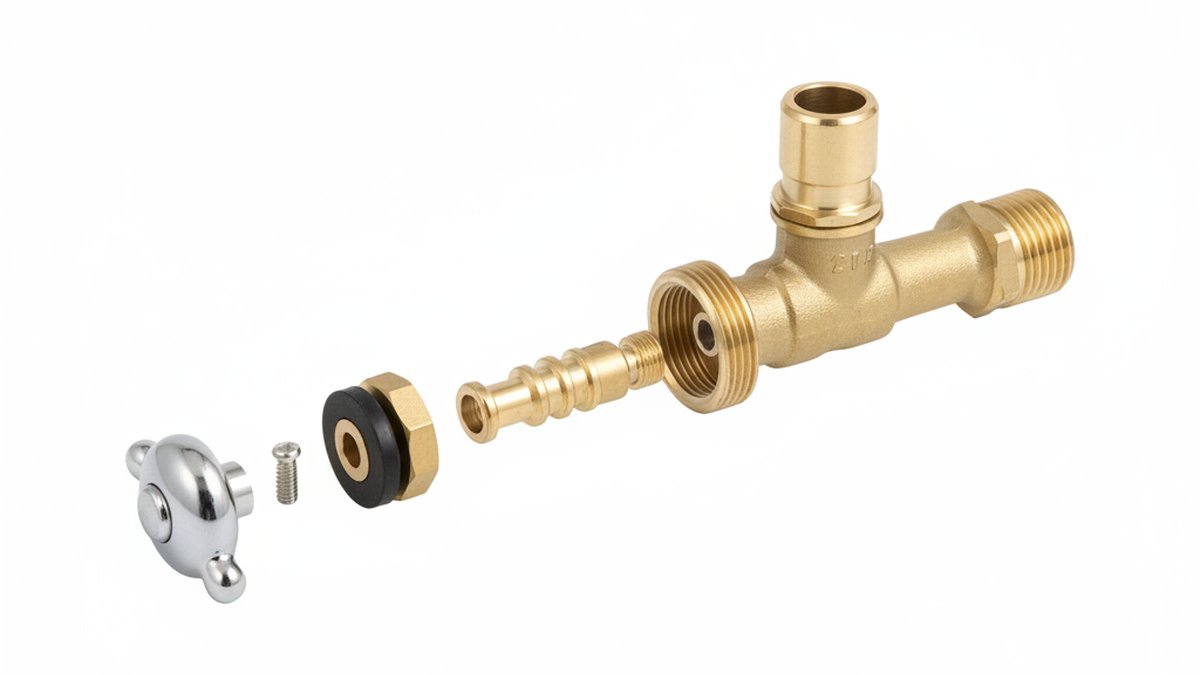
A standard garden hose faucet diagram labels these parts, in order from the outside in. Learn these eight names and you can talk to any hardware store or read any repair guide.
- Handle — the round or wheel-shaped knob you turn. Held on by a single screw.
- Handle screw / bonnet screw — the small screw at the center of the handle. Remove this first for almost any repair.
- Packing nut (bonnet nut) — the large hex nut behind the handle. If water leaks from around the handle when the faucet is ON, this nut or the packing behind it is the culprit.
- Valve stem — the long threaded shaft that moves in and out when you turn the handle. It carries the washer down onto the seat.
- Packing / packing washer — the seal wrapped around the stem that stops water from escaping past the handle.
- Bibb washer (stem washer) + stem screw — the small rubber washer on the very end of the stem, held by a brass screw. This is the part that wears out and causes the classic drip from the spout.
- Valve seat — the machined ring inside the body that the washer presses against to shut off flow. If it’s pitted or corroded, a new washer alone won’t stop the leak.
- Spout + hose threads (GHT) — the outlet where the water comes out, ending in male garden-hose threads (3/4″ – 11.5 NH). Many modern spigots also have a small vacuum breaker / anti-siphon cap on top to stop dirty hose water from being sucked back into your drinking supply.
That’s the whole faucet. Every garden hose faucet diagram you’ll find online is just a version of this list, drawn as an “exploded view” so you can see the order the parts stack in.
Which Type of Garden Hose Faucet Do I Have — Compression, Frost-Free, or Ball?
You almost certainly have one of three types, and the diagram changes slightly for each. Figuring out which you own tells you which repair kit to buy and, if you’re replacing the whole thing, which body style to order.
| Type | How to spot it | Best for | Repair note |
|---|---|---|---|
| Compression hose bibb | Short body, single handle, common on older homes and in mild climates | Warm regions, sheds, utility use | Cheapest to fix — usually just a bibb washer |
| Frost-free (freeze-proof) sillcock | Long body (6″–12″) that runs through the wall; handle sits far from the shut-off | Cold climates where pipes can freeze | The washer/seat sit deep inside; you pull the whole long stem out to service it |
| Ball / lever-valve hose faucet | Quarter-turn lever instead of a round knob | Quick on/off, easy to operate with gloves | Uses a ball or cartridge, not a washer |
The quickest test: if your handle is a round wheel and lives right at the wall, it’s a compression bibb. If there’s a long tube disappearing into the wall and the handle is 6–12 inches out, it’s frost-free. If it’s a straight lever you flip 90 degrees, it’s a ball-style valve. The garden hose faucet diagram for a frost-free model looks stretched out because the working parts are at the far, indoor end of a long stem — that’s by design, so the water shuts off inside the heated wall where it can’t freeze.
My Garden Hose Faucet Is Dripping From the Spout — Which Part Do I Replace?
A drip from the spout (the opening) when the faucet is fully off almost always means a worn bibb washer — the little rubber disc on the end of the stem. Replace that first; it’s a 15-minute, under-$5 fix. If a new washer doesn’t stop it, the valve seat is damaged and needs to be re-ground or replaced.
Here’s the order of operations, matching the parts on the diagram:
- Shut off the water to that faucet (or the whole house if there’s no dedicated valve) and open the spigot to relieve pressure.
- Remove the handle screw, then pull off the handle.
- Loosen the packing nut with a wrench and back the valve stem all the way out.
- Inspect the bibb washer at the tip. If it’s cracked, flattened, or grooved, unscrew the brass stem screw and swap in an identical washer.
- Feel the valve seat inside the body with a fingertip. Smooth = good. Gritty or pitted = it’s leaking there, and you’ll want to reface or replace the seat.
That corroded, stuck seat is its own headache. If yours won’t come loose or the edges are chewed up, we walk through the exact tools and technique in our guide on how to remove an old tap seat that’s stuck, corroded, or stripped — the method is identical for an outdoor bibb. And if the drip is actually coming from the valve area rather than the spout, the diagnosis is the same family of problem covered in why a faucet drips from the valve and how to fix it yourself.
Water Is Leaking Around the Handle, Not the Spout — What’s Wrong?
If water squirts or seeps from around the handle only when the faucet is running, the packing nut is loose or the packing washer behind it has failed. This is a different fix from a dripping spout, and the diagram makes the difference obvious: spout drips = washer/seat at the far end; handle leaks = packing at the near end.
Try the easy fix first: with the faucet off, snug the packing nut a quarter-turn clockwise with a wrench. Often that alone reseals it. If it still weeps, pull the stem and replace the packing washer (or wrap fresh graphite/PTFE packing string around the stem). Don’t over-tighten — if the handle gets hard to turn, you’ve gone too far.
This “leak point tells you the culprit” logic is the same one we use on indoor fixtures too. The same way a laundry faucet cap seals a utility faucet’s outlet, the packing on your hose bibb seals the stem — a small, cheap part doing an outsized job.
How Do I Know Which Replacement Faucet or Hose Fitting to Buy?
Buy by matching three things: the faucet type (compression vs. frost-free vs. ball), the connection to your plumbing (usually 1/2″ or 3/4″ MIP/FIP or sweat-solder), and the hose-thread size on the spout. For virtually every U.S. residential garden hose, that spout thread is GHT — 3/4 inch, 11.5 threads per inch (3/4″-11.5 NH). Get those three right and the new faucet drops in.
Here’s a quick buyer’s checklist so you don’t make a second trip:
- Climate: Cold winters → choose a frost-free sillcock sized to your wall thickness (measure from the outside wall to the indoor pipe). Mild climate → a standard compression bibb is fine.
- Material: Solid brass body lasts longest and resists corrosion; avoid thin pot-metal bodies. A quality brass build matters here for the same durability reasons it does on the indoor fixtures we cover in the best brass faucet for a bar and grill.
- Anti-siphon: Most codes now require a built-in vacuum breaker. Buy one that already has it rather than adding a screw-on cap later.
- Handle style: Lever (ball) valves are easier to operate with wet or gloved hands; round wheels are cheaper and simpler to rebuild.
- Hose thread: Confirm 3/4″-11.5 GHT so your existing hoses, splitters, and timers fit without an adapter.
Do I Actually Need to Understand the Diagram, or Should I Just Replace the Whole Faucet?
Understand the diagram first — it saves you money nine times out of ten. Most outdoor faucet problems are a $3 washer or a quarter-turn on the packing nut, not a full replacement. Replace the entire faucet only when the body is cracked (common after a hard freeze), the threads are stripped, or the valve seat is destroyed and non-replaceable.
A good rule: if the fix is washer, packing, or seat — repair it. If the fix is the cast body itself — replace it. A frozen-and-split frost-free sillcock is the classic “replace, don’t repair” case, because the crack is usually hidden inside the wall and will keep leaking behind your siding.
How This Compares to Fixing an Indoor Faucet
An outdoor hose bibb is essentially a simplified indoor compression faucet: one handle, one stem, one washer, one seat. There’s no aerator, no cartridge mixing hot and cold, no pull-down sprayer. That simplicity is why it’s such a beginner-friendly repair. If you can rebuild a hose bibb, you’re well on your way to handling indoor jobs. The main extra variable indoors is flow-restricting hardware — if you ever chase a pressure problem inside, that’s a different diagnosis entirely, which we cover in why a faucet aerator causes low pressure and how to fix it fast.
Author Note & Why You Can Trust This Guide
This guide was written by the aleashafaucet product team, who spend their days sourcing, bench-testing, and pressure-cycling faucets and valves — indoor and outdoor. We test washers and seats for wear under repeated on/off cycles and check hose-thread fitment against the ASME/ANSI standard for garden hose threads before we recommend a part. Every faucet we sell is backed by a manufacturer warranty, and we only stock hose bibbs and sillcocks with lead-free brass bodies that meet U.S. drinking-water safety standards (NSF/ANSI 61 & 372). When we tell you a solid-brass, anti-siphon frost-free model is worth the extra few dollars, it’s because we’ve watched the cheap ones fail in freeze testing.
FAQ
What is a garden hose faucet actually called?
It has several names for the same fixture: hose bibb (or bib), spigot, sillcock (specifically the long frost-free version), or outdoor faucet. On a diagram you’ll usually see “hose bibb.” They all describe the same thing: a valve with garden-hose threads on the outlet.
What size are garden hose faucet threads?
Standard U.S. residential garden hose thread is GHT: 3/4 inch nominal, 11.5 threads per inch (3/4″-11.5 NH). That’s the male thread on the spout your hose screws onto. Note this is different from pipe thread (NPT) — never force a hose fitting onto a pipe thread, as the thread angle and pitch don’t match.
Why does my garden hose faucet drip only when the hose is disconnected?
That’s the internal valve leaking past a worn bibb washer or damaged seat — the hose was masking it by holding back-pressure. Follow the spout-drip repair above: replace the washer first, then check the seat.
Can I fix a frost-free hose faucet the same way as a regular one?
Mostly yes, but the working parts sit at the indoor end of a long stem. You still remove the handle and packing nut, but you pull out a much longer stem to reach the washer. Buy a repair kit made for your specific frost-free brand and length, because the stem is not universal.
How do I stop my outdoor faucet from freezing and cracking?
Disconnect the hose every fall (a connected hose traps water and is the number-one cause of freeze cracks), shut off the interior supply valve if you have one and drain the line, and use insulated faucet covers. In cold climates, upgrade to a frost-free sillcock so the shut-off happens inside the heated wall.
Do I need a vacuum breaker on my garden hose faucet?
In most U.S. jurisdictions, yes — plumbing code requires an anti-siphon vacuum breaker on outdoor spigots to prevent contaminated hose water (from a sprayer, pool, or fertilizer mixer) from being siphoned back into your potable supply. Many newer hose bibbs have it built in; older ones can accept a screw-on add-on.