If you’re installing a Waterdrop X16 reverse-osmosis system and staring at your sink wondering where the little dedicated faucet goes, the waterdrop x16 faucet hole size you need to know is simple: the faucet’s threaded shank fits any hole from about 1/2 inch up to 1-3/8 inch (12–35 mm). That’s a wide window on purpose — Waterdrop built the X16’s drinking-water faucet to slot into the accessory holes that most kitchen sinks and countertops already have. Below, I’ll walk you through exactly how to measure, what to do if your hole is the wrong size (too small AND too big), and the little install details that trip people up.
What is the exact hole size for a Waterdrop X16 faucet?
The Waterdrop X16 dedicated faucet needs a mounting hole between 1/2 inch (12.7 mm) and 1-3/8 inch (35 mm) in diameter. The faucet’s threaded shank itself is roughly 1/2 inch (12–13 mm) across, and it ships with a rubber gasket, a base cover, and a locking nut that clamp down over whatever hole you have within that range.
Here’s why the range matters more than a single number. Most RO and filter faucets — including Waterdrop’s — are designed to be flexible because sink accessory holes are not standardized to one size. A knockout hole for a soap dispenser is usually 1-1/4 to 1-3/8 inch. A pre-drilled air-gap or sprayer hole is often 1-1/4 inch. The X16 faucet’s base plate is wide enough to cover the larger holes and its shank is narrow enough to pass through the smaller ones. So instead of asking “does my hole match exactly,” you’re really asking “is my hole somewhere in that 1/2-to-1-3/8-inch band.”
One more spec that people forget: deck thickness. The threaded shank on the X16 faucet accommodates a counter or sink deck up to about 1-1/2 inch (40 mm) thick. Thin stainless steel sinks are no problem. Thick granite or quartz countertops can be — if your stone is thicker than the shank’s threads reach, the nut can’t grab. We’ll cover the fix for that below.
How do I measure my existing sink hole before installing?
Measure the diameter of the bare hole (not the trim ring around it) with a tape measure or caliper, and measure the thickness of the deck the faucet will clamp onto. Those two numbers tell you 90% of what you need to know.
Do it in this order:
- Find or make the hole. Flip over any accessory holes on your sink. Many stainless sinks come with a second or third hole that’s covered by a chrome button or a knockout plug from the factory. Pop it out.
- Measure across the opening. Lay a tape measure across the widest part of the hole. You’re looking for a number between 1/2″ and 1-3/8″. If it lands in that range, the X16 faucet fits.
- Measure the deck thickness. Stick a toothpick or the tip of your tape down beside the hole and mark where it meets the top surface, then measure that depth. Under 1-1/2 inch and you’re fine.
- Check the clearance underneath. Reach under and make sure there’s room for the gasket, base, and nut to spin on — cabinets and sink clips sometimes crowd a corner hole.
If you’ve never drilled or fitted a faucet before, it helps to see the whole workflow once. Our step-by-step guide on how to install kitchen taps and mixers yourself covers the same deck-mount, gasket, and lock-nut sequence you’ll use for the X16 faucet — the RO faucet is just a smaller, single version of the same idea.
My sink hole is too small — can I make it bigger for the X16?
Yes. If your existing hole is under 1/2 inch — or you have no hole at all — you’ll need to drill one. For a stainless steel sink, use a 7/8″ or 1-1/4″ step drill bit (Unibit). For a granite, quartz, or porcelain countertop, you need a diamond hole saw in roughly a 1-1/4″ size, run wet and slow. Do not use a standard metal twist bit on stone — it will crack.
A few real-world cautions before you power up a drill:
- Stainless steel: mark your center with a punch so the bit doesn’t wander, add a drop of cutting oil, and run the drill at low speed with steady pressure. A 1-1/4″ hole gives you the most flexibility for the base to sit flat.
- Stone or solid-surface counters: this is where a lot of DIYers stop and call a pro, and honestly that’s often the right call. A diamond core bit, constant water to cool the cut, and patience are non-negotiable — a cracked quartz top is an expensive mistake.
- Composite/granite sinks: treat these like stone, not metal. Diamond bit, wet cut.
- Farmhouse or undermount sinks with no deck holes: you’ll usually drill through the countertop just behind the sink rather than the sink itself.
When you’re picking where to put a brand-new hole, keep the faucet at least 1-1/2 to 2 inches back from the sink edge so the base has something solid to clamp, and make sure the spout will actually reach over the basin. Test the position with the faucet dry-fit before you commit.
My hole is too big — how do I cover the gap?
If your existing hole is larger than 1-3/8 inch — a common situation when you’re pulling out an old sprayer or a chunky soap dispenser that left a 1-1/2″ or 1-3/4″ opening — the X16 base won’t cover it cleanly. The fix is an escutcheon plate (a hole cover / base plate) sized to hide the extra gap, or a snap-in reducing grommet.
This is the same problem people run into all over the sink, and it’s genuinely easy to solve. A hole cover sits under the faucet base, spreads wider than the opening, and gives you a clean finished look. If you want to understand your options and how to match the finish so it doesn’t look like an afterthought, read what a faucet hole cover is and whether you actually need one — the logic is identical whether the cover is polished nickel, chrome, or brushed to match your X16 faucet.
Quick reference for the mismatch scenarios:
| Your existing hole | Does the X16 faucet fit? | What to do |
|---|---|---|
| Under 1/2 in (<12 mm) | No — too small | Drill out to 1-1/4 in (step bit or diamond hole saw) |
| 1/2 in – 1-3/8 in (12–35 mm) | Yes — drops right in | Nothing; just mount it |
| 1-3/8 in – 1-1/2 in | Borderline | Check base coverage; add a reducing grommet if needed |
| Over 1-1/2 in (>38 mm) | No — base won’t cover | Add an escutcheon / hole cover plate |
| No hole at all | N/A | Drill a new 1-1/4 in hole in sink deck or counter |
Where should the X16 faucet actually go on my sink?
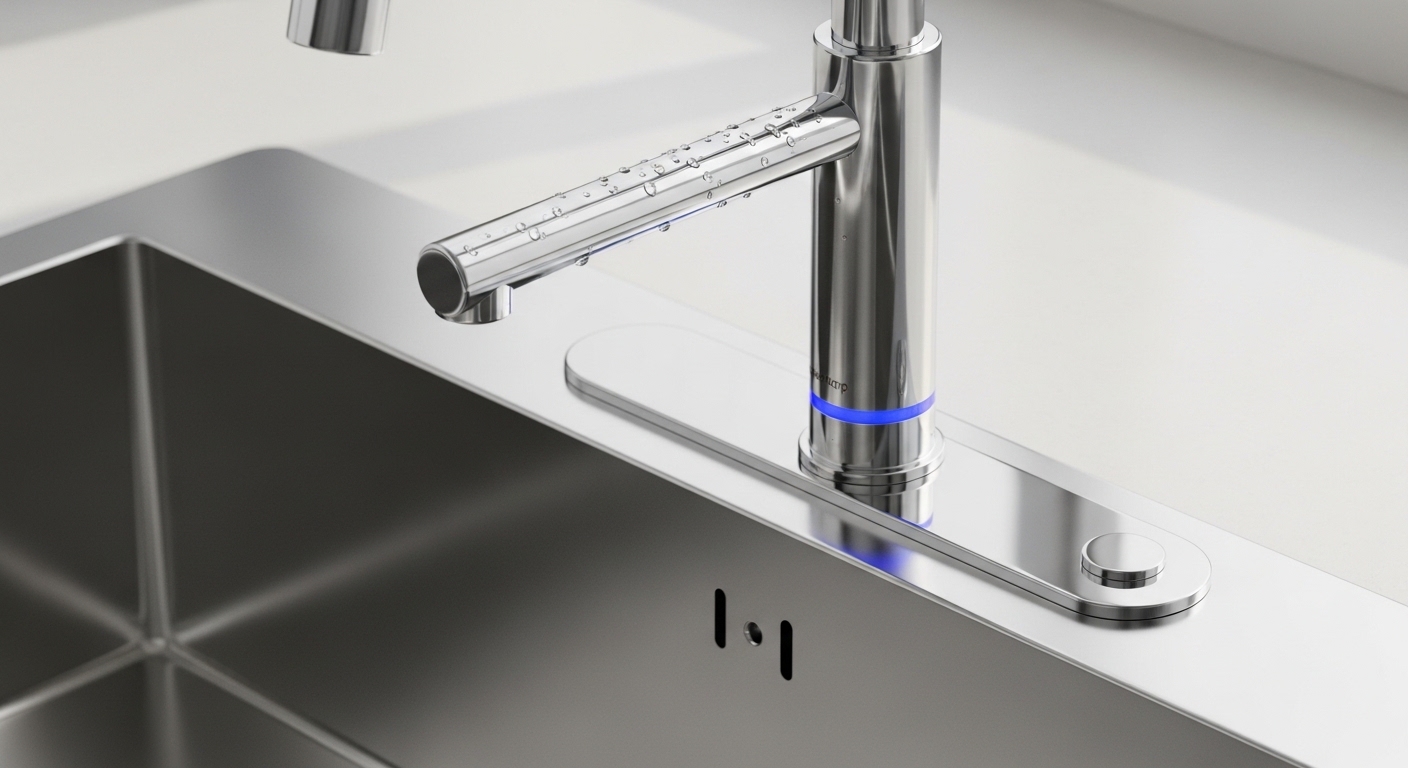
Put the X16 dedicated faucet in a rear accessory hole, usually to the right or left of your main kitchen faucet, wherever there’s a spare hole and comfortable clearance for a glass or pitcher underneath. The goal is a spot where the spout clears the basin edge and you can fill a bottle without fighting the main faucet.
Because the X16 is a tankless reverse-osmosis system, its faucet is a dedicated drinking-water faucet — it only dispenses filtered water, separate from your hot/cold mixer. That means placement is about convenience, not plumbing distance to hot and cold lines. A few placement pointers:
- Keep the tubing run short. The X16 connects to the faucet with a quick-connect tube from the unit under the sink. Shorter, gentler bends mean better flow and fewer kinks.
- Leave headroom. The X16 faucet has an LED spout that indicates filter status (blue for good, yellow/red for change soon). Don’t tuck it under a cabinet lip where you can’t see the light.
- Mind the swivel. If your model’s spout swivels, make sure it can turn without hitting a backsplash or the main faucet handle.
Does the X16 faucet finish and flow matter for drinking water?
Yes — but mostly for looks and safety, not filtration. The X16 does the actual purifying inside the tankless unit; the faucet is the last surface your clean water touches, so you want it lead-free and corrosion-resistant. Waterdrop’s dedicated faucets are made to meet U.S. drinking-water safety standards, which is exactly what you want on the tap you drink from every day.
This is the same reason we push people toward certified, lead-free materials on any tap that touches drinking water. If you’re curious why the metal itself matters — and why “lead-free brass” is more than a marketing phrase — it’s worth reading whether a lead-free brass kitchen faucet is really safer for your drinking water. The short version: on a dedicated drinking faucet, material certification is non-negotiable, and it’s one area where you shouldn’t cheap out with an off-brand replacement spout.
On flow rate, a dedicated RO faucet runs slower than your main tap by design — RO membranes produce purified water at a measured rate, and the X16’s tankless design is built to keep up with normal glass-and-pitcher use. If you ever swap or troubleshoot the end of a pull-down sprayer on your main faucet (a totally separate part), our guide to the faucet sprayer end explains how those tips thread on and off.
Step-by-step: mounting the Waterdrop X16 faucet in the right hole
Once you’ve confirmed your hole is in the 1/2″–1-3/8″ range, the actual install takes about 15 minutes and needs no special plumbing skill. Here’s the sequence:
- Turn off the cold water supply and open your main faucet to relieve pressure.
- Slip the faucet shank through the hole from the top, with the decorative base and rubber gasket seated flat against the sink deck.
- From underneath, thread on the mounting hardware — usually a washer, a metal or plastic mounting plate, and the lock nut. Hand-tighten, then snug it with a wrench a quarter turn. Don’t crank it; overtightening can crack a thin base or a stone counter.
- Connect the quick-connect tube from the X16 unit to the faucet’s inlet. Push it in firmly until it clicks; give a gentle tug to confirm it’s locked.
- Turn the water back on and run the X16 through its startup flush per the manual before drinking.
If the lock nut won’t grab because your countertop is too thick, that’s the deck-thickness limit we mentioned — you can often fix it by removing a spacer, or you may need an extended shank kit. Measure before you buy anything.
Waterdrop X16 faucet fit — quick spec summary
| Spec | What the X16 faucet needs |
|---|---|
| Mounting hole diameter | 1/2 in – 1-3/8 in (12–35 mm) |
| Faucet shank diameter | ~1/2 in (12–13 mm) |
| Max deck thickness | ~1-1/2 in (40 mm) |
| Faucet type | Dedicated single-cold RO drinking-water faucet |
| Typical location | Rear sink accessory / sprayer / soap-dispenser hole |
| Connection | Push-in quick-connect tube from under-sink unit |
Always cross-check these figures against the spec sheet in your specific X16 box — Waterdrop occasionally revises hardware between production runs, and the printed manual is the final word for your exact unit.
FAQ
What size hole does a Waterdrop X16 faucet need?
Between 1/2 inch and 1-3/8 inch (about 12–35 mm) in diameter. That range covers the standard sprayer, soap-dispenser, and accessory holes found on most kitchen sinks, so if you already have a spare hole in that band, the X16 faucet fits without any drilling.
Can I use my old sprayer or soap-dispenser hole for the X16 faucet?
Almost always yes. Sprayer and soap-dispenser holes are typically 1-1/4 to 1-3/8 inch — right inside the X16’s fit range. Pop out the old accessory or the factory knockout plug, and the X16 faucet shank drops through with the base plate covering the opening.
What if my kitchen sink doesn’t have a spare hole?
You’ll drill one. Use a 1-1/4″ step bit for a stainless steel sink or a diamond hole saw (run wet) for granite, quartz, or porcelain. If you’re not comfortable drilling stone, have a countertop pro do it — a cracked stone top costs far more than the labor to drill cleanly.
My existing hole is bigger than the X16 base — is that a problem?
Only cosmetically. If the hole is larger than 1-3/8 inch, add an escutcheon plate or reducing grommet under the faucet base to cover the gap. Match the finish to the faucet so it looks intentional rather than patched.
Does the faucet hole size affect how well the X16 filters water?
No. All the reverse-osmosis filtration happens inside the tankless unit under your sink. The faucet is just the delivery point, so the hole size affects only fit and looks — not water quality or flow. What matters for the water itself is that the faucet is lead-free and drinking-water certified.
How thick a countertop can the X16 faucet mount through?
Up to about 1-1/2 inch (40 mm). Thin stainless sinks are never an issue; very thick stone counters can be if the threaded shank can’t reach far enough for the lock nut to grab. Measure your deck thickness first, and get an extended shank kit if you’re over the limit.
Author note: This guide was written by the aleashafaucet fixtures team, who install, test, and pressure-check kitchen and bathroom faucets — including dedicated RO drinking-water faucets — as part of our product QA. About aleashafaucet: we design and sell faucets and bathroom fixtures built to U.S. lead-free drinking-water standards, and every fixture we ship is bench-tested for leaks and flow and backed by our warranty. When in doubt about fit, measure twice, and always defer to the spec sheet packed with your specific Waterdrop X16 unit.