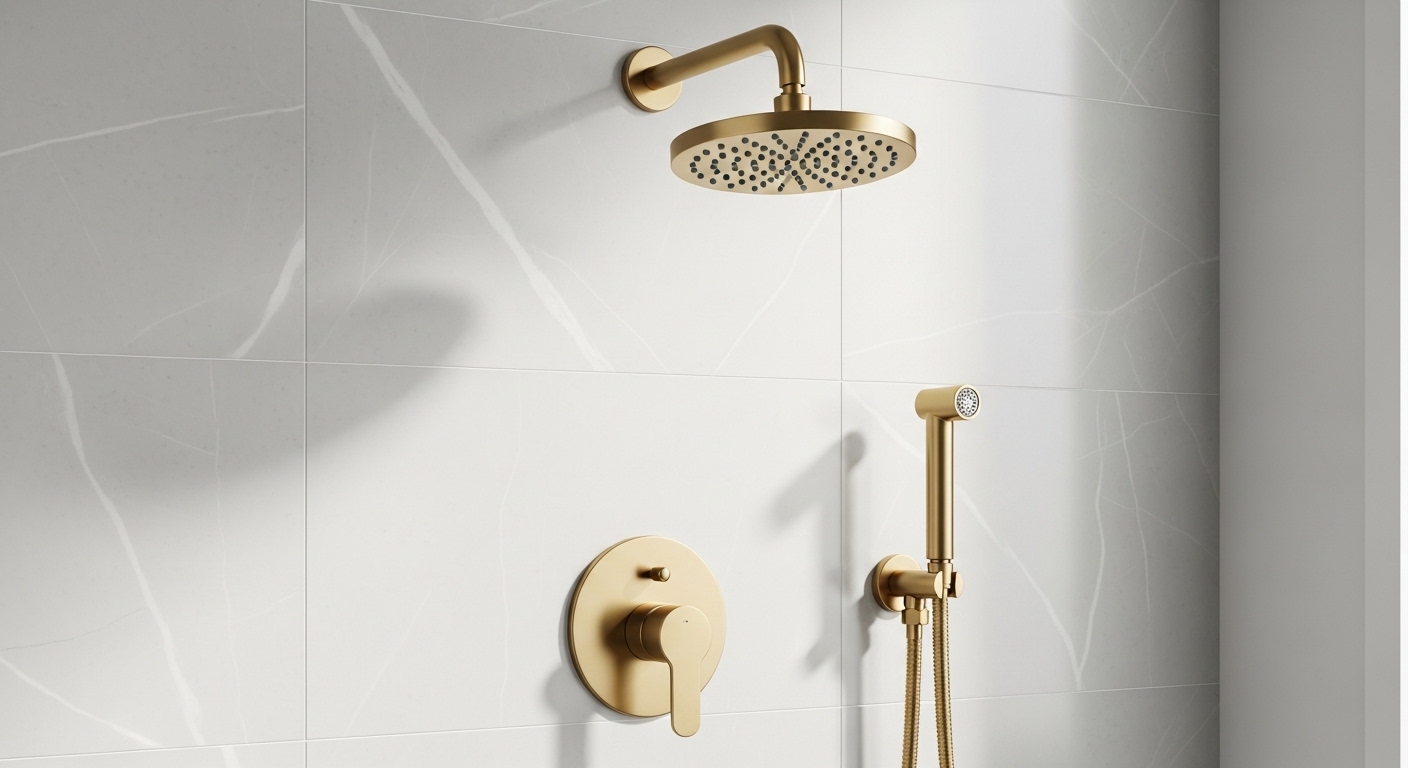
A shower faucet gold finish has gone from a bold gamble to one of the safest, most requested looks in modern bathrooms — but only if you buy the right kind. The finish name on the box tells you almost nothing; what matters is how the gold is applied, what’s underneath it, and whether the valve behind the wall is built to last 20 years. This guide walks through exactly what to look for, how the popular gold tones actually differ, what you’ll pay, and how to make the finish match the rest of your fixtures instead of clashing with them.
At aleashafaucet, we sell and stress-test shower trim across every finish, and gold — specifically brushed and champagne gold — is now one of our top three requests behind matte black and brushed nickel. Below is the honest, plain-English version of what we tell customers before they buy.
What does “shower faucet gold” actually mean — and which gold should you buy?
“Gold” on a shower faucet is a family of finishes, not one color. The three you’ll see most are polished gold (bright, mirror-like, traditional), brushed gold / brushed brass (soft satin sheen, warm, contemporary), and champagne gold / champagne bronze (muted, slightly rosy-taupe, the most forgiving). For most 2026 bathrooms, brushed gold or champagne gold is the smart pick — they hide water spots and fingerprints far better than polished gold and read as “designer” rather than “dated brass from the ’90s.”
Here’s the part that actually decides how long your faucet looks good: the coating process. Two exist, and they are worlds apart.
- PVD (Physical Vapor Deposition): the gold color is bonded to the metal at a molecular level in a vacuum chamber. It’s harder than the brass underneath, won’t tarnish, and shrugs off cleaners and hard water. This is what you want. Reputable PVD gold trim usually carries a lifetime finish warranty.
- Electroplated / “gold-tone” lacquer: a thin decorative layer sprayed or dipped on cheaply. It looks identical in photos but flakes, yellows, or develops dark blotches within 12–24 months, especially in hard-water homes. Common on sub-$80 no-name kits.
If a product listing doesn’t say “PVD” anywhere, assume it isn’t, and ask before buying. The price gap is often only $40–$60, and it’s the single most important spec on the page.
Is gold going to look dated in a few years?
No — brushed and champagne gold have proven far more durable as a trend than the shiny polished brass of the 1980s ever was. The satin, muted golds read as neutral warm metals now, the same way brushed nickel became a permanent staple. The look that ages badly is high-shine polished gold paired with equally shiny gold everything; the look that stays current is a soft brushed gold used as a warm accent against white, gray, or black. If you’re weighing warm metals generally, our deep dive on whether brushed gold traditional taps are worth it or will look dated breaks down the longevity question in detail.
How much should a gold shower faucet cost in 2026?
Expect to pay $120–$450 for a quality PVD gold shower trim kit, and remember that the “faucet” you see is really two purchases: the trim (the visible handle, escutcheon, and shower head) and the rough-in valve (the pressure-balancing or thermostatic cartridge body buried in the wall). Budget for both.
| Tier | Price range (trim kit) | Finish type | Best for |
|---|---|---|---|
| Budget | $60–$120 | Usually electroplated gold-tone | Rentals, short-term flips — expect finish wear |
| Mid-range | $120–$250 | PVD brushed / champagne gold | Most homeowners — best value and longevity |
| Premium | $250–$450 | PVD gold, thermostatic valve, solid brass | Primary baths, spa setups, multi-spray systems |
| Luxury | $450+ | PVD gold, full shower system, integrated diverter | Custom builds, rain + handheld + body sprays |
A few cost notes people miss: a thermostatic valve (holds your exact temperature even when a toilet flushes) adds roughly $80–$150 over a basic pressure-balance valve, and it’s worth it in a busy household. A full shower system with rain head plus handheld plus a diverter costs more but replaces three separate purchases. And if you’re only swapping the visible parts on an existing compatible valve, a trim-only kit is the cheapest path — no wall opening required.
Can I just swap the trim to gold without opening the wall?
Often yes — if your existing rough-in valve is from the same brand or a compatible cartridge family, you can buy a gold trim kit and change only the handle, escutcheon plate, and shower head in about 30–45 minutes with a screwdriver and plumber’s tape. That’s the cheapest, fastest way to go gold. The catch: trim and valve must match. A Delta trim won’t seat on a Moen valve, for example. If you’re mixing brands or replacing a spout-and-valve combo, read our guide on a wall mount faucet spout replacement without tearing open the wall for the workarounds that actually hold up.
What should I look for so a gold shower faucet lasts 20 years?
Prioritize the valve and the coating over everything else — a gorgeous gold handle bolted to a plastic valve body is a leak waiting to happen. Here’s the checklist we walk customers through, in priority order:
- Solid brass valve body — not zinc alloy or plastic. Brass resists corrosion and threads hold up to repeated cartridge changes. It’s heavier; weight in hand is a quick tell.
- PVD gold finish — confirmed in writing, ideally with a lifetime finish warranty.
- Ceramic disc cartridge — the part that controls flow and temperature. Ceramic discs outlast rubber washers by a decade or more and are the #1 factor in whether your faucet drips.
- Pressure-balancing or thermostatic control — protects against scald surges. Thermostatic is the upgrade; anti-scald pressure balance is the minimum, and it’s required by plumbing code in most of the U.S.
- Certifications — look for cUPC / IAPMO listing and NSF/ANSI 61 for lead-safe wetted parts. These aren’t marketing; they’re independent lab certifications.
One maintenance reality worth knowing before you commit: gold shows hard-water scale as a dull, chalky film faster than a busy chrome finish does, simply because the warm color makes deposits visible. It wipes off easily with a damp microfiber cloth, but if you have very hard water you’ll want to wipe the head and handle down weekly. That same hard water is what quietly clogs shower heads and cartridges over time — if your existing shower already runs weak, our breakdown of why a shower head has low pressure when the rest of the house is fine explains the scale-and-cartridge culprits before you blame the new gold trim.
Which gold finish matches my other fixtures?
Match the tone and sheen, not the exact brand name — a brushed gold shower faucet will happily live alongside brushed gold cabinet pulls, a gold tub spout, and gold drain covers even from different makers, as long as they’re all in the same warm, satin family. The mistakes happen when people mix a rosy champagne gold with a bright yellow polished gold, or pair a warm gold with a cool “gold-tone” that skews greenish.
Quick pairing rules that keep a bathroom looking intentional:
- Brushed gold + white or gray tile: the safest, most timeless combo. Warm metal against a neutral field.
- Champagne gold + warm beige, cream, or wood tones: cohesive and soft; great for spa-style baths.
- Polished gold + marble with gold veining: high-glam, traditional; commit fully or it looks accidental.
- Gold + matte black accents: modern and high-contrast — keep gold as the star and black as the frame (hinges, mirror, one accent), not 50/50.
If you’re building a coordinated shower — matching valve trim, rain head, handheld, and diverter all in gold — a pre-matched shower system saves you the guesswork of cross-matching finishes. Our overview of what a shower system mixer tap is and which one to buy covers how the diverter and mixer pieces work together so every visible part comes in the identical gold tone.
Does gold work with a tub-and-shower combo?
Yes, and it’s one of the best places to use it. In a tub-shower combo you’ll want the tub spout, the valve handle, and the shower head all in the same gold, which is easy when you buy them as a set. If you’re mixing a gold shower with a contrasting spout — say a gold valve trim and a black tub spout — treat it as a deliberate two-tone design and repeat each metal at least twice in the room. Our guide to picking the best black tub spout and whether it’ll match your faucet is a useful companion if you’re going the two-tone route.
Pressure-balance vs. thermostatic gold shower valves — which do I need?
Buy thermostatic if you can stretch the budget; buy pressure-balance if you can’t — but never buy a gold trim kit without confirming which valve it fits. Both prevent scalding, but they do it differently:
| Feature | Pressure-balance valve | Thermostatic valve |
|---|---|---|
| How it protects you | Balances hot/cold pressure to avoid temp spikes | Holds an exact set temperature regardless of pressure |
| Temperature stability when a toilet flushes | Good — no scald, but temp may dip slightly | Excellent — locked to your setting |
| Multiple sprays at once (rain + handheld) | Limited | Ideal — designed for it |
| Typical trim cost (gold, PVD) | $120–$220 | $220–$400 |
| Best for | Single-spray showers, tighter budgets | Body-spray systems, families, spa builds |
For a straightforward single shower head, a quality pressure-balance valve in gold is plenty and will serve you for decades. Step up to thermostatic when you’re running more than one outlet at a time or you simply hate the small temperature dip when someone runs the sink. Either way, if you ever chase a mysterious drip after installation, it’s almost always the cartridge — the same principle behind why a faucet drips from the valve and how to fix it yourself applies to shower valves too.
How do I install a gold shower faucet trim kit myself?
If your rough-in valve is already in the wall and matches your new gold trim, installation is a beginner-friendly job in under an hour. Here’s the short version for a trim-only swap:
- Shut off the water to the shower — either the in-wall stops on the valve or the main.
- Remove the old trim: unscrew the handle, pull the old escutcheon plate, and unthread the old shower head from the arm (wrap the arm threads if reusing it).
- Check the cartridge: if the valve is 15+ years old, replace the cartridge now while it’s exposed — it’s cheap insurance against drips.
- Install the gold trim: seat the new escutcheon and gasket, attach the handle, and hand-thread the new gold shower head onto the arm with fresh plumber’s tape (2–3 wraps clockwise). Snug by hand plus a quarter turn — don’t overtighten and scratch the finish.
- Turn water back on and test for leaks at the head, arm, and handle base. Run hot and cold through the full range.
Use a cloth or painter’s tape over any wrench jaws so you don’t nick the gold PVD during install. If you hit a full valve replacement instead of a trim swap, that’s a bigger job that may involve opening the wall — worth calling a pro if you’re not comfortable soldering or working with the water supply behind the tile.
Author note & why trust this guide
This article was written by the aleashafaucet product team, who spec, sell, and bench-test shower trim and valves across every major finish, including years of real-world tracking on how gold PVD holds up in hard-water regions. We base finish-durability guidance on manufacturer PVD specifications, cUPC/IAPMO and NSF/ANSI 61 certification standards, and warranty data — most quality gold trim we carry ships with a limited lifetime finish and function warranty. When we say brushed and champagne gold outlast polished gold in daily use, that’s from returns data and customer follow-ups, not guesswork. As always, confirm your local plumbing code (anti-scald valves are mandatory in most U.S. jurisdictions) before you buy.
FAQ
Does a gold shower faucet tarnish or turn color over time?
A PVD gold finish does not tarnish — the color is vacuum-bonded and harder than the brass beneath it, so it resists water spots, cleaners, and oxidation for the life of the fixture. Only cheap electroplated “gold-tone” finishes discolor, usually within one to two years. Always confirm the listing says PVD before buying.
Is brushed gold or polished gold better for a shower?
Brushed gold is better for most showers because its satin surface hides water spots and fingerprints, while polished gold shows every droplet and needs frequent wiping. Brushed and champagne gold also read as more current and pair with more tile colors, whereas polished gold suits a specifically traditional or high-glam look.
Will a gold shower faucet match my existing chrome or nickel fixtures?
Not seamlessly — gold is a warm metal and chrome/nickel are cool, so pairing them looks like a mismatch rather than a deliberate two-tone. If you’re not replacing everything at once, go full gold on the shower and repeat the gold at least twice elsewhere (drain, tub spout, or accessories) so it looks intentional. Mixing gold with matte black works; mixing gold with chrome usually doesn’t.
How do I clean a gold shower head without ruining the finish?
Wipe it with a damp microfiber cloth and mild dish soap, then buff dry — that’s all a PVD gold finish needs. Avoid abrasive pads, bleach, and acidic descalers left sitting on the surface; for hard-water buildup, soak the head in a bag of half-and-half white vinegar and water for 20–30 minutes, then rinse and dry. Never use ammonia-based glass cleaners on gold.
Can I put a gold shower faucet on any existing valve?
Only if the trim and valve are from a compatible cartridge family — usually the same brand. Gold trim kits are made to fit specific rough-in valves, so a gold trim from one manufacturer generally won’t seat on another’s valve body. If you’re switching brands, you’ll likely need to replace the valve too, which means opening the wall.
Are gold shower faucets more expensive than chrome?
Slightly — a PVD gold finish typically adds $30–$70 over the identical model in chrome, because PVD coating is an extra manufacturing step. It’s a worthwhile premium given PVD gold’s durability, and it’s far cheaper than replacing a flaked electroplated finish a year later. Expect $120–$250 for a solid mid-range gold trim kit.