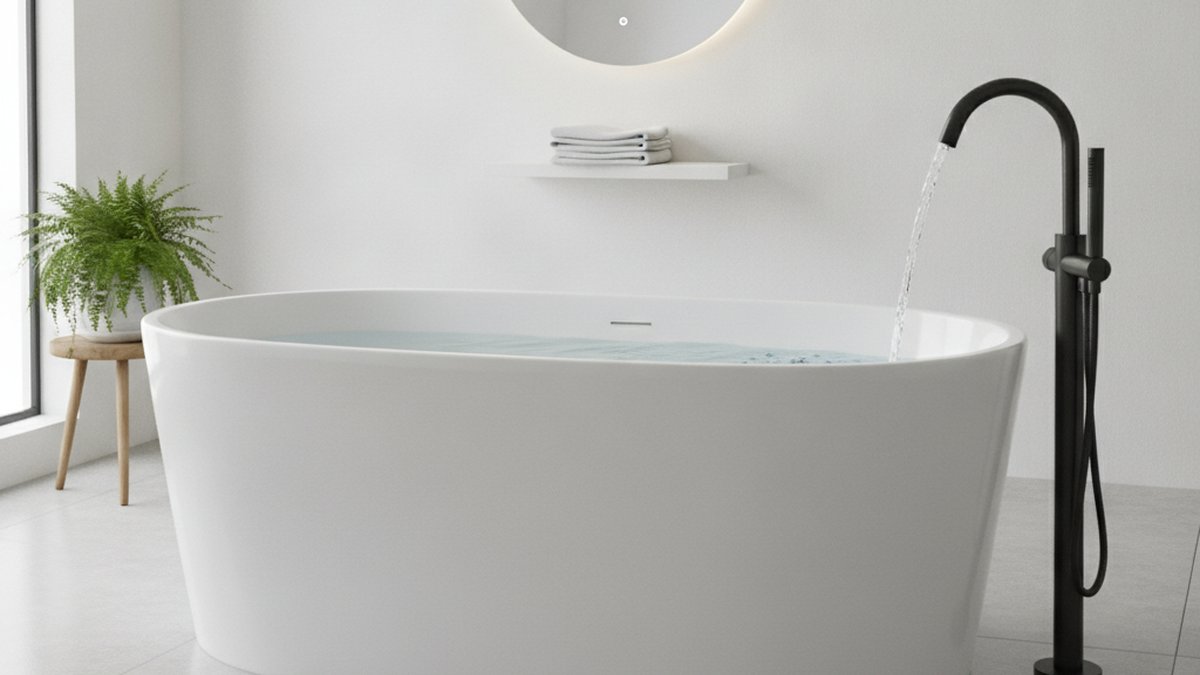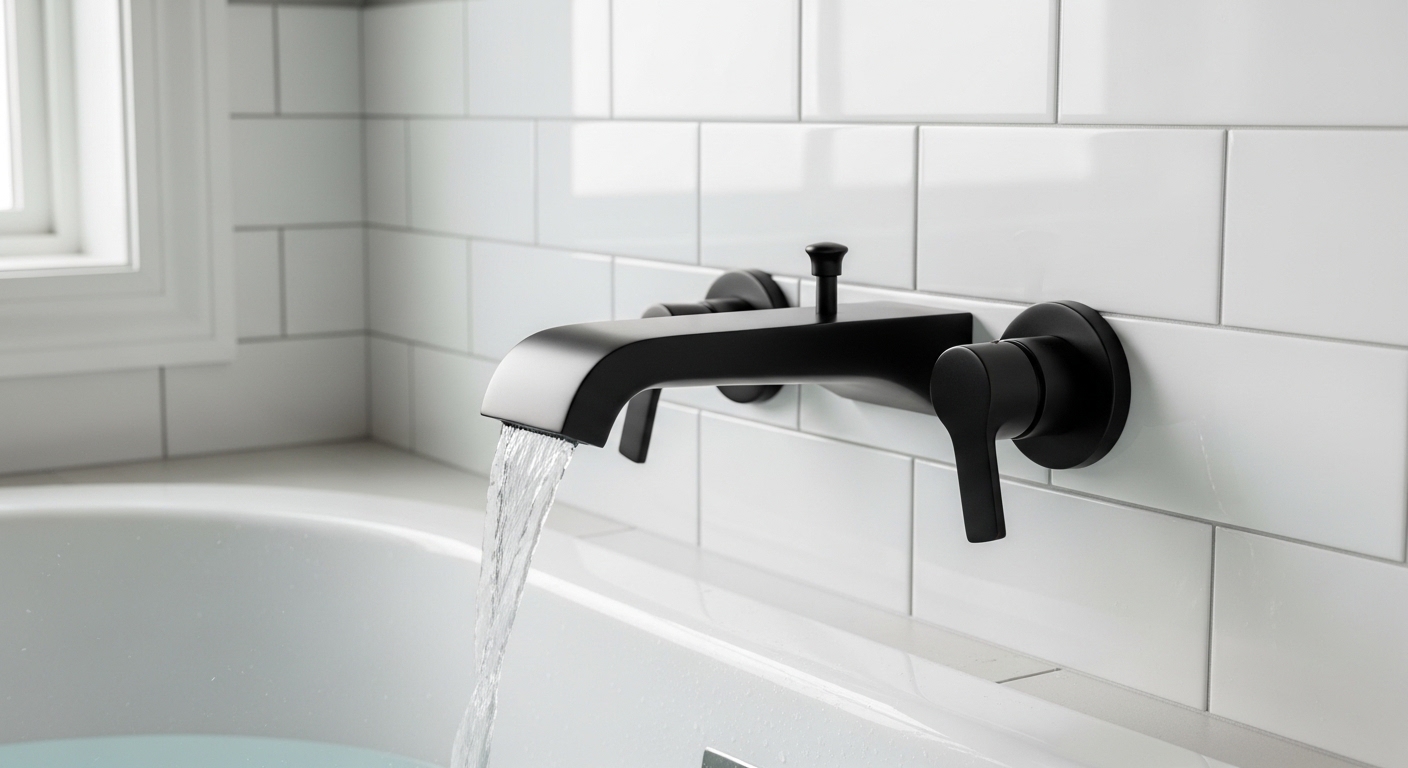
If you’ve been searching for a tub spout black upgrade because your old chrome spout looks dated or is dripping at the base, you’re making one of the cheapest, highest-impact bathroom changes there is. A tub spout swap runs 15–30 minutes, needs no plumber for most setups, and instantly modernizes the whole tub. But “black” isn’t one thing, and the wrong connection type means the spout won’t seat against the wall — so let’s get you the exact right one the first time.
Below, I’ll walk through how to tell which spout your plumbing needs, matte vs. glossy black, whether to get a diverter or non-diverter model, how black finishes hold up to hard water and cleaning, and the real-world install. By the end you’ll know precisely what to add to your cart.
How do I know which black tub spout will actually fit my bathtub?
Measure two things first: the pipe sticking out of your wall (the “stub-out”) and how far it protrudes. Whether the spout is slip-on or threaded is decided entirely by that stub-out — not by looks, brand, or price. Get this wrong and the spout either won’t tighten or won’t sit flush against the tile.
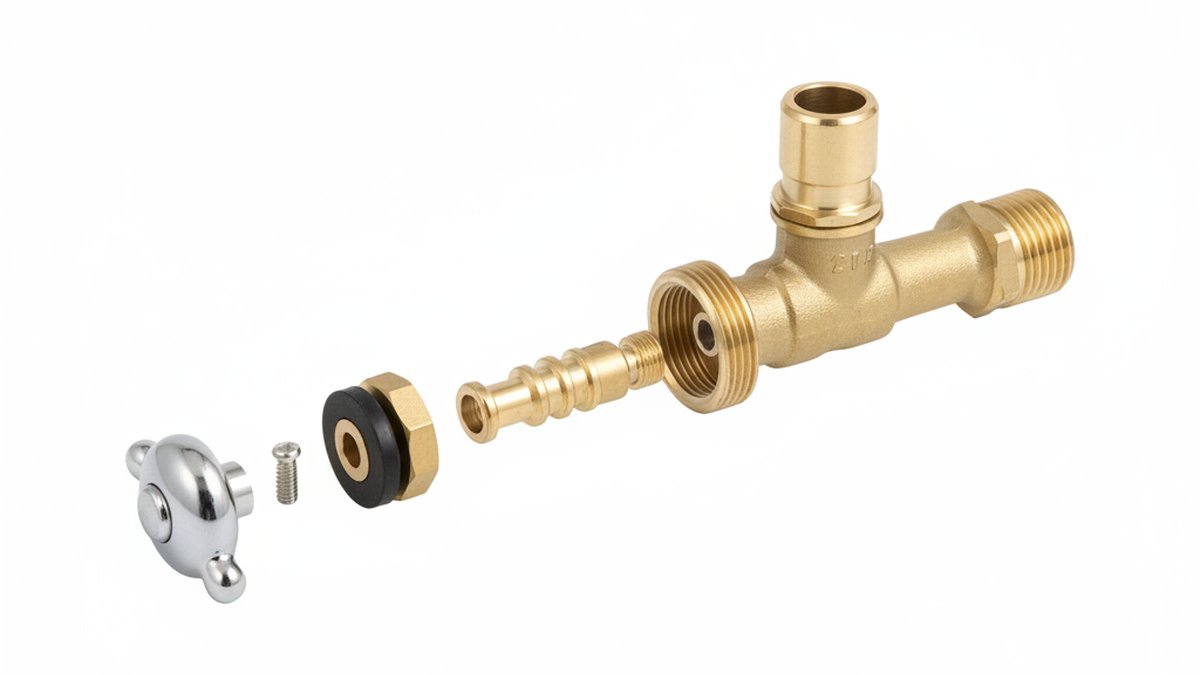
There are two connection styles, and almost every tub spout on the market is one or the other:
- Slip-on (set-screw) spout: Slides over a bare ½” copper pipe and locks with a small hex set screw underneath. The copper stub-out should extend roughly 4–4½” from the finished wall.
- Threaded (screw-on) spout: Screws onto a ½” NPT threaded nipple (galvanized, brass, or a threaded PEX/copper adapter). The nipple typically sticks out 1½–2¾” depending on the spout’s rear socket depth.
To check yours: turn off the tub, unscrew or unseat the existing spout, and look at the pipe. Smooth copper with no threads and a set screw on your old spout = you need slip-on. Threads on the pipe = you need threaded. Some spouts (like several Delta and Moen “universal” models) ship with an adapter to cover both, which is the safest buy if you’re unsure. If you’re doing a full wall-mounted setup rather than a standard alcove tub, the geometry is different — our guide on a wall mount faucet spout replacement without tearing open the wall covers those cases in detail.
What’s the difference between a diverter and non-diverter black tub spout?
A diverter spout has a pull-up knob on top that redirects water to your shower head; a non-diverter is just a tub filler with no shower. Buy the one that matches how your bathroom is plumbed — you can’t add shower function by swapping in a diverter spout if there’s no shower riser behind the wall.
If you currently pull a knob on the spout to start the shower, you need a diverter black spout. If your shower is controlled by the valve/handle on the wall (a three-handle or single-handle valve system), you want a plain non-diverter spout. Diverter models cost a few dollars more and have one extra moving part that can wear over years of use — worth knowing if longevity is your priority.
Matte black or glossy black tub spout — which one should I get?
Choose matte black if you want the current, modern look and easier hard-water maintenance; choose glossy (gloss/piano black) only if your existing fixtures are already glossy or you love a high-shine, dramatic finish. Matte black is by far the more popular and more forgiving choice in 2026.
Here’s the practical difference. Matte black hides water spots and fingerprints far better and pairs with almost everything — brushed nickel, chrome, brushed gold, even wood-tone vanities. Glossy black looks striking but shows every water droplet and smudge, and it’s harder to keep looking clean in a hard-water home. The finish itself is usually a PVD coating or powder coat over brass or zinc; PVD is the tougher, more scratch- and corrosion-resistant of the two.
| Feature | Matte Black | Glossy / Piano Black |
|---|---|---|
| Look | Modern, understated, blends easily | Bold, dramatic, high-shine |
| Shows water spots | Rarely — very forgiving | Often — needs frequent wiping |
| Fingerprints | Hides well | Shows easily |
| Best paired with | Nickel, chrome, gold, wood tones | Other glossy black or chrome |
| Typical coating | Powder coat or matte PVD | Glossy PVD or lacquer |
| Maintenance effort | Low | Higher |
My honest recommendation for most bathrooms: matte black. It’s the finish that still looks intentional five years from now and doesn’t demand daily wiping. If you’re weighing black against warmer metals for the whole room, the trade-offs are similar to what we cover in what Reddit really says about matte black finishes — the durability concerns people raise there apply to tub spouts too.
Will a black tub spout match my black shower head and handle?
Not automatically — “matte black” varies slightly between brands, so the safest way to get a true match is to buy the spout, shower head, and trim as a coordinated set or from the same manufacturer line. Two different brands’ “matte black” can read as slightly warm vs. cool up close.
That said, black is far more forgiving than metals like brushed gold, where undertones clash badly. Most matte blacks are close enough that a spout from one brand and a shower head from another look fine together in a real bathroom under normal lighting — the mismatch only shows if you hold them side by side. For a guaranteed match, do one of these:
- Buy the spout as part of a shower trim kit (spout + valve trim + shower head) from one line.
- Match the finish name exactly — many brands use standardized names like “Matte Black (BL).”
- Keep the black to one visual “zone” (all the tub/shower fixtures) and let the sink faucet be its own coordinated finish.
If you’re building out a full shower at the same time, it’s worth understanding how the valve and outlets work together — our explainer on a shower system mixer tap shows how the spout, diverter, and mixing valve coordinate so nothing fights for water pressure.
Does a black tub spout show hard-water stains more than chrome?
Matte black actually hides hard-water spotting better than chrome, while glossy black shows it more. On chrome, mineral spots are obvious against the mirror finish; on matte black they blend into the low-sheen surface until buildup gets heavy.
The catch is cleaning. Never use abrasive pads, vinegar-heavy soaks, or acidic bathroom cleaners on a black finish — those strip PVD and powder coatings over time and can leave dull patches. Wipe with a soft damp cloth and mild dish soap, dry it, and that’s it. If you have very hard water and a lot of mineral crust, a diluted, finish-safe cleaner is fine occasionally, but skip the “scrub it shiny” instinct that works on chrome.
How much should I spend on a black tub spout?
Expect to pay $25–$45 for a solid mid-range black tub spout, $50–$120 for a premium brass-body PVD model, and under $25 only for budget zinc/plastic units you should generally avoid. For a fixture that sees hot water and daily use, the metal body and coating quality matter more than the price tier alone.
| Price tier | Typical body/coating | Best for | Watch out for |
|---|---|---|---|
| Under $25 | Zinc or ABS plastic, painted | Rentals, short-term fixes | Coating chips, feels light, fades |
| $25–$45 | Zinc or thin brass, powder coat/PVD | Most homeowners | Check connection type carefully |
| $50–$120 | Solid brass, quality PVD | Long-term, hard-water homes | Overkill only if you’ll remodel soon |
The single biggest quality tell is weight and body material. A solid-brass spout feels substantially heavier than a hollow zinc one, resists corrosion far better where hot water and minerals meet metal, and holds its finish longer. If you live somewhere with hard water, that step up to brass with real PVD is the upgrade actually worth paying for. Aleasha Faucet builds our black tub spouts on lead-free brass bodies with PVD finishes rated for daily bathroom use — the same lead-free-brass logic we explain in our piece on a lead free brass kitchen faucet and drinking water safety applies to anything hot water flows through.
How do I install a black tub spout myself?
For a slip-on spout: loosen the set screw, pull the old spout off, apply plumber’s tape or silicone to the copper stub if directed, slide the new one on, and tighten the set screw. For a threaded spout: unscrew the old one, wrap the nipple threads with plumber’s tape, and hand-thread the new spout on until snug and pointing down. Both take 15–30 minutes with no special tools.
Step by step for the most common jobs:
- Shut off the water to the tub (or the whole house if there’s no local shutoff) and lay a towel in the tub to catch dropped screws.
- Remove the old spout. Slip-on: loosen the hex set screw underneath with an Allen key and pull straight off. Threaded: turn counterclockwise by hand or with a cloth-wrapped wrench.
- Inspect the pipe. Confirm copper-and-set-screw (slip-on) vs. threaded, and clean off any old tape or gunk.
- Seal it. Threaded: 3–4 wraps of plumber’s tape clockwise on the nipple. Slip-on: a bead of silicone around the wall end so water doesn’t run behind the spout (follow the included instructions — some slip-on models want silicone only at the wall, not the pipe).
- Attach the new spout. Slip on and tighten the set screw, or thread on until the spout points straight down and sits flush against the wall. Don’t over-torque — snug, not gorilla-tight.
- Turn the water back on and check for leaks at the wall and, if it’s a diverter, that the shower/tub switch works.
The one thing that trips people up: a threaded spout that ends up pointing sideways when tight. If that happens, you either need a slightly longer/shorter nipple or a spout with a rear “O-ring seal” socket design that lets you set the angle independently of thread tightness. Those O-ring style spouts are the most forgiving for DIY, so if you’re nervous, buy one.
Can I replace a chrome tub spout with a black one without changing anything else?
Yes — as long as the new black spout matches your connection type (slip-on or threaded) and roughly the length of the old one, it’s a direct swap with nothing else touched. The spout doesn’t care what color the old one was; it only cares about the pipe behind it.
You don’t need to change the valve, the handle, or the shower head to swap just the spout — though many people do a black spout first and then gradually replace the shower head and handles to match over time. That staged approach is totally fine and spreads out the cost.
What should I check before I click “buy”?
Confirm four specs and you’re safe: connection type (slip-on vs. threaded), spout length, diverter or non-diverter, and finish name. Miss any one and you risk a return. Here’s the quick pre-purchase checklist:
- Connection type — matches your stub-out (the #1 cause of returns).
- Length — measure your old spout wall-end to tip; stay within about ½” of it.
- Diverter? — match how your shower is currently controlled.
- Finish — matte vs. glossy, and ideally the same finish family as your trim.
- Body material — brass for hard water and longevity; zinc only for budget/short-term.
- Warranty — look for a finish warranty, not just a mechanical one.
Do that and a black tub spout is one of the most satisfying small upgrades in a bathroom — cheap, fast, and visually transformative.
FAQ
Are black tub spouts hard to keep clean?
No — matte black is one of the easiest finishes to maintain. Wipe with a soft damp cloth and mild soap, then dry. Avoid abrasive pads and acidic or vinegar-based cleaners, which can strip the coating over time. Glossy black shows water spots more and needs wiping more often, but neither is genuinely “hard” to clean.
Do black tub spouts fade or turn gray over time?
Quality PVD-coated brass spouts resist fading for many years; cheap painted zinc or plastic ones are the ones that fade, chip, or go gray, especially where hot water hits the metal. Buy a PVD or powder-coated brass body and use gentle cleaners, and the finish should stay true well past a decade.
Can I put a black tub spout on a copper pipe?
Yes — that’s exactly what a slip-on (set-screw) black spout is designed for. It slides over a bare ½” copper stub-out and locks with a set screw underneath. Just confirm the copper protrudes far enough (about 4–4½”) for the spout to seat properly against the wall.
Why is water leaking behind my new black tub spout?
Almost always it’s a missing or failed seal at the wall. For slip-on spouts, you usually need a bead of silicone where the spout meets the wall; for threaded spouts, you need plumber’s tape wrapped clockwise on the nipple threads. Pull the spout, reseal, and re-install — that fixes the leak in the vast majority of cases.
Does a black tub spout come with a warranty?
Reputable brands back both the mechanism and the finish. Look specifically for a stated finish warranty (many quality lines cover the coating against tarnish and corrosion), and buy from a seller that lists the body material and meets standard lead-free plumbing requirements for fixtures carrying potable water. Aleasha Faucet’s black tub spouts carry a limited warranty covering the finish and function under normal residential use.
Should I match my black tub spout to my sink faucet too?
It looks best if you do, but it’s not required. A common, clean approach is to keep all the tub/shower fixtures in one finish (black) and coordinate the sink faucet as its own deliberate choice. Because matte black pairs easily with nickel, chrome, and gold, you have flexibility that warmer metals don’t give you.
Author note: This guide was written by the Aleasha Faucet product team, who design, spec, and pressure-test bathroom fixtures for a living. Aleasha Faucet manufactures faucets, shower systems, and tub fixtures on lead-free brass bodies with PVD finishes, tested against standard residential water-supply and durability requirements and backed by a limited finish-and-function warranty. When in doubt about connection type, measure your stub-out first — it saves the most returns.