Search “shower system vintage” today and you’ll see two completely different worlds: cheap zinc-alloy sets that look like a movie prop, and serious heirloom-grade brass systems engineered to outlive your mortgage. The difference isn’t just looks — it’s whether you’ll be re-caulking, re-plumbing, and re-buying in three years, or enjoying the same shower in 2046. This guide cuts through the noise so you can buy once and buy right.
I’ve spent the last decade specifying bathroom fixtures for everything from 1890s Victorians in Boston to mid-century cottages in Pasadena, and the questions homeowners ask about vintage shower systems are remarkably consistent. Below are the real ones — phrased the way you’d actually type them into Google or ask an AI — answered concretely, with numbers, materials, and trade-offs.
What exactly counts as a “vintage” shower system in 2026?
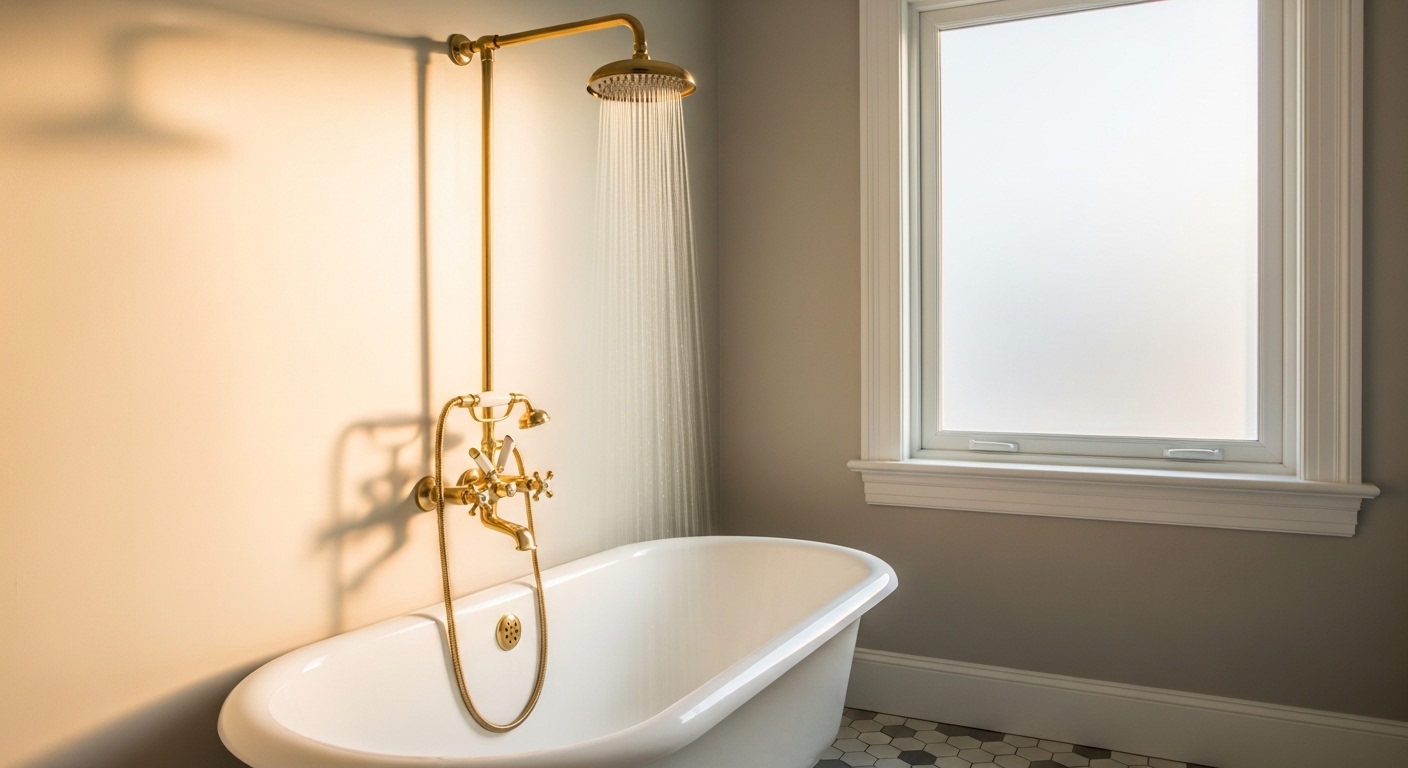
A vintage shower system is any complete shower set whose styling references late-1800s through 1950s plumbing design — typically exposed piping, cross or lever handles, a telephone-style handheld sprayer, and a wall-mount or ceiling-mount rain head, all finished in a classic metal tone. The plumbing inside, however, is modern: ceramic disc cartridges, pressure-balanced or thermostatic valves, and standard 1/2-inch NPT connections.
The word “vintage” gets misused a lot. True vintage means actual antique fixtures pulled from old houses (risky — lead solder, worn seats, no warranty). What most buyers want, and what reputable brands like aleashafaucet sell, is vintage-style: new fixtures with old-world aesthetics and contemporary engineering. That distinction matters because modern water-safety codes (NSF/ANSI 372 lead-free certification, ASME A112.18.1 flow standards) didn’t exist when real antiques were made.
Signature design cues to look for:
- Exposed riser pipe running from the valve up to a rain head — the most iconic vintage tell
- Cross handles (X-shaped) or porcelain lever handles with “Hot” / “Cold” indicators
- Telephone-style handheld sprayer on a hook cradle, often with a fabric-wrapped or metal hose
- Soldered or compression-style fittings visible as small decorative joints
- Warm finishes: polished brass, unlacquered brass (which patinas), oil-rubbed bronze, antique copper, or polished nickel — rarely matte black
How much should I budget for a quality vintage shower system?
For a complete shower system in vintage style that will actually last, plan on $300 to $1,200 for the fixtures alone, plus $400–$900 for professional installation if you’re not retrofitting an existing valve. Anything under $200 is almost certainly zinc-alloy or thin-wall brass that will pit, leak, or seize within a few years of daily use.
Here’s where the money actually goes:
| Price Tier | Typical Material | Valve Type | Expected Lifespan | Best For |
|---|---|---|---|---|
| $80–$200 (budget) | Zinc alloy / thin chrome plate | Compression washer | 2–4 years | Rentals, short-term staging |
| $250–$500 (mid) | Brass body, plated finish | Ceramic disc, pressure-balanced | 10–15 years | Most homeowner remodels |
| $550–$1,200 (premium) | Solid forged brass, lead-free | Thermostatic with anti-scald | 15–25 years | Period-correct restorations, primary baths |
| $1,300+ (heirloom) | Hand-finished brass, often unlacquered | Thermostatic, dual-outlet diverter | 25+ years | High-end historic homes |
The pressure-balanced vs. thermostatic distinction matters more than the finish. Pressure-balanced valves protect against scalding when someone flushes a toilet downstairs. Thermostatic valves let you preset a temperature and hit it every time — a huge quality-of-life upgrade in a daily shower. For any system over $400, thermostatic should be standard.
Which finish ages best on a vintage shower system — brass, nickel, or bronze?
For longevity and authentic patina, unlacquered solid brass ages best — it darkens gracefully over 5–10 years and never “wears off” because there’s no plating to chip. If you prefer a stable look that won’t change, polished nickel holds its appearance longest with the least maintenance. Oil-rubbed bronze is the riskiest because the dark coating is essentially a controlled tarnish that can wear through to brass at high-touch points like the handheld bracket.
A quick honest take on each:
- Polished brass (lacquered): Bright gold tone, locked in by a clear coat. Looks great for 7–10 years, then the lacquer eventually fails and you get blotchy patches. Best for low-humidity bathrooms.
- Unlacquered brass: The choice of restoration purists. Starts mirror-bright, develops a warm amber patina, and can be polished back to new with Wright’s or Brasso. Costs 20–40% more.
- Oil-rubbed bronze: Deep brown-black, hides water spots. Beautiful but the finish is wear-prone — read our breakdown on why bathroom faucets corrode and how to prevent it before committing.
- Polished nickel: Slightly warmer than chrome, doesn’t yellow. The most “forever” finish for vintage styling.
- Antique copper: Strong period look, but copper is reactive — hard water leaves visible mineral deposits faster than brass.
If you go with a brass or gold tone, our guide on how to keep gold finish faucets looking new walks through the exact non-abrasive cleaners that won’t strip the lacquer.
Can I install a vintage exposed shower system in a modern bathroom with standard plumbing?
Usually yes, but with one important caveat: exposed vintage systems run the supply lines outside the wall, so your existing hot/cold stub-outs need to be at the right height and spacing — typically 8 inches apart on center, exiting the wall 36–48 inches above the floor. If your current valve is recessed (most American showers built after 1980 are), you’ll either need to cap the existing valve and run new supplies, or buy a “concealed retrofit” vintage trim that hides modern plumbing behind a decorative escutcheon.
Three install scenarios I see most often:
- New build or full gut remodel: Easy. Rough in copper or PEX supplies to the manufacturer’s spec sheet, set the valve body in the wall, finish tile, then mount the exposed trim.
- Retrofitting over an existing modern valve: Use a wall-mount exposed thermostatic with adjustable inlet unions (most quality vintage systems offer ±1/2 inch of adjustment). You may need an offset adapter kit.
- Clawfoot tub conversion: Freestanding or tub-deck-mount supply with a riser and shower ring. Requires shutoffs and supply lines you can actually reach — almost always a plumber’s job.
If you’re brave enough to DIY a wall-mount, our walkthrough on how to install a wall-mounted faucet without hassle covers the framing, blocking, and torque specs that apply equally to exposed shower systems. For the tub side of a vintage clawfoot setup, the bathtub faucet shower diverter guide explains how the diverter selects between tub spout, handheld, and rain head — a piece many vintage systems get wrong.
What flow rate and water pressure do I need for a rain shower vintage head to actually feel good?
You need a minimum of 40 PSI dynamic pressure at the valve and a head rated at 1.8 to 2.5 GPM for a rain-style vintage shower to feel like rain instead of a sad drizzle. The U.S. federal cap is 2.5 GPM (2.0 GPM in California, Colorado, and Washington), and a well-designed vintage rain head meets that cap while still delivering a satisfying sheet of water because of how the nozzles are spaced.
Common mistakes that kill vintage shower performance:
- Long horizontal riser runs with too many 90° elbows — every elbow drops pressure roughly 1–2 PSI
- Pairing a 10-inch+ rain head with 1/2-inch supply lines on a low-pressure system — upsize to 3/4-inch trunk lines if you have under 45 PSI
- Clogged nozzles from hard water within the first year — soak the head in white vinegar quarterly
- Forgetting that thermostatic valves need balanced hot/cold pressure — within about 10 PSI of each other
If your home is on hard water (over 7 grains per gallon), the silicone-tipped nozzles on a modern vintage-style head will outlast brass nozzles by years, because you can wipe scale off them with your thumb. For households dealing with serious mineral content, pairing the system with a whole-house softener or at least reading our overview of tap water filter options is worth the half hour.
Do vintage shower systems work with thermostatic valves and modern anti-scald codes?
Yes — every reputable vintage shower system sold in the U.S. today includes either a pressure-balanced or thermostatic valve that meets ASSE 1016 anti-scald requirements, the same standard your local building inspector enforces. The vintage aesthetic is purely on the visible trim; the cartridge inside is the same kind found in any contemporary shower.
What changes from brand to brand is the temperature limit stop — a small adjustable collar inside the trim that caps how far you can rotate the handle toward “hot.” Building code in most U.S. jurisdictions requires this to be set so the maximum delivered temperature doesn’t exceed 120°F. On a quality vintage system you’ll set this once during installation and forget about it. Cheap systems sometimes ship without a functional limit stop, which is technically a code violation.
One thing many buyers don’t realize: a real thermostatic vintage system will hold your set temperature within ±2°F even when someone runs the dishwasher. That’s not a marketing claim — it’s required by ASSE 1016-T, the thermostatic-specific standard. If a product page won’t tell you which standard it meets, assume it meets none.
How do I match a vintage shower system to my bathroom style without it looking like a theme park?
The trick is to commit to one era and one finish family across the whole bathroom, then let about 20% of the space stay neutral so the vintage hardware reads as intentional rather than costume. A polished brass shower system sings against white subway tile, a hex-tile floor, and a mirror with a simple frame. The same system in a room full of distressed shiplap and farmhouse signage starts to feel like a movie set.
Practical pairing rules I use on real projects:
- Match the shower finish to the tub filler, sink faucet, and towel bar — mixed metals can work, but vintage styling is fussy and benefits from consistency
- Keep the showerhead height at 80–84 inches from the shower floor; vintage rain heads need ceiling clearance most stock plans don’t allow for
- Use white, cream, or pale green/blue wall colors — saturated modern colors fight with warm brass tones
- Skip recessed LED lighting in favor of a sconce or schoolhouse pendant — color temperature matters; aim for 2700K warm white
For a deeper read on where the broader category is heading, the editorial team’s piece on 2026 bathroom space design trends covers how the vintage-meets-spa direction is showing up in mainstream remodels.
How long should a quality vintage shower system actually last?
A solid-brass, ceramic-disc, thermostatic vintage shower system from a reputable brand should give you 15–25 years of daily use before any major part needs replacing, and the body itself can easily last 40+ years if cartridges are swapped every decade or so. The first thing to wear out is usually the handheld hose (5–8 years), followed by the cartridge (10–15 years), then the diverter (15–20 years).
What I look for in a “buy once” warranty:
- Lifetime coverage on finish and function for the original homeowner
- 5-year minimum on electronic or thermostatic components if applicable
- Explicit coverage of cartridges — many warranties exclude these, which is the part that actually fails
- U.S.-based parts availability — a 25-year warranty is worthless if you can’t get a replacement cartridge in 2040
Speaking of warranties — read the fine print. Our editorial on the truth about lifetime warranty faucets exposes the common exclusions (commercial use, hard water damage, installation by non-licensed plumbers) that turn a “lifetime” promise into a six-month one.
Best vintage shower system picks by use case
Rather than ranking products, here are the configurations that genuinely fit specific homes — based on real installations:
- Restored Victorian or Edwardian: Unlacquered polished brass exposed thermostatic, 8-inch brass rain head, porcelain cross handles, telephone handheld with metal coiled hose. Budget $850–$1,200.
- 1920s Craftsman or Tudor: Polished nickel exposed system with lever handles, smaller 6-inch rain head, simple wand handheld. Budget $500–$800.
- Mid-century or 1950s ranch: Polished chrome (yes, chrome is vintage-correct here) with cross handles and a tub-shower diverter spout, no rain head. Budget $300–$550.
- Modern bathroom with vintage accent: Concealed thermostatic valve with vintage-style trim plate and a single wall-mount shower arm in brushed brass. Budget $400–$700.
- Clawfoot tub conversion: Freestanding floor-mount supply with riser, shower ring (60-inch oval), and handheld. Budget $700–$1,100 plus heavier installation cost.
FAQ
Is a vintage shower system harder to clean than a modern one?
Slightly. The exposed piping has more surface area than a flush modern trim, and ornate handles have crevices that collect soap scum. A weekly wipe with a soft microfiber cloth and quarterly descaling of the head keeps it pristine. Avoid any cleaner with ammonia, bleach, or abrasive grit — those strip lacquered finishes within months.
Can I retrofit a vintage trim onto my existing modern shower valve?
Sometimes — but only if the new trim is engineered for your valve brand and model. Vintage-style trim kits exist for most major valve bodies (Moen Posi-Temp, Delta Multichoice, Kohler Rite-Temp). A universal “fits all” trim is a red flag and rarely seals correctly. Confirm the part number matches your valve before you buy.
Are vintage shower systems louder than modern flush-mount ones?
A bit, yes. Water moving through exposed brass piping is audible in a way that water moving through wall-recessed PEX is not. Most owners find it pleasant — a soft rush rather than the silent hiss of a modern setup — but if your bathroom is right next to a bedroom, it’s worth noting.
Do I need a licensed plumber to install one?
For new installations or anything that opens a wall, yes, both for code compliance and because vintage exposed systems require precise stub-out placement. Trim-only swaps over an existing valve are DIY-able with basic plumbing skills. If you’re hiring out, our guide to finding reliable plumbers covers what to look for.
Will a vintage shower system reduce my home’s resale value because it looks “dated”?
The opposite, usually. Quality period-correct fixtures in a thoughtfully designed bathroom add 3–7% to perceived value in markets where character homes are valued (Northeast, Pacific Northwest, older Southern cities). Buyers can tell the difference between “old and broken” and “intentionally classic.” The risk is only if the rest of the bathroom is dated too — then it reads as neglected.
What’s the difference between “vintage style” and “industrial farmhouse” shower systems?
Vintage style references pre-1960 plumbing design — porcelain handles, polished brass, telephone handhelds. Industrial farmhouse leans on raw black iron pipe, exposed unfinished brass, and gauges. They overlap in the exposed-piping look but diverge sharply in finish (polished vs. raw) and accessories (porcelain vs. metal). Don’t mix them in one room.
How long should the warranty be on a vintage shower system?
Look for a lifetime warranty on the body and finish, and at least 5 years on cartridges and thermostatic components. Aleashafaucet’s vintage line is tested to NSF/ANSI 61 and 372 for drinking-water safety and meets ASME A112.18.1 flow standards, with documentation provided in every box.
Final word from the bench
A vintage shower system isn’t a costume — at its best, it’s a piece of equipment that quietly does its job for decades while making your morning shower feel like a small ritual. Pick solid brass, demand a thermostatic cartridge, match the finish to the rest of the room, and let the patina do its work. If you’d rather not gamble on unbranded imports, every aleashafaucet vintage shower set ships with documented certification, a U.S. parts pipeline, and a warranty that survives normal household use — which is the only kind of warranty that matters.
About the author: this guide was written by the aleashafaucet editorial team, drawing on a combined 15+ years of fixture specification for residential restoration projects across the U.S. All product recommendations align with current ASME A112.18.1 / CSA B125.1 standards and NSF/ANSI 372 lead-free certification. Aleashafaucet has manufactured solid-brass faucets and shower systems since 2011 and backs every vintage shower system with a limited lifetime warranty.