A wall mount faucet vessel sink pairing is one of the most striking setups in modern bathroom design, but it only works when the geometry is right. Unlike a deck-mounted faucet that screws into the countertop or the sink itself, a wall mount faucet comes out of the wall above the basin, arcing water down into a freestanding vessel bowl. Get the spout height and reach correct and it looks effortless; get them wrong and you’ll have water splashing onto the counter or a spout that pours against the rim instead of the drain. This guide walks through exactly how to size it, when it beats a deck faucet, what it costs, and how to install it without regret.
What exactly is a wall mount faucet for a vessel sink, and how is it different from a regular faucet?
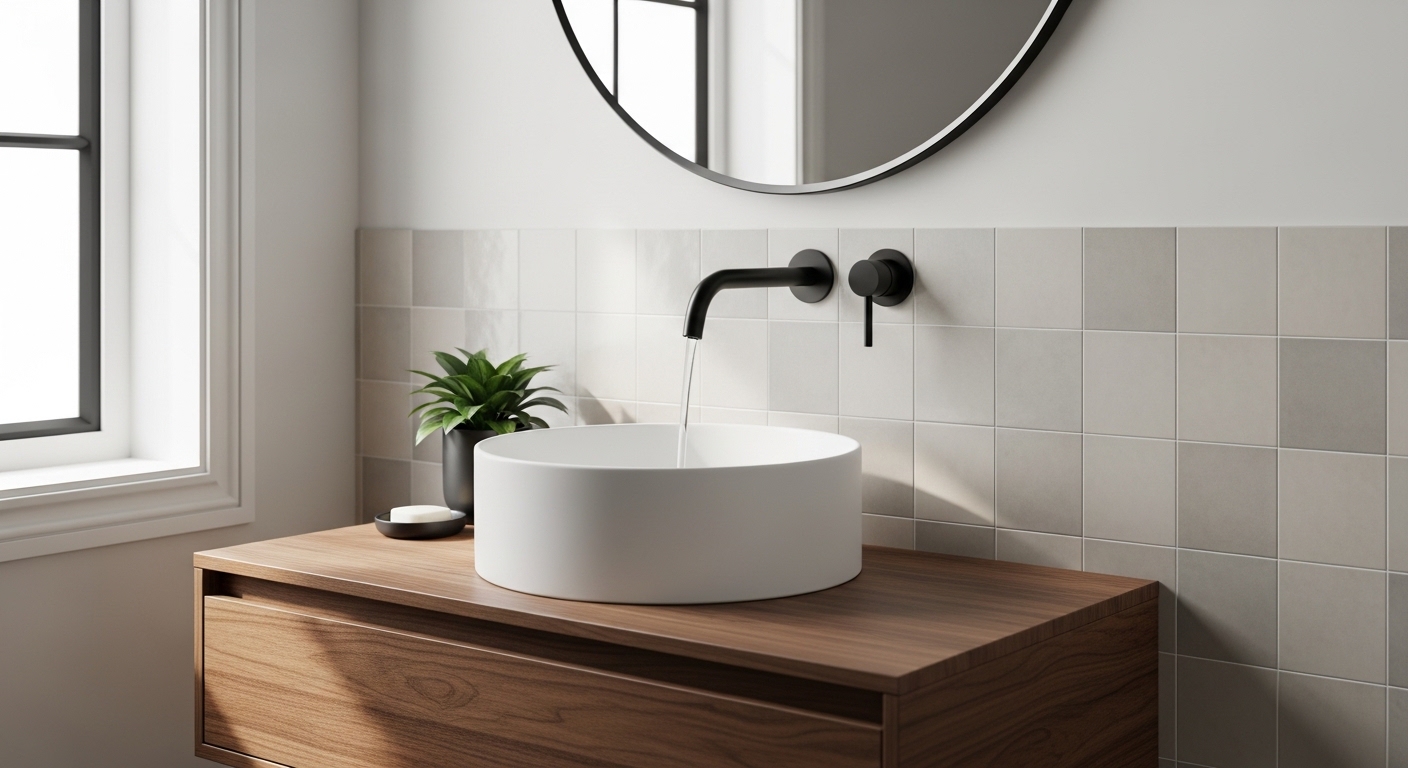
A wall mount faucet for a vessel sink is a faucet whose body and handles are installed in the wall rather than on the countertop or basin, with a spout that extends out far enough to pour into a bowl that sits on top of the counter. The key difference from a standard faucet is where the plumbing lives: the valve, mixing cartridge, and supply connections are all hidden inside the wall cavity, so nothing penetrates your counter or your beautiful stone vessel.
That changes three practical things. First, the counter stays completely clear and easy to wipe — no faucet base collecting grime, no caulk line to scrub. Second, because the spout sits higher and farther forward, it’s designed to clear the tall rim of a vessel bowl, which a short deck faucet often can’t. Third, installation moves into the wall, which means you need to plan the plumbing rough-in before the wall is closed up, not after.
- Wall mount: Plumbing in the wall, spout projects outward, counter stays bare, looks floating and modern.
- Deck mount (single-hole vessel faucet): Tall faucet body screws into the counter behind the bowl; easier to install, easier to swap later.
- Vessel-mounted: Faucet attaches to the bowl’s own pre-drilled hole (less common, limits bowl choices).
How do I know if a wall mount faucet will actually fit my vessel sink?
You need three measurements before you buy anything: the height of your vessel bowl, the spout reach (how far it projects horizontally), and the rough-in height of the faucet outlet in the wall. The golden rule is that the spout outlet should sit roughly 3 to 6 inches above the rim of the bowl and project so the water lands in the center of the basin — ideally over the drain, not the wall side of the bowl.
Here’s the math people get wrong. Vessel bowls commonly stand 4 to 6 inches tall and sit on a counter that’s around 32 to 36 inches off the floor. So the rim of your bowl ends up around 36 to 42 inches high. Add 3–6 inches of clearance, and your faucet spout should exit the wall somewhere around 39 to 48 inches off the floor — but the exact number depends entirely on your specific bowl and counter. Measure your real installation; never assume.
| Measurement | Typical range | Why it matters |
|---|---|---|
| Vessel bowl height | 4″–6″ | Taller bowls need higher spouts and longer reach |
| Spout clearance above rim | 3″–6″ | Too low = splash on rim; too high = splash out of bowl |
| Spout reach (projection) | 5″–9″ | Must reach over the rim to pour near the drain |
| Faucet rough-in height | ~39″–48″ from floor | Set in the wall before tiling — hard to change later |
A quick field trick: before the plumber sets the valve, place your actual bowl on the counter, hold the spout where you think it should go, and run an imaginary line straight down. If that line lands in the middle third of the bowl, you’re good. If it lands on the front rim or the back wall of the bowl, adjust the reach or height.
Is a wall mount faucet better than a deck-mounted vessel faucet?
For looks and cleanability, a wall mount faucet usually wins; for ease and flexibility, a deck-mounted vessel faucet wins. There’s no universally “better” — it depends on whether you’re building/renovating with the wall open, or just upgrading an existing setup.
Choose wall mount if you’re already opening the wall (new build, full remodel, or moving the vanity), you want a high-end floating aesthetic, and you have a tall vessel bowl that a deck faucet struggles to clear. Choose a deck-mounted vessel faucet if your plumbing already comes up through the floor or counter, you want a weekend DIY job, or you think you might change the bowl or faucet again in a few years.
| Factor | Wall mount faucet | Deck-mounted vessel faucet |
|---|---|---|
| Counter space | Completely clear | Faucet base sits on counter |
| Cleaning | Easiest — wipe straight across | Grime around base & caulk line |
| Install difficulty | Higher — in-wall rough-in needed | Lower — fits a single counter hole |
| Future swaps | Harder (valve in wall) | Easy — unscrew and replace |
| Best for tall bowls | Excellent | Depends on faucet height |
| Typical look | Modern, minimalist, floating | Classic to contemporary |
If you’re weighing finishes alongside the format, it’s worth checking whether your chosen color is still on-trend before you commit something permanent into the wall. Our breakdowns on whether matte black is out of style in 2026 and whether brushed gold is out of style in 2026 are useful gut-checks, since a wall mount faucet is much harder to change than a deck one.
How much does a wall mount faucet vessel sink setup cost in 2026?
Expect roughly $120 to $600 for the faucet itself, plus $150 to $450 in labor if you hire a plumber, with the total install landing around $300 to $900 for most bathrooms — more if the wall has to be opened and re-tiled. The biggest cost driver isn’t the faucet; it’s whether the wall is already open.
- Faucet (entry/mid-range): $120–$300 for a solid brass single-handle or widespread wall mount unit with a ceramic cartridge.
- Faucet (premium): $300–$600+ for designer finishes, two-handle widespread sets, or heavier solid-brass bodies.
- Rough-in valve & supply work: $100–$300 if accessible; significantly more if a wall must be opened.
- Labor: $150–$450 depending on region and whether tile/drywall repair is involved.
- The vessel bowl itself: $80–$400 for ceramic, glass, stone, or concrete bowls (separate from the faucet).
One money-saving note: the cheapest time to do this is during a remodel when the wall is already open. Retrofitting a wall mount faucet into a finished, tiled wall is where budgets balloon, because you’re paying to demo and rebuild the wall around the valve. If your wall is closed and you’re not remodeling, a deck-mounted vessel faucet is the far cheaper path.
What’s the best finish and material for a wall mount vessel faucet?
For durability, choose a solid-brass faucet body with a ceramic disc cartridge in a finish that resists water spotting — brushed nickel, brushed gold, and matte black all hide water marks better than polished chrome. The material under the finish matters more than the color: solid brass resists corrosion far better than the zinc-alloy bodies common in budget faucets.
Finish is partly aesthetic and partly maintenance. Polished finishes show every droplet and fingerprint; brushed and matte finishes are far more forgiving in a real, daily-use bathroom. If you go gold, knowing how to keep gold finish faucets looking new will save you frustration. And because a vessel bowl puts the faucet front and center, corrosion resistance is not optional — read why bathroom faucets corrode and how to prevent it before you choose a budget unit, since a corroded wall mount valve is a wall-opening repair.
Also confirm the faucet is certified lead-free for drinking water safety. Faucets sold for U.S. residential use should meet the federal lead-free standard and ideally carry NSF/ANSI 61 and 372 certification. If you’re not sure how to read the markings, our guide on how to identify lead-free bathroom faucets explains exactly what to look for.
How do you install a wall mount faucet over a vessel sink?
The core sequence is: rough-in the valve in the wall at the correct height, pressure-test the connections, close and finish the wall, then mount the spout and handles and connect the drain. The single most important step is setting the valve at the right height and depth before the wall is finished — that’s the decision you can’t easily undo.
- Plan the layout. Place your actual bowl, mark the spout exit point 3–6″ above the rim with the reach landing over the drain.
- Set the rough-in valve. Mount the valve body in the wall cavity at the marked height; mind the finished-wall depth so the trim sits flush.
- Connect supply lines. Hot and cold to the valve, secured and supported inside the wall.
- Pressure-test. Turn the water on and check every joint for leaks before closing the wall. This step prevents the worst-case scenario.
- Finish the wall. Drywall and tile, leaving clean openings for the spout and handles.
- Install trim, spout & handles. Attach the visible parts and the included escutcheons.
- Set the vessel & drain. Install the bowl and a vessel-specific drain (often a grid or pop-up without overflow, since most vessel bowls have no overflow).
One vessel-specific detail people miss: most vessel bowls have no overflow hole, so you need a drain assembly designed for no-overflow basins. Using a standard overflow drain on a no-overflow bowl can cause slow draining or leaks. If you’re tackling related deck-mounted plumbing or backsplash work elsewhere in the bathroom, our guide on how to mount a faucet to a backsplash covers similar wall-pluming principles.
Will a wall mount faucet splash too much in a vessel sink?
It can, and the cause is almost always wrong spout height or a shallow bowl — not the faucet itself. Water falling from too high into a shallow, flat-bottomed vessel will splash; water entering a deeper bowl near the drain at a moderate height won’t. Control splashing by keeping the spout 3–6 inches above the rim, choosing a bowl with some depth (4″+), and picking a faucet with an aerator that softens the stream.
A good aerator does a lot of quiet work here — it mixes air into the water to create a softer, non-splashing stream while also cutting flow. If your faucet ever starts spitting or spraying sideways, it’s usually mineral buildup in the aerator, which is simple to fix. Hard-water households should expect to clean it periodically, and our walkthrough on cleaning a clogged faucet aerator applies directly.
Who should NOT choose a wall mount vessel faucet?
Skip it if your wall is already finished and you’re not remodeling, if you rent, or if you like swapping fixtures frequently. The in-wall valve makes a wall mount faucet a commitment — it’s the opposite of a quick upgrade. In those cases, a tall deck-mounted vessel faucet gives you 90% of the look with a fraction of the hassle.
You should also reconsider if your vessel bowl is unusually wide or oddly shaped, because some artisan stone and irregular bowls make it nearly impossible to land the stream over the drain from a fixed wall spout. And if your water pressure is very low, the higher spout and longer reach can make an already weak stream feel weaker. If your faucet feels stiff or weak in general, that’s a separate issue — see why your faucet is hard to turn.
The bottom line
A wall mount faucet vessel sink combination delivers a clean, high-end, easy-to-wipe bathroom — but only when you nail the three numbers: bowl height, spout reach, and rough-in height. Plan it while the wall is open, buy a solid-brass, lead-free, ceramic-cartridge faucet in a forgiving finish, and use a no-overflow drain. Do that, and you get the floating, magazine-worthy look that holds up to daily use for years.
Author note: This guide was written by the Aleasha Faucet product content team, drawing on hands-on testing of wall mount and vessel faucet pairings across a range of bowl heights and counter setups. About Aleasha Faucet: Aleasha Faucet designs and sells bathroom and kitchen fixtures built around solid-brass bodies and ceramic disc cartridges, and we evaluate fit, flow, and finish durability against recognized U.S. standards. Look for NSF/ANSI 61/372 lead-free certification and a manufacturer warranty (many quality faucets carry a limited lifetime warranty on the finish and cartridge) before you buy.
FAQ
What height should a wall mount faucet be for a vessel sink?
The spout should exit the wall so it sits about 3 to 6 inches above the rim of your vessel bowl, which usually lands the rough-in around 39 to 48 inches off the floor depending on your counter and bowl height. Always measure your actual bowl and counter rather than relying on a generic number, because vessel bowls vary from about 4 to 6 inches tall.
How far should the spout reach over a vessel sink?
Far enough that the water stream lands in the center third of the bowl, ideally right over the drain — typically a 5″ to 9″ spout reach for common bowl sizes. Hold the spout in place over your real bowl and drop an imaginary vertical line; if it hits the front rim or the back of the bowl, adjust the reach or height before finalizing the rough-in.
Can you install a wall mount faucet without opening the wall?
Usually no — the valve, mixing cartridge, and supply lines have to live inside the wall cavity, so the wall needs to be open during rough-in. The exception is during new construction or a remodel when the wall is already open. If your wall is finished and you don’t want demolition, a tall deck-mounted vessel faucet is the practical alternative.
Do vessel sinks need a special drain with a wall mount faucet?
Yes. Most vessel bowls have no overflow hole, so you need a drain assembly made for no-overflow basins (often a grid drain or a pop-up without an overflow channel). Using a standard overflow-style drain on a no-overflow bowl can cause slow draining or leaks, regardless of whether the faucet is wall- or deck-mounted.
Why does my wall mount faucet splash in the vessel sink?
Splashing is almost always caused by the spout being mounted too high above a shallow bowl, or by a hard, un-aerated stream. Fix it by keeping the spout 3 to 6 inches above the rim, choosing a bowl at least 4 inches deep, and using a faucet with a quality aerator. If it suddenly starts spraying sideways, clean the aerator — mineral buildup is the usual culprit.
What’s the most durable material for a wall mount vessel faucet?
A solid-brass body with a ceramic disc cartridge is the most durable and corrosion-resistant combination, and it’s worth paying for since a wall-mounted valve is hard to replace. Avoid budget zinc-alloy bodies, confirm the faucet is certified lead-free (NSF/ANSI 61 and 372), and choose a brushed or matte finish to hide water spots and fingerprints.