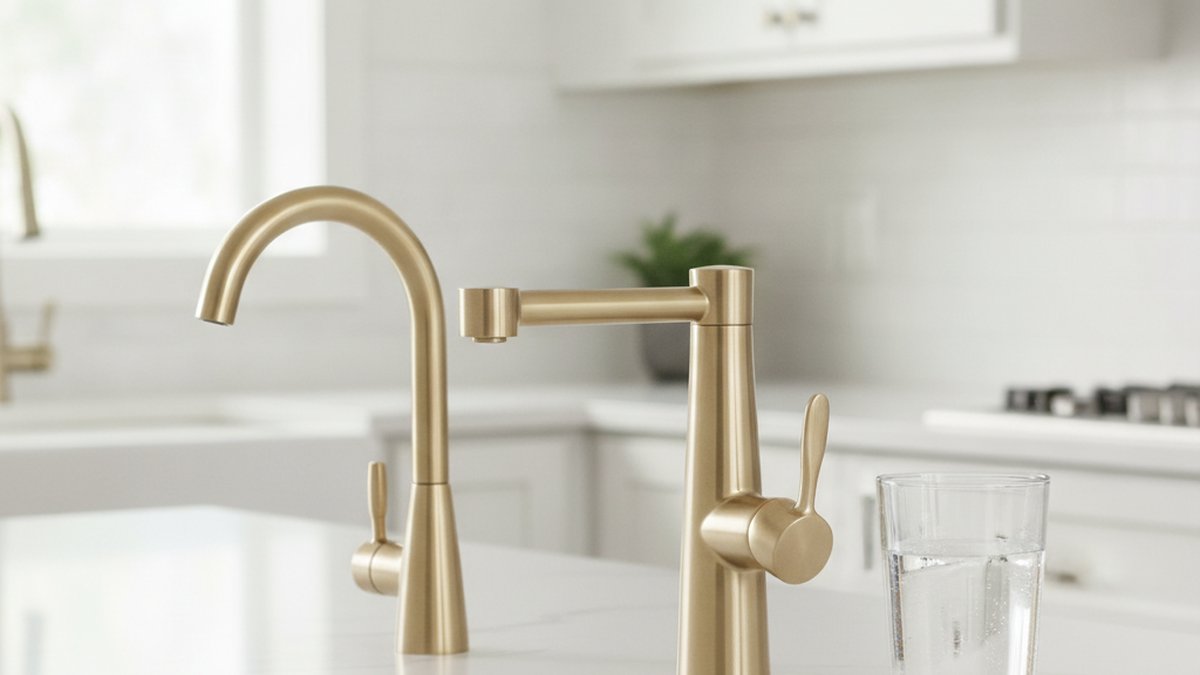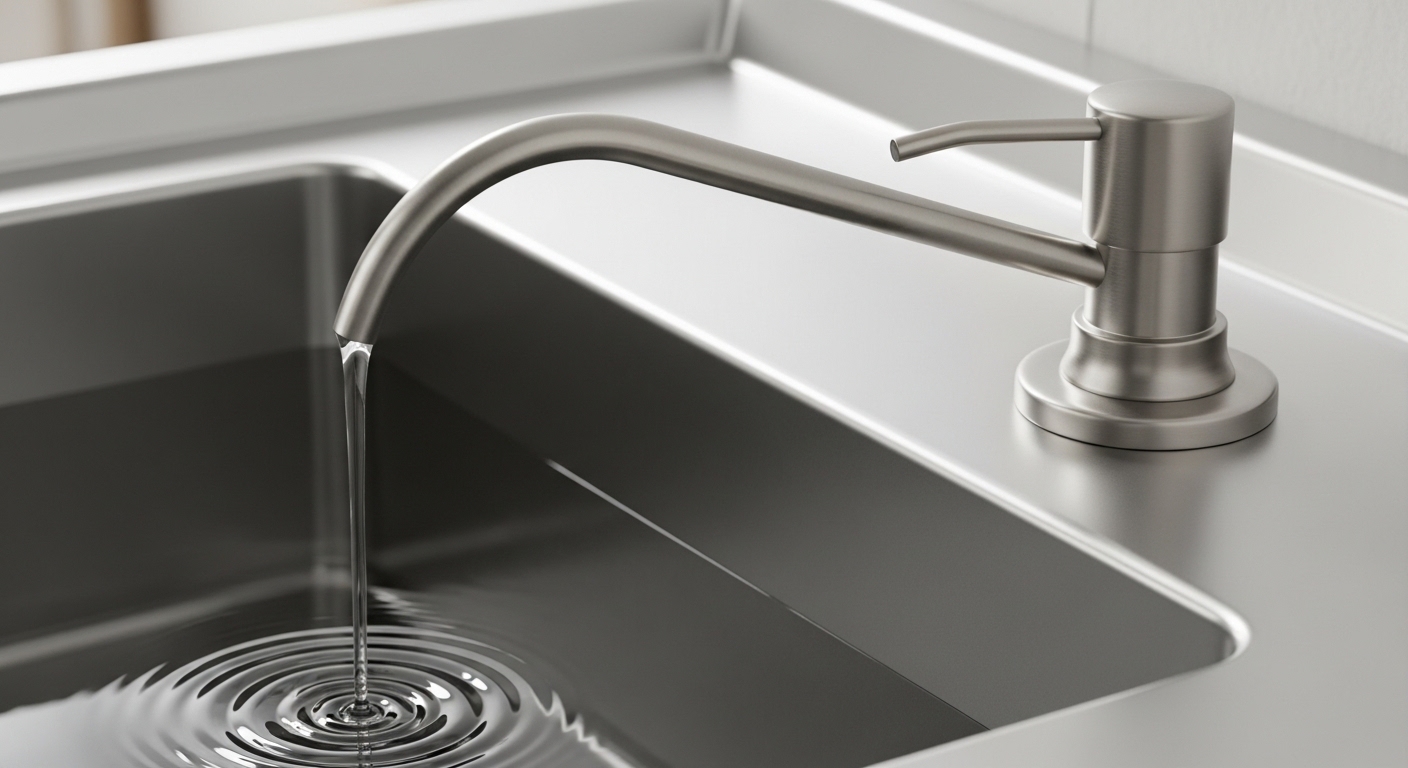
If you’ve ever crouched sideways to squirt soap into a 10-inch stainless prep basin, you already understand the problem. A soap dispenser long spout exists specifically to solve that geometry — extending the nozzle far enough past the deck-mount escutcheon that gravity (and your soap) lands where you actually want it: inside the bowl, on your hands, or directly on the pan you’re scrubbing. For restaurants, bars, salons, dental offices, breweries, and any home kitchen with an apron-front or workstation sink, that extra reach isn’t a luxury — it’s the difference between a clean countertop and a sticky one by the end of the shift.
Below is the full, working-pro breakdown: what “long spout” really means in measurable inches, when the upgrade pays off, the trade-offs nobody mentions in product copy, how to spec one correctly for commercial installations, and how to keep the pump alive for the long haul.
What Counts as a “Long Spout” Soap Dispenser — and Why Does It Matter?
A long spout soap dispenser is any deck-mounted (or wall-mounted) pump-style dispenser with a nozzle extension of 4.5 inches or more, measured from the top of the deck collar to the tip of the dispensing nozzle. Standard residential dispensers come in around 2.75″–4″. Anything beyond 4.5″ is sold as “long,” “extended reach,” or “commercial” spout, and they typically max out around 6.5″–7″.
Why does that one dimension matter so much? Because soap dispensers are pure geometry. The pump pushes liquid out, and gravity drops it straight down. If the nozzle doesn’t physically extend past the inside lip of your sink basin — usually about 1.5″–2.5″ inboard from the deck edge — the soap lands on the rim, runs onto the counter, and you spend the rest of the day wiping it up. In a commercial environment that turns into a slip hazard, a sanitation violation, and a real labor cost.
Long spout models also clear taller bottles, fillable pitchers, and stockpots that wouldn’t fit under a short pump. For a busy line cook filling a sanitizer bucket, or a hairstylist rinsing a color bowl, the extra inch of head clearance is the entire point.
When Should You Choose a Long Spout Over a Standard Soap Dispenser?
Choose a long spout whenever the sink is deep (9″ or more), the deck is thick, the workflow involves large vessels, or multiple people share the station. For shallow vanity sinks or small bar prep sinks under 7″ deep, a standard spout is genuinely fine — paying for the longer reach buys you nothing.
Here are the concrete scenarios where the upgrade is almost always worth it:
- Workstation kitchen sinks (10″+ deep): The popular single-bowl 30″–36″ stainless workstations have steep walls and an integrated ledge. A short spout deposits soap on the ledge, not the bowl.
- Apron-front (farmhouse) sinks: The forward overhang of the apron typically pushes the dispenser further back; you need spout reach to get over that lip.
- Three-compartment commercial sinks: Health code expects soap delivery directly into the wash compartment for hand-wash adjacent areas. Long spouts also clear the divider walls.
- Hand-wash stations in food service: NSF/ANSI 2 environments require the dispenser to be reachable without leaning over food contact surfaces.
- Salon shampoo bowls and dental scrub sinks: The user is usually standing further from the basin; the spout has to project to meet them.
- Granite, quartz, or thick butcher block counters (≥1.5″): Thick decks eat up to an inch of spout length before it even crosses the sink edge.
If two or more of those apply to your install, a soap dispenser long spout is the right call — not the standard one.
How Long Should the Spout Actually Be? (Quick Sizing Math)
For a precise spec, take three measurements and add them. The nozzle tip should land at least 1″ inside the inner sink wall, with at least 4″ of vertical clearance underneath for hands or a 32 oz bottle.
Use this formula: required spout length = deck thickness + inboard distance from mounting hole to inner sink wall + 1″ safety margin. For a typical 1.5″ quartz slab with the soap hole drilled 3″ back from the sink edge, you need a spout of at least 5.5″ — which puts you firmly in long-spout territory.
| Sink / Counter Scenario | Sink Depth | Recommended Spout Length | Mount Type |
|---|---|---|---|
| Standard residential double-bowl, laminate counter | 7″–8″ | 3.5″–4″ | Deck (1.25″ hole) |
| Workstation single-bowl, quartz counter | 10″ | 5″–6″ | Deck (1.25″ hole) |
| Farmhouse apron-front, thick butcher block | 9″–10″ | 5.5″–6.5″ | Deck, set back 4″+ |
| Commercial 3-compartment, stainless deck | 12″–14″ | 6″–7″ | Deck or wall |
| Bar prep / vanity sink | 5″–6″ | 3″ | Deck |
| Salon shampoo bowl | 8″ | 5″ | Deck, set back from user |
What Finish Holds Up Best for a Commercial Long-Spout Dispenser?
For commercial duty, solid brass with PVD brushed nickel or matte black is the gold standard — it resists soap residue, citric cleaners, and the bleach-water wipe-downs typical at closing time. Cheap zinc-alloy dispensers with electroplated finishes start blistering within months in food-service environments.
Finish failure on dispensers happens faster than on faucets because dispensers get drenched in soap, sanitizer, and sometimes degreaser daily. The pump body sits in a damp deck cutout. If you’ve already noticed corrosion creeping around your faucet bases, this guide on why bathroom faucets corrode and how to prevent it applies one-to-one to dispenser bodies — same metallurgy, same failure modes.
Here’s how the common finish options stack up under real commercial use:
| Finish | Durability (Commercial) | Soap/Cleaner Resistance | Looks After 2 Years |
|---|---|---|---|
| PVD Brushed Nickel (on brass) | Excellent | Excellent | Essentially unchanged |
| PVD Matte Black | Excellent | Excellent — hides water spots | Very good; minor sheen change |
| Polished Chrome (plated brass) | Very good | Good | Light scratching; pitting near pump |
| PVD Brushed Gold | Excellent | Excellent | Color stable; needs gentle wipe-down |
| Electroplated Zinc Alloy | Poor | Poor | Bubbling, peeling, green tarnish |
| Stainless Steel (304) | Very good | Excellent | Minor brushing wear |
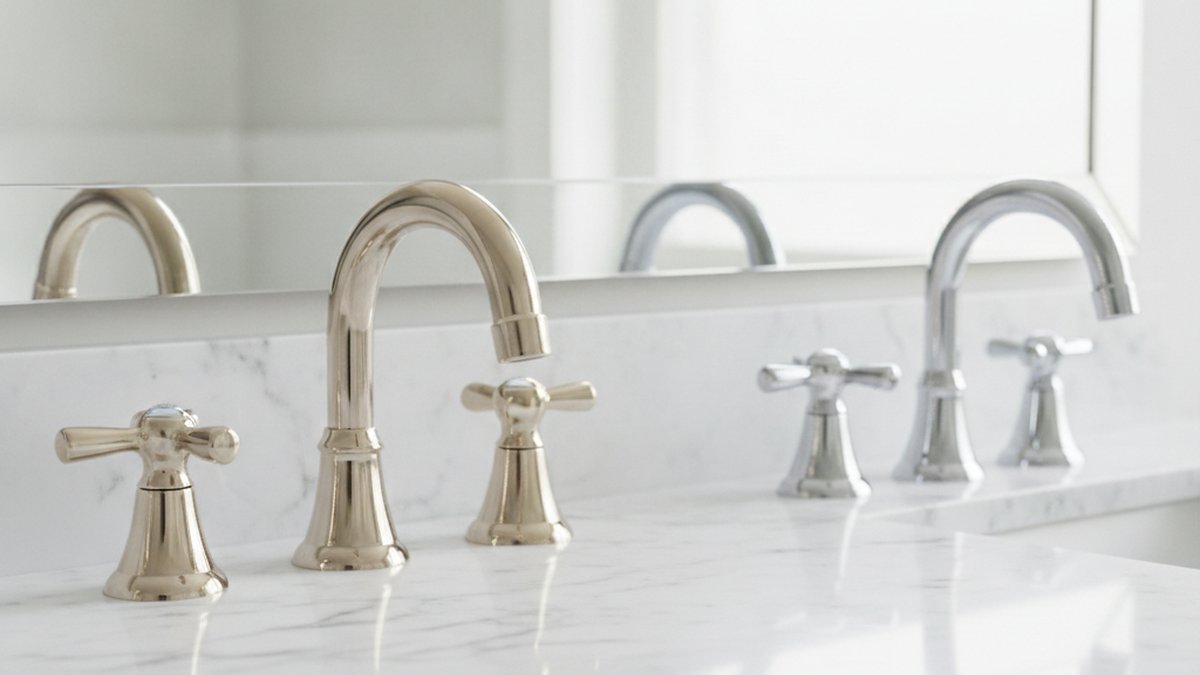
If you’ve committed to a black or gold faucet at the install, the dispenser finish has to match the faucet’s PVD tone, not just the color name. Our long-form notes on keeping gold finish faucets looking new walk through the cleaner chemistries that protect PVD on both fixtures.
Deck-Mount or Wall-Mount: Which Is Better for High-Volume Use?
Deck-mount long-spout dispensers are the right pick for 90% of residential and light-commercial installs. Wall-mount makes more sense for true high-volume hand-wash stations — restrooms, hospitals, food prep lines — where bulk soap is fed from a reservoir below the counter or behind the wall.
The reason is refill access. Deck-mount dispensers refill from above through a 1.25″ hole — fast, no tools, easy at a busy moment. Wall-mount commercial units typically use a 1L+ refillable reservoir or a sealed cartridge, which is cheaper per ounce but requires opening a service panel.
Mounting through a thick or hard counter material adds an installation step most DIYers underestimate. The technique is the same as setting any deck fixture into a stone counter — our walkthrough on how to mount a faucet to a backsplash covers the silicone bedding, gasket compression, and torque sequence that prevent leaks at the deck collar. The exact same approach applies to a soap dispenser collar — and if you skip it, soap will wick down into the cabinet within weeks.
How Do You Refill, Maintain, and Unclog a Long Spout Soap Dispenser?
For deck-mount models, lift the spout-and-pump assembly straight up out of the collar, pour soap directly into the bottle, drop the pump back in. For top-fill versions (more common on modern units), tilt the spout back and pour through the funnel opening — no removing parts. Both designs should be refilled with thinned, non-abrasive liquid soap, never undiluted concentrated dish soap or hand sanitizer.
The single biggest reason long-spout dispensers fail is dried soap inside the spout channel. Here’s the maintenance routine that actually keeps them working:
- Use the right soap viscosity. If your soap is thicker than honey, cut it 1:1 with warm water. Thick soap clogs the pump piston seat first, then the spout.
- Flush monthly. Empty the bottle, fill with hot water, and pump 15–20 times to clear the spout channel. Same idea as our guide to flushing bathroom faucets — built-up residue causes intermittent flow long before it causes a full block.
- Soak clogs in warm white vinegar. If the nozzle goes weak or hissy, unscrew the pump head and submerge the spout assembly in 50/50 hot water and white vinegar for 20 minutes. Pump it under running water to clear.
- Inspect the check valve annually. A failed one-way ball valve causes soap to retreat down the suction tube, producing the classic “first three pumps are air” symptom.
- Re-grease the piston shaft. A drop of food-safe silicone grease on the pump shaft once a year stops the stiff, sticky pump that drives people crazy.
A well-built brass long-spout pump should last 8–10 years in residential use and 3–5 years in heavy commercial duty before the piston seal needs replacement. Plastic-pump units sold cheaply online often fail inside 12 months — they’re not engineered for the cycle count.
How Do You Spec a Long Spout Dispenser for Commercial Compliance?
For commercial buyers, the dispenser must meet three overlapping standards: NSF/ANSI 372 for lead content (≤0.25% weighted average across wetted surfaces), local plumbing code for the deck penetration, and — for food service — health department rules for hand-wash station placement and reach. A soap dispenser long spout makes that last requirement much easier to satisfy, because the nozzle reaches over the basin without the user contaminating the deck.
Lead-free is non-negotiable in any plumbing-adjacent fixture sold in the US. Even though most jurisdictions enforce this only for drinking-water fixtures, the same brass alloy choice that gets a faucet certified — typically C46500 or C87850 — is what you want in a dispenser body. Our walkthrough on identifying lead-free bathroom faucets covers exactly how to read the certification marks. Ask the supplier for the same documentation on the dispenser.
For procurement specs, look for and require:
- NSF/ANSI 372 lead-content certification on all wetted parts
- NSF/ANSI 61 if the dispenser ever shares plumbing with the potable supply (rare but worth verifying)
- 304 stainless or solid brass body — not zinc alloy
- PVD finish, not electroplated, for any environment with daily sanitizer wipe-downs
- Top-fill design if your staff turnover is high (saves training time)
- Minimum 4.5″ effective spout reach measured from collar to nozzle tip
- Manufacturer warranty of at least 5 years on the pump mechanism
What Does a Quality Long Spout Dispenser Actually Cost?
Expect $35–$80 for a residential-grade brass long-spout dispenser with a PVD finish, $80–$160 for a commercial unit with a bulk-refill reservoir, and $15–$30 for the cheap zinc-alloy units that will fail within a year. The cost difference is almost entirely body metallurgy, pump-mechanism cycle life, and finish process — not aesthetics.
If you’re buying for a commercial environment, do the math on labor. A dispenser that fails twice a year and triggers two service calls easily costs more in technician time than a unit twice the unit price that lasts five years. For high-cycle stations (think a busy lunch counter), this is one of the cleanest ROI upgrades you can make in the back-of-house.
Why Aleasha Faucet Builds Long Spout Dispensers This Way
At Aleasha Faucet, we engineer our long-spout soap dispensers from solid lead-free brass (C46500 / C87850), apply a PVD-deposited finish across all visible surfaces, and bench-test every pump mechanism to a minimum of 200,000 cycles before it ships — roughly 10 years of typical residential use, or 3 years on a busy commercial hand-wash station. Spout reach options run from 4.5″ to 6.5″, with both standard and top-fill bottle configurations.
Every dispenser ships with a 5-year limited warranty on the pump mechanism and a lifetime warranty on the finish, backed by our in-house QC team. We don’t sub-source pump internals to the lowest bidder, which is the single most common failure point in budget dispensers — and the reason most “cheap” dispensers cost more over five years than ours do.
FAQ
How long is a “long spout” soap dispenser, exactly?
4.5 inches or more from the top of the deck collar to the tip of the nozzle. Standard residential dispensers fall in the 2.75″–4″ range. True commercial extended-reach units go to 6.5″–7″.
Can I retrofit a long spout into the same hole as my current soap dispenser?
In almost every case, yes. Standard deck-mount dispensers use a 1.25″ (32 mm) hole. As long as your current dispenser uses the same mounting hole and your counter is thick enough to seat the new collar, the swap takes about 15 minutes and only needs an adjustable wrench from below.
Why does my new long spout dispenser pump only air?
Almost always one of three things: the soap is too thick to climb the suction tube (cut 1:1 with warm water), the suction tube isn’t fully seated against the pump head, or the soap level is below the bottom of the tube. Trim 1/4″ off the suction tube if it’s bottoming out at an angle in the bottle.
Is a long spout dispenser worth it for a regular home kitchen?
Only if your sink is at least 9″ deep, your counter is at least 1.25″ thick, or your dispenser hole is more than 2.5″ inboard from the sink edge. If you have a shallow drop-in sink and a thin laminate counter, a standard 3.5″ spout is fine and cheaper.
How often should a commercial long spout soap dispenser be refilled?
In a busy food-service hand-wash station, expect to refill a 12 oz bottle every 1–3 days. That’s why most commercial buyers go with under-counter reservoir systems holding 32 oz to 1 L — refills drop to weekly or biweekly. For salons and dental offices, weekly refills on a standard top-fill bottle are typical.
Will hard water damage the long spout pump?
Hard water alone won’t damage the pump, but the scale it deposits inside the spout channel will eventually slow flow and gum up the check valve. A monthly hot-water flush, or a 20-minute soak in 50/50 white vinegar, dissolves the buildup. If your home has aggressive hard water, the same routine that keeps your aerator clean — covered in our guide on cleaning a clogged rectangular faucet aerator — applies directly to dispenser nozzles.
Can I use hand sanitizer or foaming soap in a standard long spout dispenser?
Sanitizer (alcohol-based) is usually fine but evaporates inside the spout and crystallizes faster than soap — flush weekly. Foaming soap requires a dedicated foaming pump with an air-injection chamber; using foaming soap concentrate in a non-foaming pump just clogs it. Always match the pump type to the soap chemistry.
What’s the difference between gooseneck and straight long spouts?
A gooseneck (curved) spout puts the nozzle further inboard for the same overall length, giving better coverage into a deep basin. A straight spout has a cleaner industrial look and is easier to wipe clean. Functionally, gooseneck wins for deep workstations; straight wins for minimalist designs and easier cleaning.
Author note: This guide was written by the Aleasha Faucet product engineering and editorial team, drawing on more than a decade of designing, testing, and shipping deck-mount and wall-mount kitchen and bath fixtures to residential and commercial customers across North America. Pump cycle figures are based on internal QC bench testing; finish durability ratings are based on accelerated salt-spray and chemical-resistance testing aligned with ASTM B117 protocols. Long-spout soap dispensers ship with a 5-year mechanism warranty and a lifetime finish warranty.