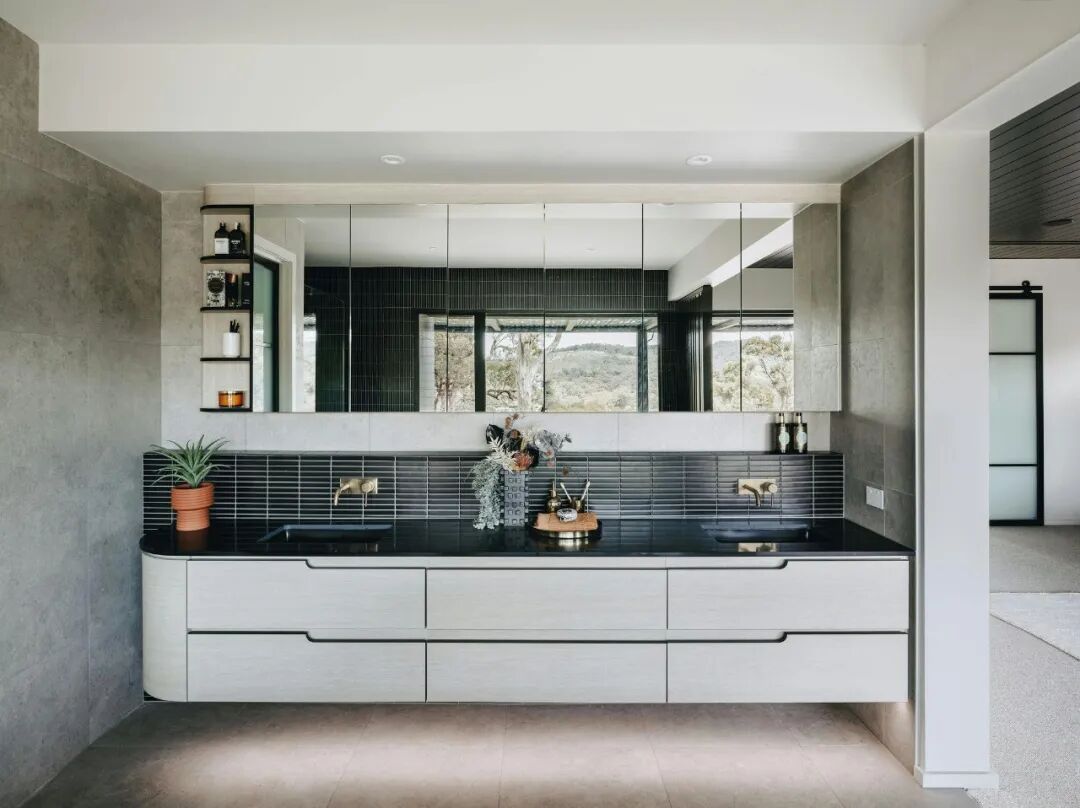
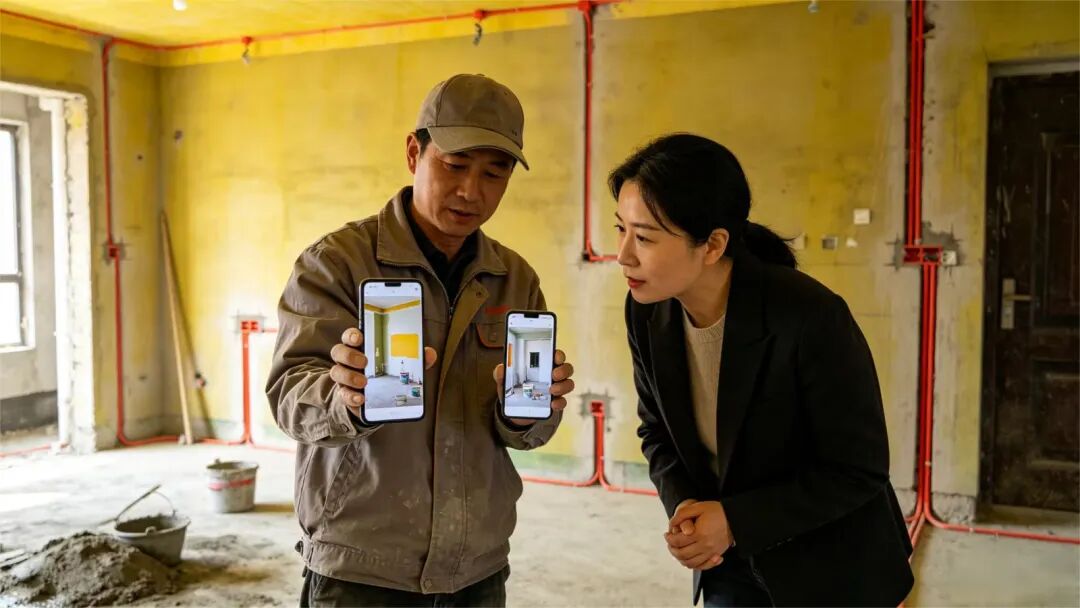
Many people find when purchasing bathroom products that what really gives them a headache is not choosing the products, but rather the various details of bathroom construction.
As a space used extremely frequently in daily life, the bathroom serves the two core needs of washing and toileting. Its construction involves multiple aspects including water supply, drainage, waterproofing, and electrical circuits. It is both the focal point of renovation and the area most prone to problems.
Today, we will use the construction sequence as the core to break down the construction key points of the three major bathroom zones (vanity area, toilet area, shower area), helping everyone avoid detours and prevent rework.
First, we must emphasize that the plumbing and electrical disclosure meeting before construction is of paramount importance—doing this step well can prevent 90% of subsequent problems. Most bathroom failures are not due to inadequate craftsmanship, but rather oversights in the coordination between construction and product installation. Conducting the disclosure meeting in advance can effectively avoid this.
I. Vanity Area: How to Choose Between Ready-Made and Custom? Don’t Miss the Details
When purchasing a vanity, ready-made models are the top recommendation, offering better value for money at typically less than half the price of custom models. However, if the bathroom space in this area is small or irregularly shaped, custom models can be chosen to maximize space utilization. Additionally, if the washing machine is planned to be placed in the bathroom, it is recommended to custom-make the vanity simultaneously for overall aesthetics and practicality—the panel can cover the washing machine, and the countertop can be used for storage.
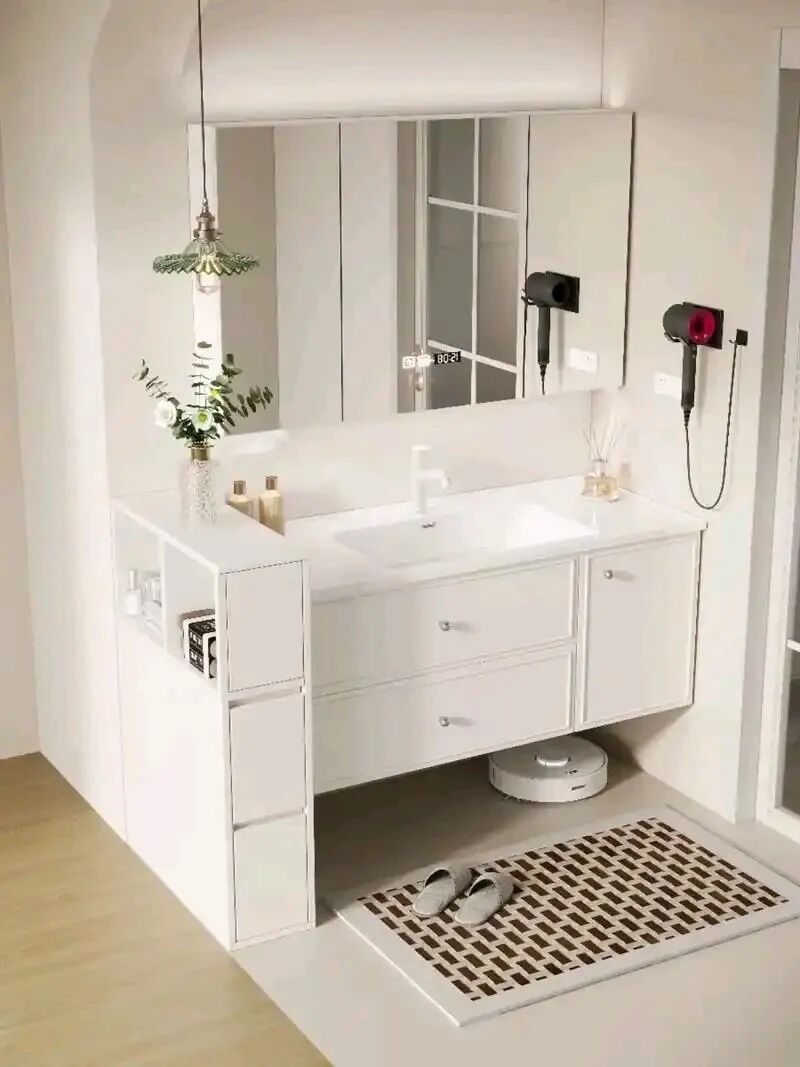
Additionally, many young people nowadays consider installing robot vacuums with water supply and drainage functions during renovation. Whether choosing a ready-made or custom vanity, the model of the robot vacuum must be determined in advance—for base stations with water tanks, attention should be paid to reserved height; for versions without water tanks, attention should be paid to reserved depth. At the same time, plan the water and electricity needs of the robot vacuum and washing machine in advance.
The choice of mirror cabinet can be based on personal needs. If the mirror cabinet has LED strips, electrical outlets need to be reserved in advance; also consider the power needs of small appliances such as hair dryers and electric toothbrushes, and plan socket locations in advance.
Another key detail: whether to choose a wall-mounted or floor-standing vanity. Floor-standing models do not require additional consideration of load-bearing capacity. If choosing a wall-mounted model, the wall’s load-bearing capacity must be confirmed—load-bearing walls are best, red brick walls are second, and lightweight walls and hollow bricks have the weakest load-bearing capacity. The weight of the vanity should also be considered—for example, aluminum alloy vanities are relatively lighter. The specifics can be confirmed on-site by the designer and foreman during the plumbing and electrical disclosure meeting to avoid subsequent returns or safety hazards due to insufficient load-bearing capacity.
II. Toilet Area: Confirm Rough-In Distance + Electrical Outlets in Advance to Avoid Pitfalls
During the plumbing and electrical disclosure stage, it is necessary to clarify whether smart toilets, electric towel racks, electric water heaters, and other equipment will be installed. All of these require electrical outlets to be reserved in advance to avoid damaging walls or circuits by drilling holes later.
The core of toilet purchasing is the rough-in distance. The two mainstream rough-in distances on the market are 305mm and 400mm. The rough-in distance refers to the horizontal distance from the center point of the toilet’s drainage pipe to the rear wall. Among them, 305mm is suitable for over 90% of households. As long as the actual measured rough-in distance is above 290mm, it can be used; 290mm-305mm is the golden rough-in distance, providing the highest degree of fit between the toilet and the wall after installation. If the rough-in distance exceeds 305mm, the larger the rough-in distance, the larger the gap between the toilet and the wall, affecting aesthetics. If the rough-in distance is above 390mm, a toilet with a 400mm rough-in distance can be chosen.
If the designer and construction team are experienced enough to accurately estimate the actual rough-in distance after tiling, the toilet can be purchased in advance. A cost-effective toilet can be bought for just over 1,000 yuan. It should be noted that if the bathroom layout is adjusted and the toilet position needs to be moved, the drainage pipe needs to be laid horizontally. Due to the limited height of the settlement box, the slope of the drainage pipe will be very small, even close to horizontal. The longer the horizontal pipe, the more it will affect the drainage performance of siphon-type toilets, so try to avoid this situation.
In addition, southern households have high humidity year-round, and electric towel racks are practical items that enhance life satisfaction and are recommended for installation. If an electric water heater is placed in the bathroom at home, a socket needs to be reserved in advance. Prioritize models with waterproof covers and independent switches, and the electric water heater needs to use a 16-amp dedicated socket to avoid safety hazards.
III. Shower Area: Showerheads, Bathtubs, Shower Enclosures—Choose According to Needs for Practicality
The core purchasing point of the shower area is the showerhead. By appearance, they can be divided into wall-concealed and standard models. Most households choose standard models, which are not only affordable but also easier to repair and replace in case of subsequent failures. By function, they can be divided into thermostatic showerheads and regular showerheads. In earlier years, thermostatic showerheads were mostly joint-venture brands priced at two to three thousand yuan. Now, domestic brands offer outstanding value for money, equally good to use and several hundred yuan cheaper. High-end models can be purchased for just over a thousand yuan—there’s no need to blindly pursue high prices.
Regarding bathtubs, since new home bathrooms are generally not large nowadays, few households install bathtubs. The decision can be based on bathroom size, location of residence, and usage habits—the northern climate is dry, and if the bathroom is not large, simply hanging a shower curtain can meet the needs; shower enclosures take up more space. The south has higher humidity, and it is recommended to install shower enclosures whenever possible, which can effectively divide wet and dry areas and enhance the user experience.
There are two options for the timing of purchasing a shower enclosure: purchasing before tiling allows for convenient pre-embedding of the stone base, making installation more secure; purchasing after tiling means it can only be glued to the tile surface, with slightly poorer stability. In terms of materials, prioritize double-layer laminated tempered glass, which has better explosion-proof performance. Even if spontaneous explosion occurs, it will not injure people, providing better safety assurance.
Originally published in WeChat by Du Li She Ji Shi Ye Shan on 2026-04-22. Translated and edited for English-language readers.